For the fastest overall tomato growth, a balanced fertilizer with a slight nitrogen lean (something like 10-8-8 or 12-6-6) gives you the strongest vegetative push early on, then you shift to a more balanced or slightly phosphorus-forward formula (like 5-10-10) once flowers start forming. Liquid fertilizers act fastest because nutrients reach roots within days rather than weeks. But here's the honest truth: the fertilizer type is only part of the equation. Without the right soil pH, consistent watering, and enough sun and heat, even the best fertilizer does almost nothing. All of those factors have to work together, and this guide will show you exactly how to line them up.
Which Type of Fertilizer Helps Tomatoes Grow Fastest?

Marcus Holloway
14 May 2026
What 'fastest growth' actually means for tomatoes
Before you chase maximum growth speed, it helps to know what you're actually optimizing for. Early on, you want fast, sturdy vegetative growth: thick stems, deep green leaves, and a root system that can support a heavy crop. That's where nitrogen does its job. But 'fast growth' gets more complicated once the plant matures.
One of the most common mistakes I see is hammering tomatoes with nitrogen all season. The result is a gorgeous, bushy plant with tons of lush foliage that just sits there not fruiting. Research from the University of Maryland Extension specifically flags excess nitrogen as the reason tomato plants go vegetative-crazy while dragging their feet on fruit set. Fertilizer can also help you aim for taller plants by supporting vigorous, healthy growth as long as you don't overdo nitrogen excess nitrogen as the reason tomato plants go vegetative-crazy while dragging their feet on fruit set. So fast vegetative growth and fast fruiting are actually different goals, and the best fertilizer strategy shifts between them.
Temperature also sets a hard ceiling on how fast your plants can grow, regardless of feeding. Tomatoes grow best between 60°F and 90°F. Below 55°F, growth stalls and cold soil at transplant time can stunt a young plant for weeks. Above 90°F, pollination suffers and fruit set drops off. So if you're gardening in a region with late cold snaps or brutal summer heat, no fertilizer is going to override those physical limits. Getting the timing right matters as much as the feeding strategy.
The best fertilizer types for rapid tomato growth
Fertilizers are labeled with three numbers representing nitrogen (N), phosphorus (P), and potassium (K), in that order. Each nutrient plays a distinct role, and the ratio you need changes as the plant moves through its life stages.
Nitrogen, phosphorus, and potassium: what each does
- Nitrogen (N): drives leaf, stem, and canopy growth. The nutrient you want more of during early vegetative stages.
- Phosphorus (P): supports root development, flowering, and fruit set. Critical when you want fast transitions from seedling to flowering plant.
- Potassium (K): regulates water movement in the plant, strengthens cell walls, and improves fruit quality and disease resistance.
Which ratios to use at each growth stage
| Growth Stage | Recommended N-P-K Ratio | Why |
|---|---|---|
| Transplant / early establishment | 5-10-10 or similar (low N, higher P/K) | Encourages root development and reduces transplant shock |
| Vegetative growth (weeks 2–6) | 10-8-8, 12-6-6, or balanced 10-10-10 | Fuels rapid stem and leaf growth without overdoing nitrogen |
| Pre-flower to fruit set | 5-10-10 or 8-32-16 (tomato-specific blends) | Pulls back nitrogen, pushes phosphorus to trigger and support flowering |
| Fruiting and ripening | Low N, higher K (e.g., 4-6-8 or 5-7-10) | Supports fruit fill, flavor, and resistance to blossom end rot |
Tomato-specific fertilizers sold at garden centers are usually already formulated with these stage shifts in mind. Brands that say 'tomato and vegetable' on the label often run around 8-32-16 or similar ratios tuned for fruiting crops. Those are genuinely useful. You can also just read the numbers on any general-purpose bag and apply the same logic.
Granular, liquid, or organic: choosing the right form
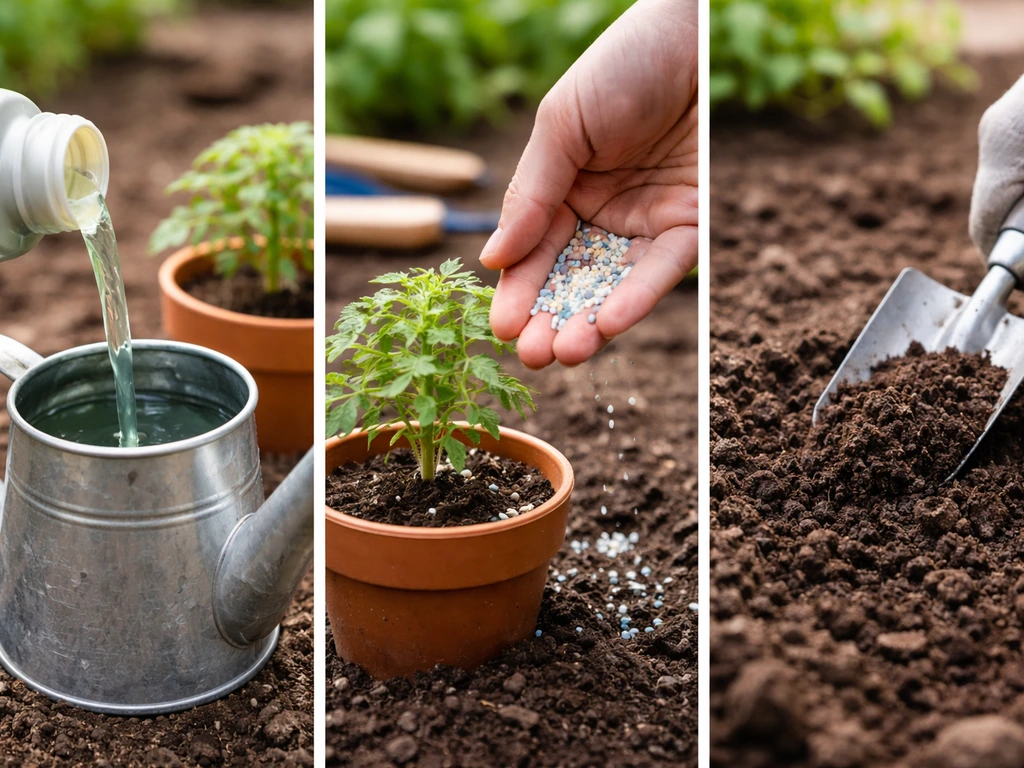
The form your fertilizer comes in affects how fast it works, how easy it is to control, and how forgiving it is if you apply too much. Here's how the main options stack up for speed-focused tomato growing.
| Fertilizer Form | Speed of Uptake | Burn Risk | Best For |
|---|---|---|---|
| Liquid (synthetic) | Days (fastest) | Moderate if overdosed | Quick corrections, weekly feeding during vegetative growth |
| Water-soluble granules (e.g., Miracle-Gro) | Days | Moderate | Consistent weekly or biweekly feeding, easy to dose |
| Slow-release granules (e.g., Osmocote) | Weeks (steady) | Low | Low-maintenance feeding mixed into soil at planting |
| Compost / aged manure | Weeks to months | Very low | Building long-term soil health, pre-planting amendment |
| Fish emulsion / kelp (organic liquid) | Days to a week | Very low | Gentle feeding, seedlings, organic gardens |
If you want the fastest response, diluted liquid fertilizer applied directly to the root zone wins every time. I use a liquid tomato feed every 7 to 10 days during peak vegetative growth and see noticeable growth jumps within a few days of feeding. Slow-release granules are great for low-maintenance gardeners or for use at planting time as a baseline, but they can't be adjusted quickly if the plant shows a deficiency or you realize you need to shift nutrient ratios.
Compost and aged manure are fantastic soil builders but shouldn't be your sole nutrient source if speed is the goal. They release nutrients slowly and unpredictably, and their NPK numbers are typically very low (something like 1-1-1 or 2-2-2 for good compost). Use them to improve soil structure and microbial activity, then layer in a targeted fertilizer on top.
How to apply fertilizer for speed without burning your plants
Fertilizer burn happens when salt concentrations around roots get too high, pulling water out of root cells instead of letting them absorb it. It shows up as brown, crispy leaf margins and wilting even when the soil is moist. The fix is simple: don't overdo it, water thoroughly after applying granules, and always dilute liquids to label recommendations or slightly below.
A practical feeding schedule
- At transplanting: Mix a slow-release granular fertilizer (or compost) into the planting hole. Add a small amount of phosphorus-rich starter fertilizer (like 5-10-10) or use a liquid starter solution at half strength to encourage root establishment.
- Weeks 2–4 (vegetative surge): Switch to a balanced liquid fertilizer at full label dilution, applied every 7–10 days. Aim for formulas in the 10-8-8 to 12-6-6 range.
- When first flowers appear: Reduce or stop high-nitrogen feeding. Switch to a lower-N, higher-P formula and continue every 10–14 days.
- During fruit set and development: Maintain potassium-rich feeding (look for K numbers of 8 or higher) to support cell development and reduce blossom end rot risk.
- Flush the soil every 3–4 weeks: Water deeply without fertilizer to leach excess salt buildup, especially in containers.
On dosing: always start at the lower end of the label's recommended rate, especially with liquid concentrates. Most tomato growers I've talked to use about 75% of the suggested dose at higher frequency rather than full dose less often. It's steadier, lower risk, and keeps the plant in a constant state of available nutrition rather than feast-and-famine cycles.
Keep granular fertilizer off the stem and at least 4 to 6 inches away from the base of the plant. Water it in thoroughly right after application. For liquid feeds, apply to moist soil (never dry), which further reduces the concentration spike at the root zone.
Soil testing and fixing common deficiencies
This is the step most gardeners skip, and it's often the real reason their fertilizer doesn't seem to be working. If your soil pH is off, plants literally cannot absorb many nutrients even when they're present in the soil. Tomatoes prefer a pH between 6.0 and 6.8. Below 6.0, phosphorus and calcium become less available. Above 7.0, iron and manganese lock up. In both cases, you can apply fertilizer all season and see minimal response.
A basic soil test from your county extension office or a home test kit tells you pH, nitrogen, phosphorus, and potassium levels for around $15 to $25. It's the single best investment before you spend money on fertilizer. If you've been fertilizing regularly and still see pale yellow leaves or stunted growth, there's a good chance a pH problem (not a shortage of fertilizer) is the culprit.
Common deficiencies and quick corrections
| Deficiency | Symptom | Quick Fix |
|---|---|---|
| Nitrogen | Pale yellow leaves starting from the bottom up | Liquid nitrogen-rich fertilizer (e.g., fish emulsion or balanced liquid); results in 3–5 days |
| Phosphorus | Purplish tint on leaf undersides, slow growth | Phosphorus fertilizer or superphosphate; also check if pH is too low |
| Calcium | Blossom end rot on fruit | Calcium nitrate spray or amendment; fix watering consistency first |
| Magnesium | Yellow between leaf veins (interveinal chlorosis) | Epsom salt foliar spray: 1 tbsp per gallon of water |
| Iron | Yellow new growth, green veins | Usually a pH problem above 7.0; lower pH with sulfur, then chelated iron if needed |
To raise pH (acidic soil): add garden lime (calcium carbonate) at roughly 5 to 10 pounds per 100 square feet and mix in a few weeks before planting if possible. To lower pH (alkaline soil): incorporate elemental sulfur at around 1 to 2 pounds per 100 square feet. Both adjustments take a few weeks to fully register, so correcting in fall or early spring gives you the best head start.
Watering, light, and heat: the factors that unlock your fertilizer
You can have the perfect fertilizer program, but if your plants are sitting in low light or getting inconsistent water, the nutrients won't get used efficiently. Tomatoes need at least 6 to 8 hours of direct sunlight daily, according to Oregon State University Extension guidance. Less than that and photosynthesis slows, which means the plant has less energy to drive growth regardless of what's in the soil.
Water is how nutrients physically move from soil into roots. Without consistent moisture, nutrient uptake stalls. Tomatoes do best with deep, consistent watering rather than light daily sprinkles: aim for about 1 to 1.5 inches per week, adjusted for heat and container size. Drip irrigation or soaker hoses keep moisture steady and reduce the fungal disease risk that comes with wet foliage. Inconsistent watering is also the number one cause of calcium deficiency and blossom end rot, which no amount of calcium fertilizer will fix if the water supply is erratic.
Soil temperature matters a lot at transplant time. Cold soil (below 60°F) slows root metabolism, which means even well-nourished soil won't deliver nutrients efficiently. Cornell's garden-based learning resources specifically flag cool transplant conditions as a stunting risk. Warming the soil with black plastic mulch or row covers for a week before transplanting can meaningfully speed up early establishment. Combined with a phosphorus starter fertilizer, this is one of the most effective early-season tactics I've used.
Fast-growth myths vs. what science actually shows
The internet is full of tomato growing 'hacks': bury a banana peel under your transplant, add Epsom salt every week, pour leftover coffee on your plants, water with diluted hydrogen peroxide. Some of these have a grain of truth to them (Epsom salt genuinely helps if you have a confirmed magnesium deficiency), but most of them are classic gardening folklore that doesn't hold up under controlled conditions.
Epsom salt is the big one. It's useful specifically for magnesium deficiency, which is a real issue in some soils. But if your soil already has adequate magnesium (which most garden soils do), adding more won't make your plants grow faster. It may even interfere with calcium uptake and contribute to blossom end rot. The same goes for overdosing any single nutrient: more is not better when the soil is already balanced. Nutrient toxicity is a real thing and it looks a lot like nutrient deficiency from the outside.
There's also the high-nitrogen-for-fast-growth myth. It feels logical: nitrogen makes plants green and leafy, so more nitrogen equals faster growth, right? But as University of Minnesota Extension research points out, what you get with excess nitrogen is a bushy plant with abundant foliage that's slow to flower and fruit. That's not faster growth in any useful sense.
The relationship between fertilizer and flowering is also explored in other areas of plant science, like how fertilizer-driven vegetative growth can suppress or delay reproductive stages in flowering plants generally. In flowering plants, the main driver of taller growth is overall plant vigor and genetics, while fertilizer can shift vegetative growth and sometimes delay flowering if nitrogen is excessive flowering plants to grow taller.
The science-backed version of 'fast growth' is actually straightforward: get the pH right, use the correct N-P-K ratio for the growth stage, apply liquid fertilizer consistently at moderate doses, keep soil moisture steady, make sure the plant gets full sun and warm temperatures, and avoid the temptation to override any single factor with a larger dose. The same approach of strong light, stable moisture, and balanced feeding can help weed plants grow better too full sun and warm temperatures. There's no shortcut that beats getting the fundamentals right. That combination is genuinely hard to improve on.
Your fast-growth action plan
Here's how to pull everything together for the fastest, healthiest tomato growth starting right now:
- Test your soil pH before anything else. Adjust to the 6.0–6.8 range if needed and give it at least a week to stabilize before planting.
- Amend your planting bed with 2 to 3 inches of compost worked into the top 12 inches of soil for structure and baseline organic nutrition.
- At transplant, use a low-nitrogen, phosphorus-rich starter fertilizer (5-10-10 or a liquid starter solution at half strength) and make sure soil temperature is at least 60°F.
- Through vegetative growth, apply a balanced liquid fertilizer (10-8-8 or similar) every 7–10 days at the label's lower recommended dose.
- When flower buds form, switch to a low-N, higher-P/K formula and continue feeding every 10–14 days through fruit set.
- Water deeply and consistently, targeting 1 to 1.5 inches per week, and mulch around plants to retain moisture and regulate soil temperature.
- Position or transplant where plants receive at least 6–8 hours of direct sun daily, and don't rush transplanting if nighttime temperatures are still dropping below 55°F.
Stick to this plan and you'll see the fastest growth your conditions actually allow. The fertilizer choice matters, but it's the whole system working together that turns a good feeding program into a genuinely fast-growing, productive tomato plant.
FAQ
If I want the fastest growth possible, should I buy a “tomato fertilizer” or use a general-purpose fertilizer?
Either works. The key is matching the N-P-K ratio to the growth stage. Tomato-labeled products usually bake in the switch from a nitrogen-leaning mix early to a more phosphorus-inclusive mix during flowering, but you can replicate that by reading the three numbers on any balanced bag and timing your applications.
How do I adjust fertilizer once my tomatoes start flowering, without stalling growth?
When flowers appear, reduce the nitrogen emphasis and move toward a more balanced or slightly phosphorus-forward blend. If you keep using the early high-nitrogen pattern, you may keep producing foliage while fruit set slows, so use the ratio shift rather than simply increasing dose.
Is liquid fertilizer always faster than granules, or is it only faster in theory?
Liquid tends to show effects sooner because nutrients reach roots quickly, especially when applied to moist soil. However, granules can be very effective if you start with a good baseline and choose slow-release types, then supplement with a smaller liquid dose when you need a quick correction.
What concentration should I use for diluted liquid tomato feed to stay safe and still move fast?
Start on the low end of the label and dilute accordingly. A common fast-growth approach is slightly under the label rate more frequently, because it keeps nutrient salts from spiking around roots and reduces the chance of fertilizer burn.
Can I use compost or manure alone if my goal is faster growth?
Compost and aged manure improve soil and can support growth, but they usually release nutrients too slowly and unpredictably to reliably maximize speed. For fastest results, use them as soil-building layers, then add a targeted fertilizer on top to control the N-P-K during early growth and flowering.
My tomato plants are growing quickly but not fruiting. What’s the most likely fertilizer-related cause?
Excess nitrogen is the usual culprit. It often creates thick, lush foliage while flowering lags, so check your N-P-K ratio and your dosing pattern, then shift toward a more balanced or phosphorus-forward strategy once flowers begin.
What should I do if I keep fertilizing but leaves turn pale or growth stays stunted?
Before adding more fertilizer, test or verify soil pH. Tomatoes struggle to absorb nutrients outside about pH 6.0 to 6.8, so the plants can look underfed even when fertilizer is present in the soil.
How can I tell whether my issue is fertilizer burn versus watering problems?
Fertilizer burn often shows as brown, crispy leaf margins plus wilting even when the soil still feels moist. If the soil moisture swings between dry and wet, you are also setting up calcium uptake problems, which fertilizer cannot fix, so focus on steady watering first and then reassess dosing.
How far from the plant base should granules be placed to avoid problems?
Keep granules away from the stem, typically 4 to 6 inches from the base, then water in thoroughly after applying. This reduces direct salt exposure to the roots and helps prevent scorching.
Do I need a soil test every season to grow tomatoes fast?
Not necessarily, but it’s smart when you see repeated problems or when you change products, beds, or amendments. pH can shift over time, and since absorption depends heavily on pH, a test is the quickest way to avoid wasting money on the wrong nutrient strategy.
Is Epsom salt a good “fast growth” booster for tomatoes?
Only if you have a confirmed magnesium deficiency. If magnesium is already adequate, adding more does not reliably speed growth and can interfere with calcium uptake, increasing the risk of blossom end rot.
What’s the fastest way to help transplants establish if the weather is cool?
Cold soil slows root metabolism, so focus on warming the root zone before adding more fertilizer. Using black plastic mulch or row covers ahead of transplanting can speed early establishment, then use a phosphorus-leaning starter approach to support early root growth.
Does fertilizing compensate for too little sun or inconsistent watering?
No. Tomatoes need enough direct sunlight to drive growth, and water movement is what carries nutrients into roots. If either is limiting, fertilizer will not translate into faster growth, so stabilize sun exposure and watering before increasing feeding.
Next Articles
How Do Microorganisms Help Plants Grow: Practical Guide
Learn how microbes in the rhizosphere fix nitrogen, boost phosphorus, aid roots, suppress disease, and how to grow them.
How Does Yeast Help Plants Grow? Safe, Practical Guide
Learn how yeast boosts plant growth via soil microbes, safe dilution and timing, plus myths, limits, and troubleshooting
Do Mushrooms Help Plants Grow? Science and How to Use
Science-backed answer on whether mushrooms help plants grow, plus how to use mycorrhiza, compost, and test results.