Most solar garden lights will not meaningfully help plants grow. The typical path light or stake light puts out somewhere around 300 lumens, runs for only a few hours after dark, and emits light at an intensity so low that plants barely register it as a usable signal. That said, the answer isn't a flat no in every situation. A few specific setups, the right plant types, and some deliberate choices about placement and hardware can squeeze real supplemental value out of solar lighting. But you need to know exactly what you're working with before assuming those glowing garden stakes are doing your seedlings any favors.
Do Solar Lights Help Plants Grow? What to Know
Marcus Holloway
30 May 2026
How solar lights work vs. what plants actually need
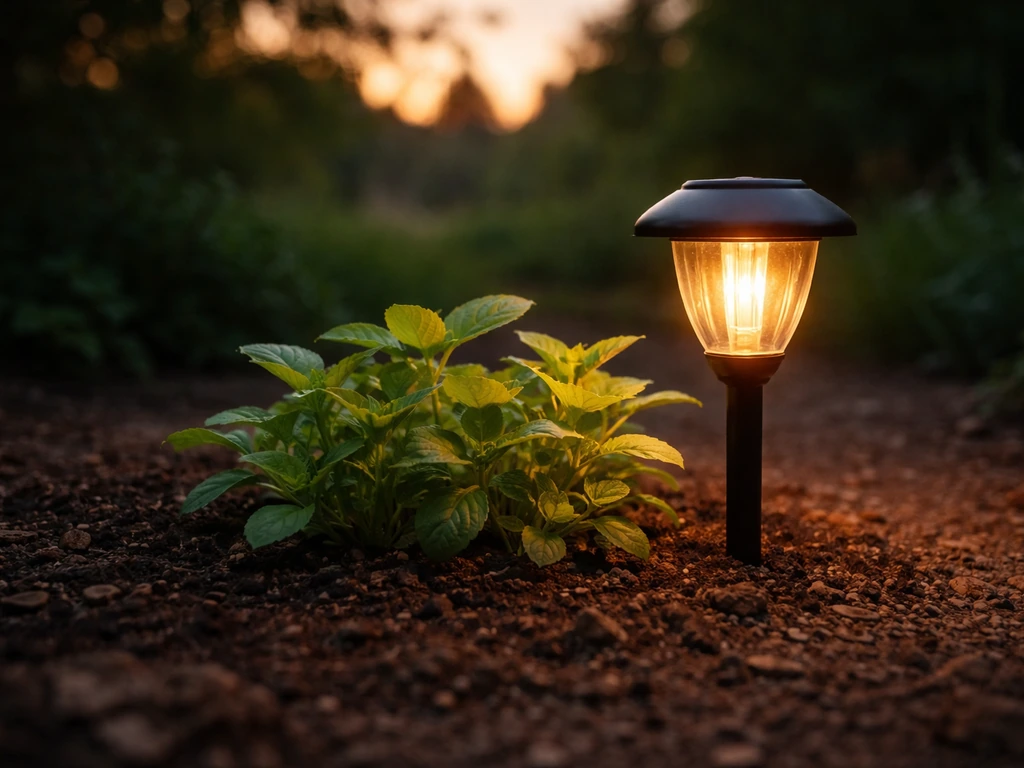
Solar garden lights follow a simple circuit: a small photovoltaic panel charges a battery during the day, then a sensor triggers the LEDs to switch on after dark. Most consumer models use lithium iron phosphate (LiFePO4) batteries, which store enough charge for roughly 6 to 10 hours of runtime depending on how much sun the panel captured. The light output is designed entirely around human visibility, specifically illuminating paths and driveways so people don't trip. Horticultural performance is not part of the engineering brief.
Plants need something quite different. In practice, what frequency helps plants grow depends on light duration and intensity, not the “brightness” setting on a solar fixture. What matters for photosynthesis is PAR (photosynthetically active radiation), measured as PPFD (photosynthetic photon flux density) in micromoles per square meter per second (µmol·m²·s⁻¹). This measures photons in the 400 to 700 nm range, which is the band plants actually use for photosynthesis. Lumens, the unit on every consumer light box, measure brightness as perceived by the human eye, which is weighted heavily toward yellow-green wavelengths. Those are actually among the least efficient wavelengths for photosynthesis. So a light that looks impressively bright to you might be delivering a surprisingly small photon dose to your plant.
The other key metric is DLI, the daily light integral. DLI (measured in mol·m²·day⁻¹) is the total accumulation of PAR photons a plant receives over a full day. A low-light houseplant might need a DLI of 6 to 10 mol·m²·day⁻¹, while seedlings and herbs typically want 12 to 16 mol·m²·day⁻¹ or more. You get there by combining PPFD intensity with hours of exposure. If your PPFD is very low, you need a very long photoperiod to hit the same DLI target, and that's where solar lights run into serious trouble.
Do solar lights actually provide enough light?
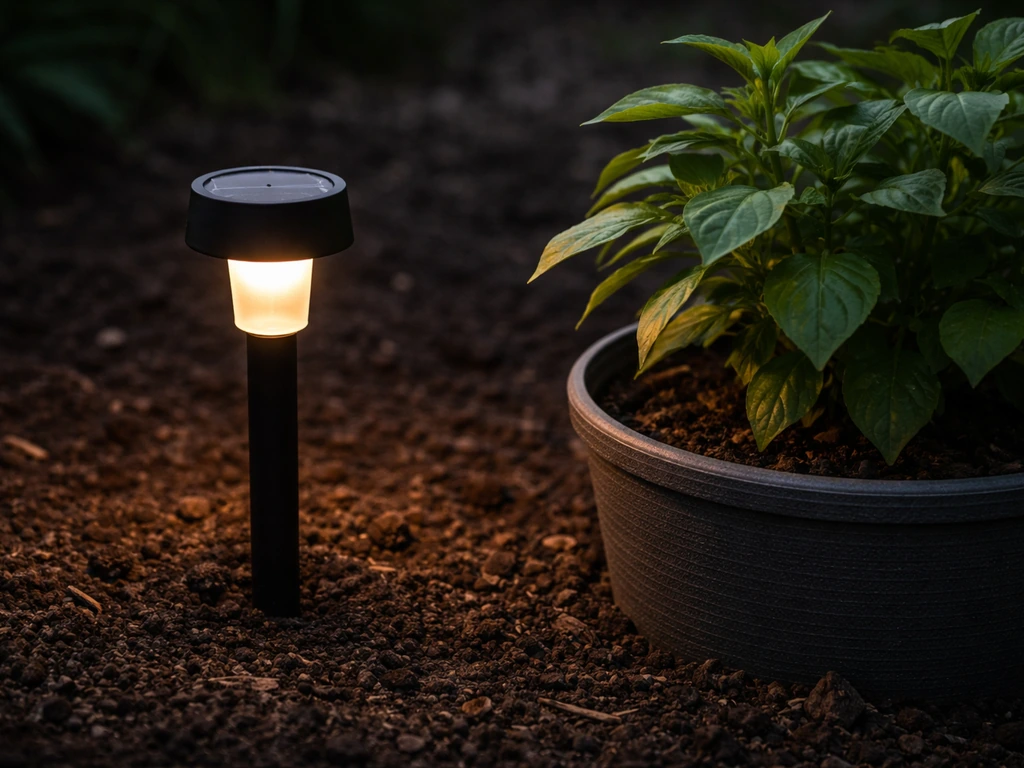
Let's put some numbers to this. A solar LED stake running at 300 lumens, placed 18 inches from a plant, is delivering maybe 1 to 5 µmol·m²·s⁻¹ of PPFD at best, once you account for the inverse-square drop-off in light intensity with distance. Compare that to a dedicated LED grow light at the same distance, which might deliver 200 µmol·m²·s⁻¹ or more. Now run the DLI math: at 5 µmol·m²·s⁻¹ running for 8 hours, you're delivering about 0.14 mol·m²·day⁻¹. The target for low-light plants starts at 6. You're not even in the same order of magnitude.
It gets worse when you factor in runtime. Solar lights are sensor-controlled, meaning they come on at dusk and run until the battery drains or sunrise hits the panel. That runtime is unpredictable and weather-dependent. After a cloudy day, your light might only run for 3 to 4 hours. Seedlings commonly need 16 to 18 hours of light per day to thrive under artificial lighting. A solar path light running 6 hours at low intensity isn't coming close to that, even on a perfect sunny day.
There's also the distance problem. Light intensity falls off with the square of the distance from the source. A light that measures 100 lux at 1 meter delivers only 25 lux at 2 meters. Most solar stake lights are positioned on the ground pointing upward or at a fixed angle for aesthetics, not placed close enough to a plant canopy to deliver meaningful intensity. Unless the light is within 12 inches of the foliage, the PPFD hitting the leaves is negligible.
The spectrum problem: what solar LEDs miss
Most solar garden lights use white LEDs. White LEDs are made by coating a blue LED chip with a yellow phosphor, which produces a broad but heavily blue-green-biased spectrum. Plants need strong contributions from red wavelengths (around 630 to 680 nm) for photosynthesis and from blue wavelengths (around 400 to 450 nm) for vegetative development and de-etiolation. White LEDs do deliver some blue, but the red output is typically weak compared to dedicated grow LEDs or red-spectrum plant bulbs.
Research on seedling responses tells an interesting story here. Etiolated seedlings (ones that have been stretching toward light in darkness) show measurable morphological responses even to low-intensity LED exposure, but the responses are wavelength-dependent. Wheat seedling research reported that blank" rel="noopener noreferrer">red-light-induced near-etiolation was reversed by far-red or by blue light, with specific intensity thresholds for the responses. Blue and white light tend to suppress excessive elongation, while red-dominant light can promote it. So spectrum matters not just for photosynthesis rates but for the actual physical shape and quality of your plants. A white solar LED might trigger some de-etiolation response, but it won't drive the full range of photomorphogenic effects that a red-and-blue grow spectrum would. De-etiolation, including cotyledon greening and seedling survival, is regulated and depends on light exposure after darkness, so insufficient photon dose can prevent full greening even when some light is present blank" rel="noopener noreferrer">de-etiolation response.
There's also a common assumption that solar lights carry the full solar spectrum automatically, since they're "solar powered." They don't. The panel captures sunlight as electricity. What comes out of the LED is entirely determined by the LED chip, not by the original sunlight that charged it. Standard solar garden LEDs emit very little to no UVB, produce minimal far-red (730 nm), and are not balanced for plant PAR needs. The fact that the energy originated from the sun is irrelevant to the spectrum you're delivering to the plant. Even though solar panels convert sunlight into electricity, most solar garden lights still provide far too little usable light to meaningfully help plants grow does electricity help plants grow.
Which plants might actually benefit
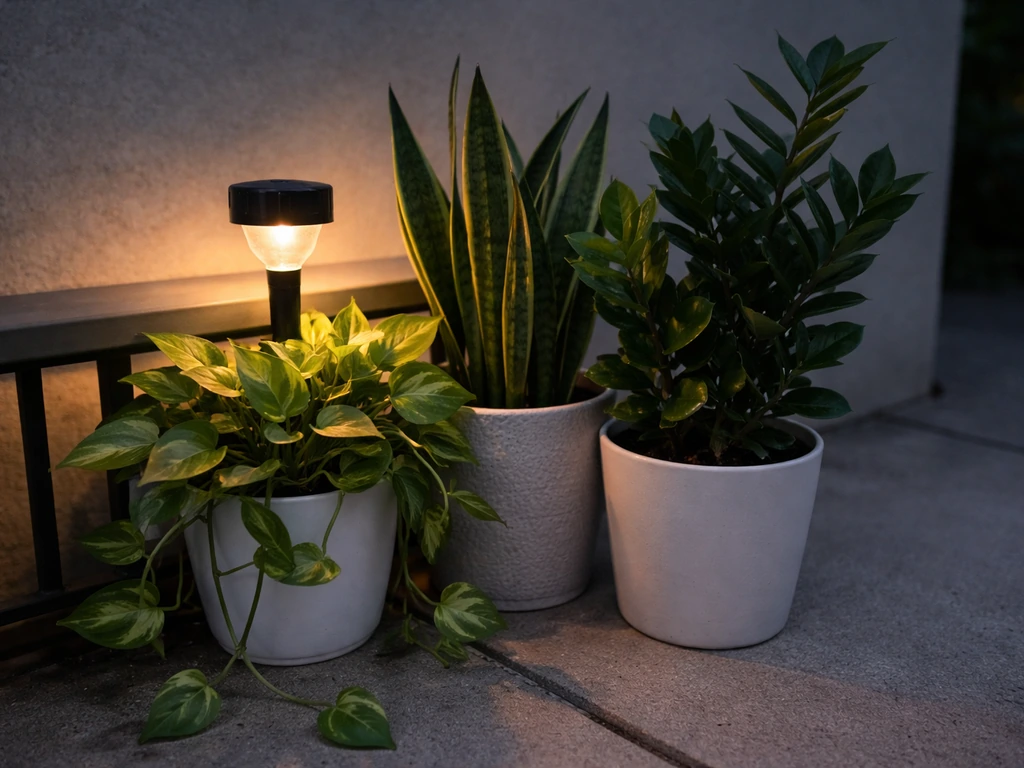
That said, it's not all hopeless. There are situations where solar lights can provide some measurable supplemental value, especially if you're strategic about it.
- Low-light tolerant houseplants (pothos, snake plants, ZZ plants) have DLI requirements of 4 to 6 mol·m²·day⁻¹. A solar light mounted very close (6 to 8 inches) and running 8 or more hours could nudge the total DLI closer to threshold, especially indoors where ambient light is already low.
- Outdoor beds in winter where plants need a light signal extension rather than full photosynthetic input. Even a low-intensity light can extend the perceived photoperiod, which matters for some flowering triggers and slow-growing perennials.
- Seedlings in a cold frame or low-light corner where you're trying to prevent extreme etiolation while a proper grow light isn't available. It won't replace real grow lighting, but it can reduce the worst stretching.
- Herbs like mint or parsley in a partially shaded outdoor spot where a solar-powered supplemental light nearby adds an extra hour or two of low-intensity input. It won't transform growth, but it can reduce stress during overcast stretches.
- Established outdoor ornamentals that are already getting most of their light from the sun during the day. Here, solar lights offer no practical photosynthetic benefit at night.
How to actually test if your solar light is doing anything
The simplest real-world test is etiolation. If your plant is stretching, pale, or producing small widely spaced leaves, it's not getting enough light regardless of whether the solar light is running. That's your signal that the total DLI is too low. A plant getting adequate light stays compact with dark green, normally sized leaves.
If you want a more precise answer, you can use a PAR meter or a PPFD meter app on your phone (the phone apps are imprecise but better than nothing). Measure the PPFD at leaf level while the solar light is your only light source. Then use the DLI formula: multiply PPFD (µmol·m²·s⁻¹) by the number of seconds in your photoperiod, then divide by 1,000,000 to get mol·m²·day⁻¹. If you're below 4 mol·m²·day⁻¹ for a low-light plant, or below 10 to 12 for anything more demanding, the solar light isn't contributing enough to matter.
Best practices if you want to make solar lights work harder
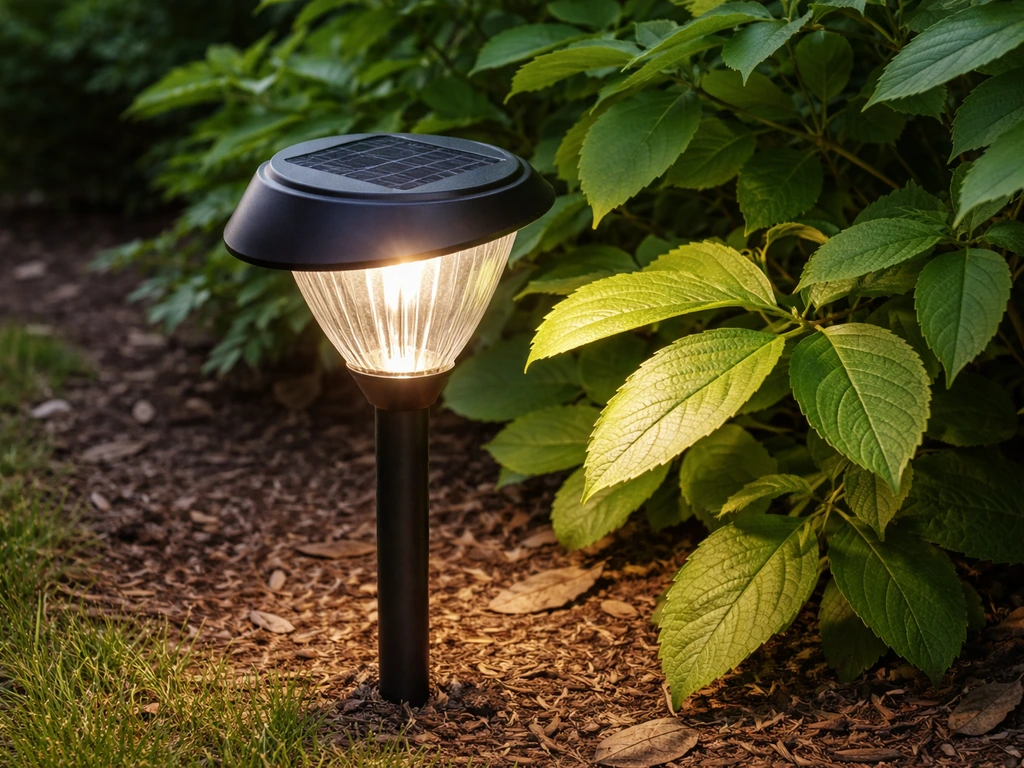
If you're committed to using solar lights and want to get the most out of them, these adjustments make the biggest practical difference.
- Get the light as close to the foliage as possible. Within 6 to 12 inches is the target. Every additional foot roughly quarters the PPFD the plant receives due to the inverse-square law.
- Choose higher-output models. Some solar garden lights now reach 800 to 1000 lumens and use more efficient LEDs. While still far below grow-light levels, higher lumen output does translate to marginally higher PPFD.
- Remove frosted or colored covers. Many decorative solar lights have diffusers or colored lenses that further reduce the already limited light output reaching the plant.
- Use multiple units clustered around one plant. Three or four solar lights at close range can collectively deliver more useful PPFD than one unit from a distance.
- Look for solar lights marketed specifically as plant or grow lights rather than path lights. These use red-and-blue LED arrays designed to hit PAR wavelengths, and some include adjustable panels that let you aim the charge plate at the sun while directing the light at the plant.
- Monitor battery performance and replace aging batteries. LiFePO4 batteries degrade over time, reducing runtime. A light that ran 8 hours last year might only run 5 hours this season.
- Position the solar panel where it gets direct, unshaded sun for at least 6 hours per day. Partial shading dramatically cuts charge capacity and reduces runtime.
Common myths worth clearing up
"Any light helps plants grow"
Not really. Light below the threshold needed to trigger photosynthesis at a meaningful rate is essentially neutral. A dim glow in an otherwise dark room might trigger some photomorphogenic responses in seedlings, but it won't drive meaningful photosynthesis or growth. Plants have a light compensation point, below which respiration consumes more energy than photosynthesis produces. Soft solar stake light from 3 feet away is likely below that compensation point for most plants.
"Solar lights have the full sun spectrum"
As covered above, this is a misconception. The solar panel converts sunlight into electricity, and the LED converts electricity into light according to its own chip design, not the solar spectrum. Standard white LEDs are blue-biased with a phosphor conversion and lack significant far-red, UV, and the balanced red spectrum that purpose-built grow lights provide. "Solar powered" tells you about the energy source, not the light quality.
"More hours at night is always better"
For some plants, particularly short-day flowering species, extended artificial light at night can actually suppress flowering by interrupting the dark period they need to set buds. Chrysanthemums, poinsettias, and some strawberries are classic examples. If you're running solar lights near these plants all night, you may be preventing them from flowering rather than helping them grow. Always check whether your target plant is a short-day, long-day, or day-neutral species before adding night lighting.
"Solar LEDs will burn or stress plants with heat or UV"
This one goes the other direction, and it's also wrong. Standard solar garden LEDs produce very little heat and essentially no UVB radiation. White LEDs are made from a blue chip plus phosphor and aren't designed to emit UV. Heat stress from a low-wattage garden stake light is not a realistic concern, even if the fixture is close to foliage. The problem with solar lights isn't that they're too intense. It's that they're far too weak.
When solar lights clearly won't cut it, and what to use instead
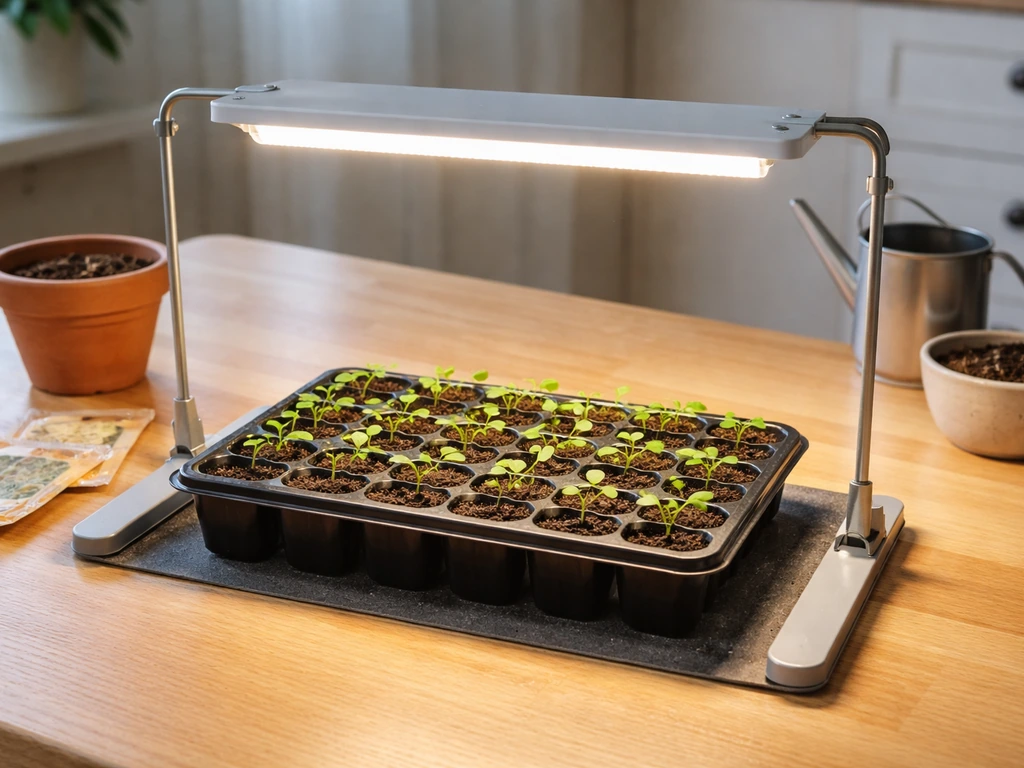
If you're trying to grow seedlings, start plants from seed, support vegetable transplants, or grow fruiting crops indoors, solar garden lights are the wrong tool entirely. If you're wondering whether thunder helps plants grow, the closer analog is that outside energy sources do not automatically translate into the specific light intensity, spectrum, and duration plants need does thunder help plants grow. You need a dedicated LED grow light with a red-and-blue or full-spectrum output, adjustable height, and the ability to run on a timer for 14 to 18 hours per day. A basic T5 fluorescent or LED panel grow light costs less than many premium solar garden lights and will actually move the needle on plant growth.
| Situation | Solar garden light | Better option |
|---|---|---|
| Starting seeds indoors | Not sufficient, DLI too low | LED grow light on timer, 16-18 hrs/day |
| Outdoor beds in winter | Marginal at best | Relocate plants or use supplemental grow light |
| Low-light houseplants, close placement | Possibly helpful | Daylight LED bulb or small grow panel |
| Preventing seedling etiolation short-term | Minimal help if close | Proper grow light or natural window |
| Ornamental flowering plants (short-day) | May disrupt flowering | Keep lights away or use timers carefully |
| Decorative outdoor garden beds | No meaningful benefit | Prioritize daytime sunlight placement |
If your plants are already in a spot that gets direct sun during the day, the most effective intervention is almost always repositioning rather than adding artificial light. A plant moved from a shady corner to a south-facing window gains far more usable PPFD than any solar stake light could provide. Similarly, reflective mulch or white walls around outdoor beds can bounce natural light back into the canopy more effectively than a low-lumen solar fixture.
For those interested in the broader science of light and plant growth, the questions around light frequency and spectrum (how different wavelengths affect plant development), whether standard daylight bulbs are a practical grow-light substitute, and even how environmental electrical factors interact with plant biology are all related threads worth exploring. If you are comparing options like daylight bulbs, it helps to evaluate intensity, spectrum, and duration the same way you would with solar lights. The common theme is that plants respond to very specific physical inputs, and "light" as a general category needs to be broken down into intensity, spectrum, and duration before you can predict whether any given light source will actually help.
The bottom line: keep solar garden lights where they work well, which is illuminating paths and adding ambiance. If you want to meaningfully support plant growth, invest in the right tool. Even a modest dedicated grow light will outperform a bank of solar stakes every time, and you'll see the difference in your plants within two weeks.
FAQ
If my plants already get sun, will solar lights make a noticeable difference at night?
Use the outdoor period you actually have. If your plants will still receive strong sun for most of the day, a solar light may add almost nothing. If they rely on dim conditions, the extra night glow can at best nudge photomorphogenesis, not raise DLI, so prioritize fixing day exposure first (window placement, shade removal, reflective surfaces).
How can I compare solar lights if lumens do not tell me what the plant gets?
Try not to rely on lumen ratings at all. Two fixtures with the same lumens can deliver very different PPFD because LED type, beam angle, and distance change photon output dramatically. Measure PPFD at leaf height if you can, or at least keep the light very close (within about 12 inches) and use narrow optics so more photons reach the canopy.
Can I set a photoperiod with solar lights the way I can with a grow light timer?
No, because solar fixtures run on a dusk-to-dawn, battery-limited schedule that usually falls far below the 14 to 18 hours many seedlings need. If you must use solar at all, treat it as an occasional supplemental light and do not plan it to replace a real photoperiod.
When solar lights can help, is it mostly about preventing stretching rather than boosting growth?
Yes for a narrow use case, but only if you use the light strategically. For “etiolation correction,” you are looking for reduced stretching and greener, tighter growth, not higher yield. Positioning close to the canopy and ensuring the light runs long enough matters more than making it look bright to you.
Could solar lights accidentally stop flowers from forming?
Consider a day length check. Many common flowering plants require uninterrupted darkness, so even weak night lighting can disrupt bud set. If your plant is short-day or day-length sensitive, avoid leaving any lights on through the dark period, even if they are solar-powered.
Do solar lights ever provide the red and blue balance plants need, or are they usually the wrong spectrum?
White LEDs are usually blue-biased and phosphor-based, so they may not provide enough red contribution for many growth goals. If you want to try solar anyway, look for explicit red or “plant” spectra claims and avoid relying on UV or far-red expectations. In most cases, you will still be short on total DLI.
What simple observation test can tell me if my solar setup is actually doing anything?
Do a compensation test. Turn off all other light sources, run the solar light for a full night (or full expected runtime), and observe leaf spacing and color over 2 to 3 weeks. If you see no compactness improvement compared with an identical group without the solar light, the contribution is likely negligible.
What should I change first if my plants look leggy outdoors?
For most setups, the practical fix is relocating plants to increase daylight before adding any night lighting. Options include moving from a shaded area to a brighter spot, using reflective materials around the bed, or bringing seedlings closer to a window. Only after improving daytime PPFD should you consider any supplemental light.
How reliable are PPFD meter apps for checking whether a solar light contributes enough?
Phone apps are usually too inaccurate for decision-making at low intensities. If you use an app, use it only to spot major differences, then verify with an actual PPFD or PAR meter if you are making a go or no-go purchase.
How do clouds and seasonal changes affect whether solar lights help at all?
If you are building a setup that relies on solar, treat weather and season as variables. Cloudy days can cut runtime to a fraction of sunny-day performance, so your plants may get inconsistent DLI week to week. For seedlings and consistent results, use grid-powered timers instead.
Next Articles
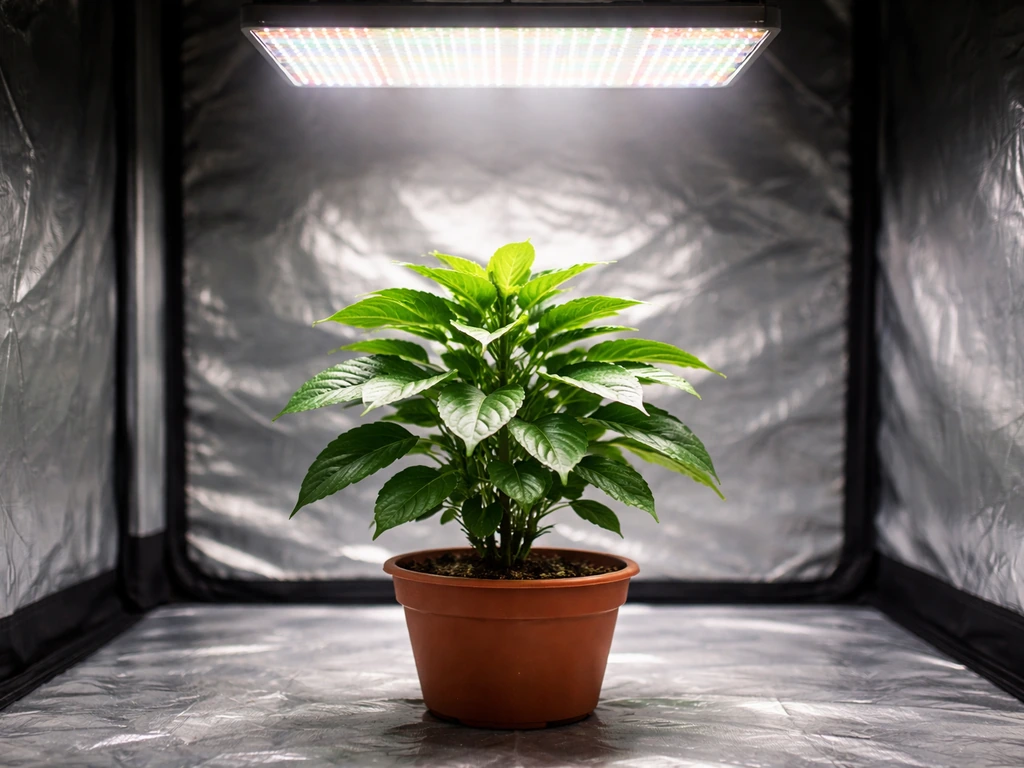
Does Electricity Help Plants Grow? Electric Light Guide
Learn if electricity or electric light helps plants grow, plus how to set spectrum, intensity, distance, and timers safe
Do Daylight Bulbs Help Plants Grow? What to Know
Find out if daylight LED bulbs really help plants grow, what to check for spectrum and intensity, and how to place run t
What Frequency Helps Plants Grow: Water, Fertilizer, Light
Find the right watering, feeding, and light timing to help plants grow, with signs to fix an off schedule.