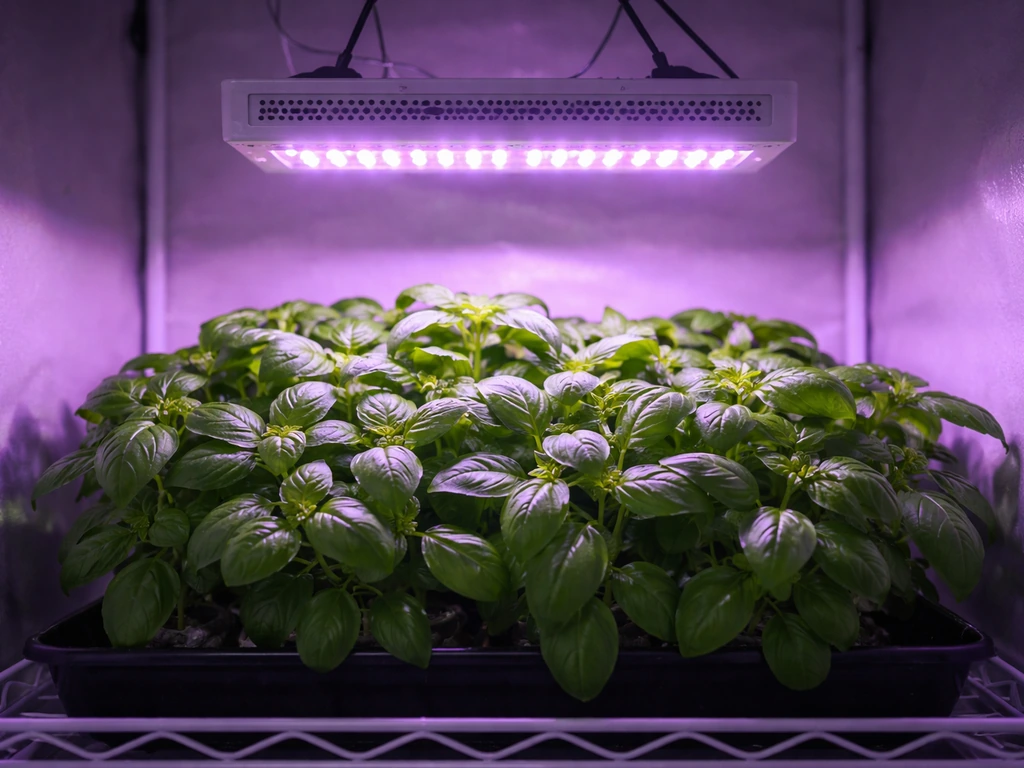
Yes, purple light can help plants grow, but not because it's purple. What actually matters is the specific wavelengths inside that purple glow and whether they're hitting your plants at the right intensity and duration. Most purple grow lights are a blend of blue (around 450 nm) and red (around 660 nm) LEDs, which together appear purple or magenta to your eyes. Those two wavelengths are genuinely useful to plants. A true violet LED at 405 nm is a different story, and that distinction matters a lot when you're deciding what to buy or whether your current setup is actually doing anything.
Does Purple Light Help Plants Grow? Practical Guide

Marcus Holloway
29 Apr 2026
What 'purple light' really means for plant growth
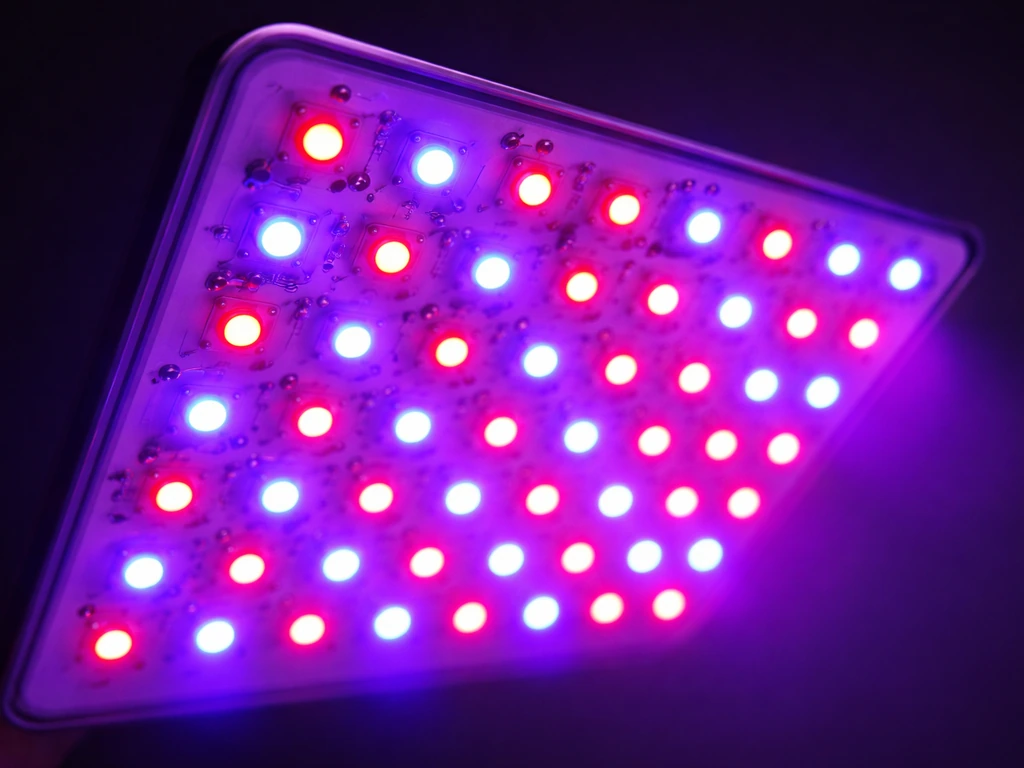
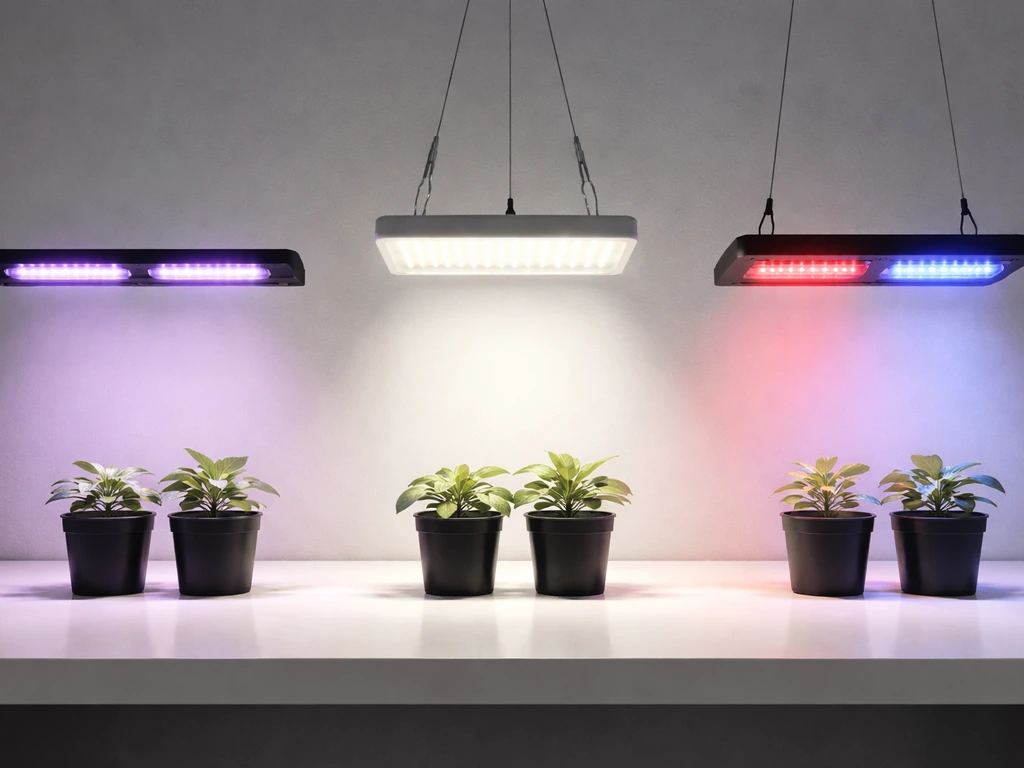
When most people say 'purple grow light,' they're describing one of two things. The first is a blurple LED panel, which combines red chips (peaking around 660 nm) and blue chips (peaking around 450 nm). Because your eyes see red and blue mixed together, the light looks purple or magenta. The second is a true violet or UV-A emitter, typically around 405 nm, which sits right at the edge of visible violet and near-UV. These two are not the same thing, and treating them as interchangeable is where a lot of confusion comes from.
The blurple panel is actually a tried-and-tested horticultural concept. You're getting red photons that land right on chlorophyll's main absorption peak and blue photons that drive both photosynthesis and photomorphogenesis (the way plants shape themselves in response to light). The 405 nm violet LED is narrower, emitting a band only about 10 to 15 nm wide, and it sits in a region where plant photoreceptors are active but not maximally efficient. Some commercial full-spectrum fixtures like the Guardian900W include a 405 nm channel precisely to fill out the spectrum, not as the primary growth driver.
The science: which wavelengths actually drive photosynthesis and growth
Plants have two main photoreceptor systems you need to know about. Phytochromes respond to red and far-red light, with the active (Pr) form absorbing most strongly around 660 nm and the Pfr form responding at around 730 nm. Red light helps plants grow best when it provides the right intensity at the 660 nm range that phytochromes respond to does red light help plants grow. Cryptochromes and phototropins handle the blue and UV-A region, with blank" rel="noopener noreferrer">phototropin peak activity around 470 nm. Together these systems govern photosynthesis rate, stem elongation, leaf expansion, flowering, and stomatal opening.
Violet light at 405 nm does fall within the cryptochrome and phototropin action spectrum, so it can trigger blue-light responses. But it's less efficient at delivering usable photons per watt than blue or red LEDs. Research comparing photon efficacy (how many usable photons you get per joule of electricity) ranks 660 nm LEDs highest, followed by 450 nm blue, with 405 nm violet coming in lower. That means if your goal is maximizing photosynthesis for the power you're spending, violet is the least cost-effective of the three. It's not useless, but it shouldn't be your primary light source.
The 400 to 700 nm range is what we call PAR (photosynthetically active radiation), and this is what you want to measure and optimize. Your 405 nm violet LED does sit just inside that window, so it counts toward your PPFD (photosynthetic photon flux density) readings when measured with a full-spectrum quantum sensor calibrated to 400 to 700 nm.
Do purple LEDs alone help, or do you need other colors too
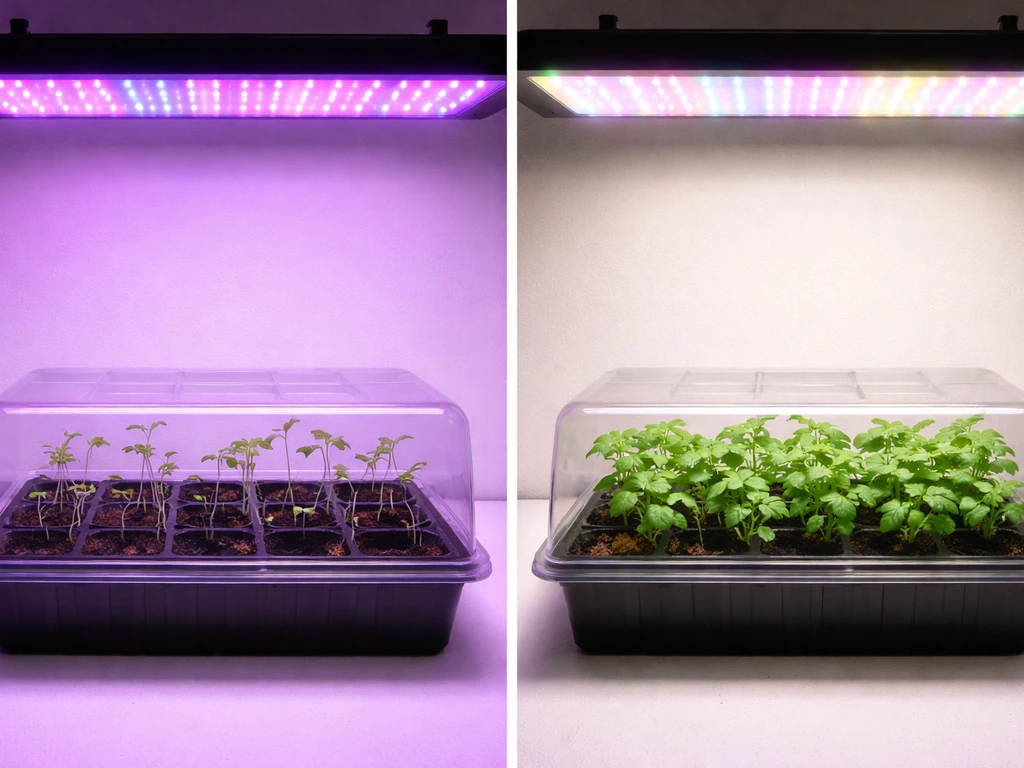
A blurple panel (red plus blue LEDs) can grow plants reasonably well on its own, and plenty of people have done it successfully with leafy greens and herbs. The issue is that plants use more than just 450 nm and 660 nm. Green, yellow, and far-red photons play real roles in canopy penetration, photosynthetic efficiency, and signaling. Reddit hobbyist discussions about far red (around 730 nm) emphasize how phytochrome signaling depends on the Pr and Pfr states rather than on the light looking “purple.” blank" rel="noopener noreferrer">Green, yellow, and far-red photons play real roles in canopy penetration, photosynthetic efficiency, and signaling.. Green light can help by contributing to canopy penetration, photosynthetic efficiency, and signaling, but it should complement red and blue rather than replace them Green, yellow, and far-red photons. So while red-blue-only setups work, they leave some capability on the table compared to a well-engineered full-spectrum LED.
A pure violet LED at 405 nm used alone is a different situation entirely. You'd be delivering photons that only weakly trigger growth responses and doing it inefficiently. Plants would survive, but you'd see slow, etiolated growth because you're not delivering meaningful red photons for photosynthesis or the core blue photons that cryptochromes and phototropins respond to most strongly. Violet alone is not a viable grow light strategy.
The myth worth busting here is that any purple-colored light is automatically a good grow light. Color is what your eyes perceive, not what the plant's photoreceptors experience. A purple-hued incandescent or fluorescent bulb running hot and emitting most of its energy as heat and the wrong wavelengths won't perform like a purpose-built LED panel, even if both look purple in the room.
How to tell if your setup is working
The best way to confirm your light is doing something useful is to measure PPFD at canopy level with a quantum sensor. For leafy greens and herbs, you're aiming for roughly 100 to 300 µmol·m⁻²·s⁻¹ during your photoperiod. You can then calculate your DLI (daily light integral) using a simple formula: DLI equals 0.0036 multiplied by your PPFD multiplied by your photoperiod in hours. Leafy greens and herbs generally need a DLI of around 12 mol·m⁻²·d⁻¹ or more. For example, running 210 µmol·m⁻²·s⁻¹ for 16 hours gets you close to that target.
Beyond numbers, you can read your plants directly. Healthy plants under adequate purple grow light (the blurple red-blue kind) show compact internodes, dark green leaves, and steady new growth. If you're wondering whether pink light helps plants grow, the answer depends on the actual wavelengths and intensity, not the color your eyes perceive does pink light help plants grow. Signs your light isn't enough: stretched, leggy stems reaching toward the fixture, pale or yellowish leaves, and slow overall development. Signs you might be overdoing intensity: bleached or whitish leaf tips, curling, or stress markings on new growth.
- Compact stem spacing (short internodes) means your plants are getting enough light
- Dark, rich leaf color indicates sufficient photosynthetic activity
- Leggy, stretched growth means your PPFD is too low or the light is too far away
- Pale or bleached patches suggest excessive intensity or thermal stress
- Slow root and leaf development often means DLI is falling short of crop targets
Best ways to use purple light: combine it, don't rely on it alone
The most effective approach with a blurple LED panel is to treat it as a solid baseline and supplement with green or full-spectrum light if you're growing denser canopies or fruiting plants. Research on lettuce, for example, used controlled PPFD of around 200 µmol·m⁻²·s⁻¹ with red peaking at 660 nm and blue at 450 nm as the foundational spectrum, then varied the ratios to optimize morphology and nutritional content. Results showed that getting the red-to-blue ratio right matters, and that moving even slightly within the blue region (comparing 435 nm to 450 nm chips, for example) can produce measurable differences in growth and leaf quality.
If you have a fixture with a 405 nm violet channel, use it as a component of a fuller spectrum rather than as a standalone light source. Think of it as a trim piece that fills the UV-A and short-blue end of the spectrum, potentially supporting some cryptochrome activity and secondary metabolite production (which can improve flavor and nutrition in herbs and leafy greens) without being the workhorse of your light plan.
Full-spectrum LEDs that include violet (405 nm), blue (450 nm), red (660 nm), and some green and far-red content give plants the most complete photon environment. If you're upgrading from an older blurple panel, that's a meaningful step up, especially for plants you're taking from seedling to harvest. For seedlings and clones specifically, research using 16-hour photoperiods at around 200 µmol·m⁻²·s⁻¹ with stage-appropriate red and blue ratios produced reliable results.
Purple vs. full-spectrum vs. red-blue: a practical comparison
| Light Type | Key Wavelengths | Plant Growth Effectiveness | Best Use Case | Efficiency (photons per watt) |
|---|---|---|---|---|
| Blurple LED (red+blue) | ~450 nm + ~660 nm | Good for leafy greens and herbs, adequate for most indoor crops | Dedicated grow tents, propagation shelves | High (660 nm is most efficient, 450 nm close behind) |
| True violet / UV-A LED | ~405 nm | Low on its own; useful as a spectrum supplement | Component in full-spectrum fixtures only | Lower than red or blue at same watt input |
| Full-spectrum LED (includes violet) | 400–700 nm with peaks at violet, blue, red | Best overall for all growth stages | Seedlings through harvest, fruiting crops | Variable; best fixtures optimize photon efficacy across spectrum |
| Red-only LED | ~660 nm | Drives photosynthesis well but poor photomorphogenesis alone | Specific research setups; not recommended solo for most crops | Highest single-wavelength photon efficacy |
| Blue-only LED | ~450 nm | Supports photomorphogenesis, compact growth, limited photosynthesis rate | Microgreens or supplemental blue channels | Good, but suboptimal as sole source |
Choosing and using purple grow lights today
If you're shopping for a grow light now and drawn to the purple options, here's how to approach it practically. Look at the manufacturer's spectral data, not just the marketing language. A good blurple panel will list peak wavelengths (you want to see 450 nm and 660 nm explicitly). A full-spectrum fixture claiming 405 nm coverage should show it as part of a broader spectrum, not as the only blue-adjacent channel.
For placement, start with the fixture about 18 to 24 inches above the canopy for leafy greens and adjust based on what you measure at canopy level. A basic quantum PAR meter (or a well-reviewed smartphone sensor app as a rough check) can tell you whether you're in the 100 to 300 µmol·m⁻²·s⁻¹ window. Move the light closer if you're falling short, but watch for bleaching if you push past 300 µmol·m⁻²·s⁻¹ on sensitive seedlings.
For timing, a 16-hour photoperiod works well for most leafy greens and herbs and is a well-tested default. Use a simple outlet timer so your plants get consistent light and dark cycles. If you run 200 µmol·m⁻²·s⁻¹ for 16 hours, you're delivering a DLI of about 11.5 mol·m⁻²·d⁻¹, which is right at the threshold for leafy greens. Nudging up to 210 to 220 µmol·m⁻²·s⁻¹ pushes you comfortably past 12, which is a more confident target for consistent harvests.
- Check the fixture's spectral datasheet for explicit peak wavelengths, especially 450 nm and 660 nm
- Measure PPFD at canopy level using a quantum sensor (full-spectrum type for accurate readings under narrow-band LEDs)
- Target 100 to 300 µmol·m⁻²·s⁻¹ at canopy for leafy greens and herbs
- Set a 16-hour photoperiod with a consistent outlet timer
- Calculate your DLI: multiply PPFD by hours by 0.0036 and aim for 12 or more for leafy crops
- Adjust height first, then intensity settings, before changing photoperiod
- If upgrading from a blurple panel, move to a full-spectrum fixture that includes violet, blue, green, red, and far-red channels for the most complete plant response
Purple light is one piece of a real and useful picture, especially when 'purple' means a properly engineered red-plus-blue or full-spectrum LED. Where it fails is when gardeners assume any purple-tinted light source will do the job, or that the color alone is what matters. The wavelengths inside the light, the intensity at canopy level, and the hours per day your plants receive it are what actually determine whether your plants thrive. Get those three things right, and whether the light looks purple, white, or pink to your eye becomes largely irrelevant.
FAQ
Does any purple LED help plants grow, or does the wavelength matter more than the color?
Only if the spectrum inside the “purple” contains meaningful red (around 660 nm) and blue (around 450 nm), and you deliver enough PPFD at the leaf level. A fixture that looks purple because of mixed colors but lacks the right wavelength peaks or enough intensity will not reliably hit target DLI values.
If my light has a 405 nm violet channel, can I run it as the main grow light?
It can contribute, but it is usually the least efficient part of a grow light for photosynthesis. If your goal is maximizing growth per watt, prioritize delivering strong blue and red first, then treat 405 nm as a supporting channel rather than the main light.
Will a purple-colored home bulb work as well as a purpose-built grow light?
Not always. Purple-tinted incandescent or fluorescent bulbs often produce lots of heat and an unfavorable spectrum for plants. Even if the room looks purple, plants care about what arrives in the 400 to 700 nm range at the canopy and in the right proportions.
How can I tell if my purple grow light is actually strong enough?
Measure PPFD with a quantum sensor calibrated for 400 to 700 nm at canopy height, then compute DLI from that reading. Smartphone apps and PAR “indicators” are often rough, and the error can be large enough to explain slow growth or bleaching.
How do I know whether I placed my purple light too high or too close?
If your fixture is too far, your PPFD drops and you may see leggy stems and paler leaves. If it is too close or set too powerful, you may see bleaching, curling, or stress marks on new growth, especially on seedlings.
Should the PPFD target be the same for seedlings, clones, and mature plants under purple light?
Use the target based on your plant stage and DLI, not only your PPFD number. For example, seeds and cuttings can be sensitive to high intensity, so start at the low end of the range and adjust upward gradually while watching for stress signs.
Why do some red-blue (purple) setups underperform for dense canopies?
Green and far-red photons can change canopy performance, even if they do not make the light “look purple.” If you are growing dense leafy canopies or fruiting plants, adding a fuller spectrum (or supplementing beyond red and blue) can improve penetration and overall efficiency.
If my plants look a bit pale under a purple setup, is the fix adding more violet or more blue/red?
A 405 nm channel can support specific signaling, but it may not meaningfully replace blue. If your plants look underlit despite “violet coverage,” confirm you are delivering enough 450 nm and 660 nm photons and adequate total DLI.
Does adding a violet channel improve growth even if I keep the same PPFD and photoperiod?
If the violet channel boosts total spectrum without raising PPFD, it may not improve results. The practical test is whether PPFD at canopy level increases and whether DLI meets your target, then compare growth and morphology over at least a week or two.
Can I compensate for lower PPFD from a purple light by running the photoperiod longer?
Yes, but only when the photoperiod and total DLI are appropriate. If you increase hours to raise DLI, ensure you still provide a real dark period, because nonstop lighting can stress plants and disrupt normal development.
Next Articles
Does Blue Light Help Plants Grow? Practical LED Guidance
Learn how blue LED light boosts photosynthesis and compact growth, and how to set spectrum, intensity, and timing for pl
Does Red Light Help Plants Grow? Setup Guide and Why
Learn if red LED light helps plants grow, why it works, and how to set wavelength, distance, and schedule.
What Color Light Helps Plants Grow Best (LED Guide)
Learn which light colors boost plant growth fastest using LEDs, plus science on red, blue, far-red and setup tips.