Red and blue light are the heavy lifters when it comes to plant growth. For a direct answer to what color light makes plants grow faster, start by choosing red and blue wavelengths, then add far-red carefully based on your growth stage best light colors for plant growth. If you're shopping for grow lights or trying to figure out why your indoor plants aren't thriving, that's the short answer. But the fuller picture is more interesting and more useful, because knowing why those wavelengths matter, what far-red does, and how to actually set up your lights will make a real difference in your results.
What Color Light Helps Plants Grow Best (LED Guide)
Marcus Holloway
22 Apr 2026
Quick answer: the best light colors for plant growth
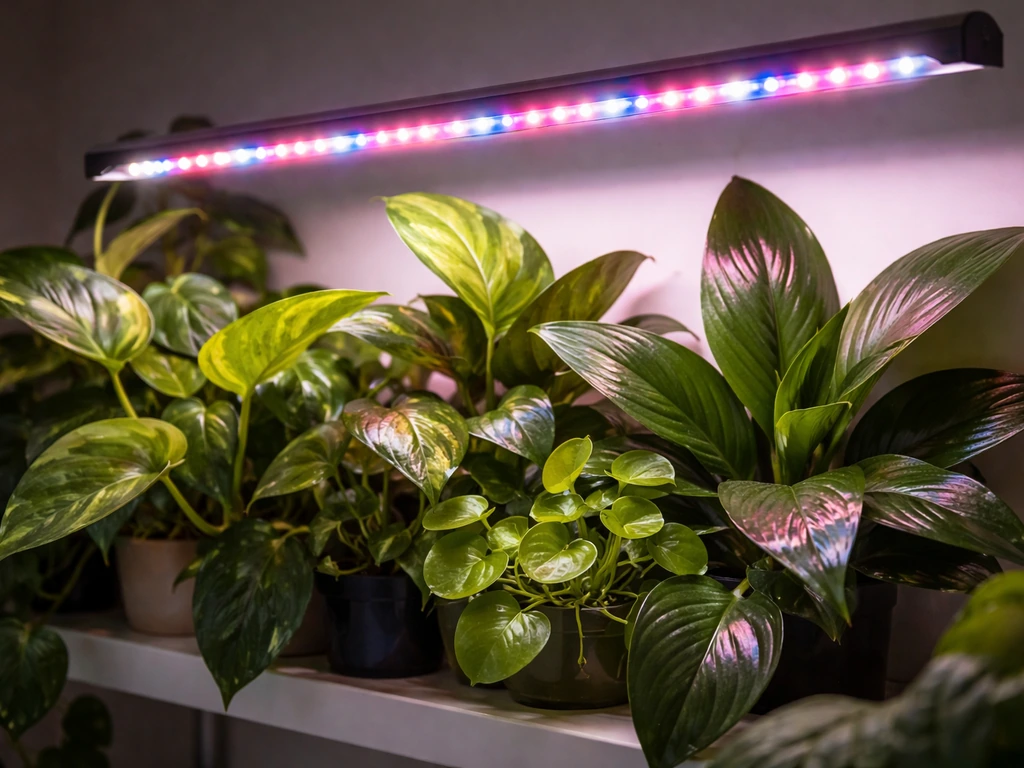
Plants use light through photosynthetic pigments, primarily chlorophyll a and chlorophyll b, and those pigments have specific absorption peaks. Chlorophyll a absorbs most strongly around 430 nm (deep blue-violet) and 665 nm (red). Chlorophyll b peaks around 453 nm (blue) and 642 nm (orange-red). That's why red and blue LEDs dominate serious grow light setups. They're delivering photons right where the plant's machinery is most hungry for them.
Beyond red and blue, far-red light (roughly 700 to 800 nm) plays a different but important role through a separate receptor system called phytochrome. It doesn't drive photosynthesis directly the way red does, but it powerfully influences plant behavior: flowering timing, stem elongation, and how a plant interprets its environment. Green and yellow light (500 to 600 nm) are often dismissed, and while they're not the main drivers, they aren't entirely useless either. More on each of those below.
| Light Color | Wavelength Range | Primary Role | Priority for Growers |
|---|---|---|---|
| Deep blue / violet | 400–500 nm | Chlorophyll a & b absorption, vegetative growth, compact structure | High |
| Red | 620–680 nm | Chlorophyll a & b absorption, photosynthesis, flowering trigger | High |
| Far-red | 700–800 nm | Phytochrome signaling, flowering timing, stem elongation | Medium (stage-dependent) |
| Green | 500–570 nm | Some leaf penetration, minor photosynthetic contribution | Low (useful in full-spectrum) |
| Yellow / orange | 570–620 nm | Minimal direct photosynthetic role | Low |
How plants actually respond to different parts of the spectrum
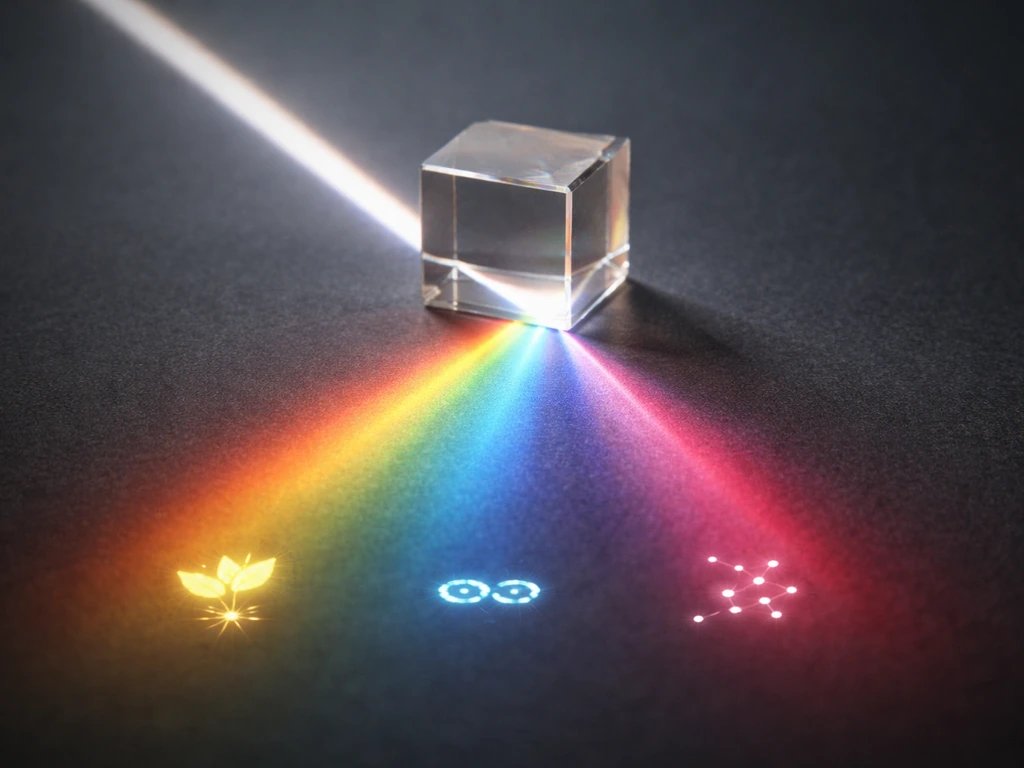
Thinking in colors is a useful shortcut, but your plant doesn't see colors, it absorbs photons at specific wavelengths. Here's what's happening at each part of the spectrum, explained in terms a gardener can use.
Red light (620–680 nm): the photosynthesis engine
Red is where the bulk of photosynthesis happens. Chlorophyll a has its strongest long-wavelength absorption right around 665 nm, which is why red LEDs are so commonly used in grow lights. In sweet pepper seedling studies, red-blue combinations significantly increased epidermis thickness, CO2 assimilation rates, and photochemical capacity compared to monochromatic red or blue alone. Red light is also the primary trigger for the phytochrome system: when plants receive a lot of red relative to far-red, they interpret it as full sun exposure and behave accordingly, staying compact and directing energy into leaf and root development.
Blue light (400–500 nm): structure and regulation
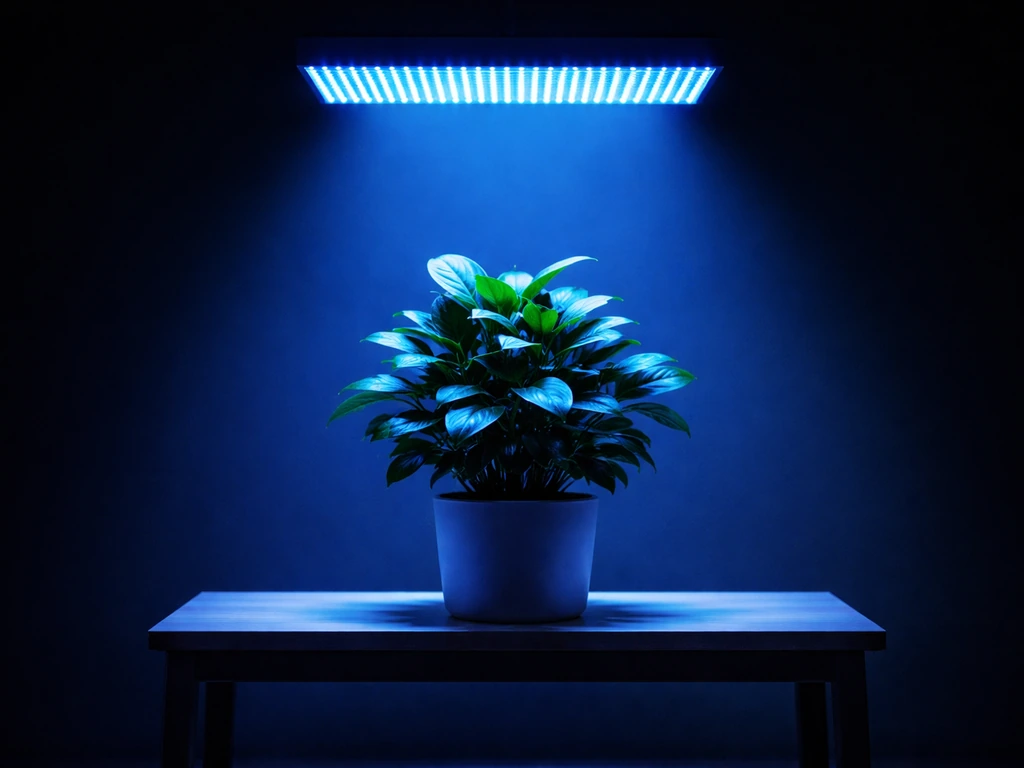
Blue light controls stomatal opening, which directly affects how well a plant can take in CO2 and release water vapor. Blue light also supports plant growth by regulating key processes like stomatal opening, which helps plants take in CO2 and manage water loss effectively. It also promotes compact, sturdy vegetative growth, which is why seedlings grown without enough blue often get leggy even if they're getting plenty of red. In ornamental plant studies, photosynthetic rates were highest under mixed red-blue LEDs compared to either color alone. Blue light is especially important during the vegetative stage, and it's one of the reasons full-spectrum white LEDs tend to outperform the old 'blurple' lights that skewed heavily toward red without enough blue in the right band.
Far-red light (700–800 nm): the phytochrome switch
Far-red doesn't power photosynthesis the way red does, but it's a critical signaling wavelength. Phytochromes exist in two interconvertible forms: Pr (inactive, absorbs red at ~660 nm) and Pfr (active, absorbs far-red at ~730 nm). Red light converts Pr to the active Pfr form, which promotes germination, leaf expansion, and other growth responses. Far-red converts Pfr back to Pr. So the ratio of red to far-red light that a plant receives essentially tells it whether it's in open sun or shade, and the plant adjusts accordingly.
When far-red is elevated relative to red (a low red:far-red ratio), plants trigger shade-avoidance responses: stems elongate, leaves stretch, and flowering timing shifts. A 2026 lettuce study confirmed that a higher far-red component drives increased stem and petiole elongation as a classic shade-avoidance trait. This is useful to know for two reasons: you can use end-of-day far-red pulses to manipulate flowering in photoperiod-sensitive plants, and you need to avoid accidentally creating a high-far-red environment when you want compact, vegetative growth.
Green and yellow light: not totally useless, but not the priority
Green light (roughly 500 to 570 nm) is the wavelength that plants reflect most, which is why they look green. But 'reflect most' doesn't mean 'absorb none.' Research published in Plant and Cell Physiology found that green light can drive leaf photosynthesis more efficiently than red under strong white light conditions, partly because green photons penetrate deeper into the leaf tissue beyond the surface layer that red and blue saturate. That said, this is a nuanced finding that applies under specific intensity conditions, and it doesn't make green light a substitute for red and blue. Some sources claim green penetrates deeper into the plant canopy overall, but that claim is disputed and not supported by straightforward measurements. For most home growers, green matters as part of a full-spectrum setup but not as a wavelength to seek out on its own.
LED vs. other grow lights: reading the specs that actually matter
LEDs have become the dominant choice for indoor growing, and for good reason: they're energy-efficient, run cooler than HPS or fluorescent lights, and can be engineered to emit specific wavelength bands. But the marketing around grow lights is full of vague claims, so here's what to actually look at when buying.
- Look for specific wavelength bands, not color names. A label that says '660 nm red' and '450 nm blue' tells you something meaningful. A label that says 'plant spectrum pink-purple' tells you almost nothing.
- Check for PPFD ratings at a stated distance. PPFD (photosynthetic photon flux density) measures how many photons are actually reaching a square meter of plant surface per second, expressed in μmol·m⁻²·s⁻¹. This is the number that determines whether your light can actually support growth.
- Be skeptical of 'blurple' lights. The early generation of red+blue-only LEDs was built around the idea that you only need to match chlorophyll absorption peaks. Research and grower experience have consistently shown that full-spectrum lights, including some green and far-red components, produce better real-world results.
- For flowering and fruiting plants, look for lights that include far-red output or are adjustable. Some quality fixtures let you tune the red:far-red ratio for different growth stages.
- Compare HPS and fluorescent only if heat or upfront cost is a real constraint. HPS produces a lot of light but also a lot of heat and draws more electricity. T5 fluorescents work well for seedlings and low-light plants but can't deliver the intensity most fruiting plants need.
| Light Type | Spectrum Control | Heat Output | Energy Efficiency | Best For |
|---|---|---|---|---|
| Full-spectrum LED | High (tunable bands) | Low | High | Seedlings through fruiting, all stages |
| Red+Blue LED (blurple) | Limited | Low | High | Basic vegetative growth, not ideal for fruiting |
| HPS (High-Pressure Sodium) | Fixed, red-heavy | High | Moderate | Large fruiting plants, greenhouses |
| T5 Fluorescent | Fixed, broad | Low-moderate | Moderate | Seedlings, herbs, low-light houseplants |
| CMH / LEC | Broad, full-spectrum | Moderate | Moderate-high | All stages, close to natural light quality |
Does 'faster growth' come from better wavelengths or more intensity?
This is one of the most common points of confusion, and it's worth clearing up directly. Faster plant growth comes from delivering the right wavelengths at sufficient intensity across enough hours. None of those three factors works in isolation.
The useful metric here is DLI, or daily light integral. For example, MSU Floriculture Extension’s DLI “requirements” guidance explains DLI in mol·m⁻²·day⁻¹ terms and targets crop light needs using ranges by crop type. DLI represents the total number of photons delivered to a plant surface over a full day and is calculated by multiplying PPFD by the number of seconds in the photoperiod, then converting units. University of Missouri Extension uses an example of a target DLI of 16 mol·m⁻²·day⁻¹, achievable with a PPFD around 510 μmol·m⁻²·s⁻¹ over the right number of hours. The University of Maine provides practical PPFD targets by stage: seedlings and clones do fine below 100 μmol·m⁻²·s⁻¹, vegetative plants need 100 to 500, and flowering or fruiting plants typically need 400 to 1,200.
PPFD and photoperiod are somewhat interchangeable in terms of DLI math, but they're not perfectly interchangeable in terms of plant response. A 2019 study on lettuce and mizuna found that with the same DLI, longer photoperiods (lower intensity over more hours) increased photosynthetic activity and growth compared to shorter, more intense periods. So running your lights for 16 hours at moderate intensity will often outperform 10 hours at very high intensity, even if the math produces the same DLI. The takeaway: chasing a specific 'magical' color without also hitting adequate PPFD and photoperiod targets won't get you faster growth.
How to set up your lights at home
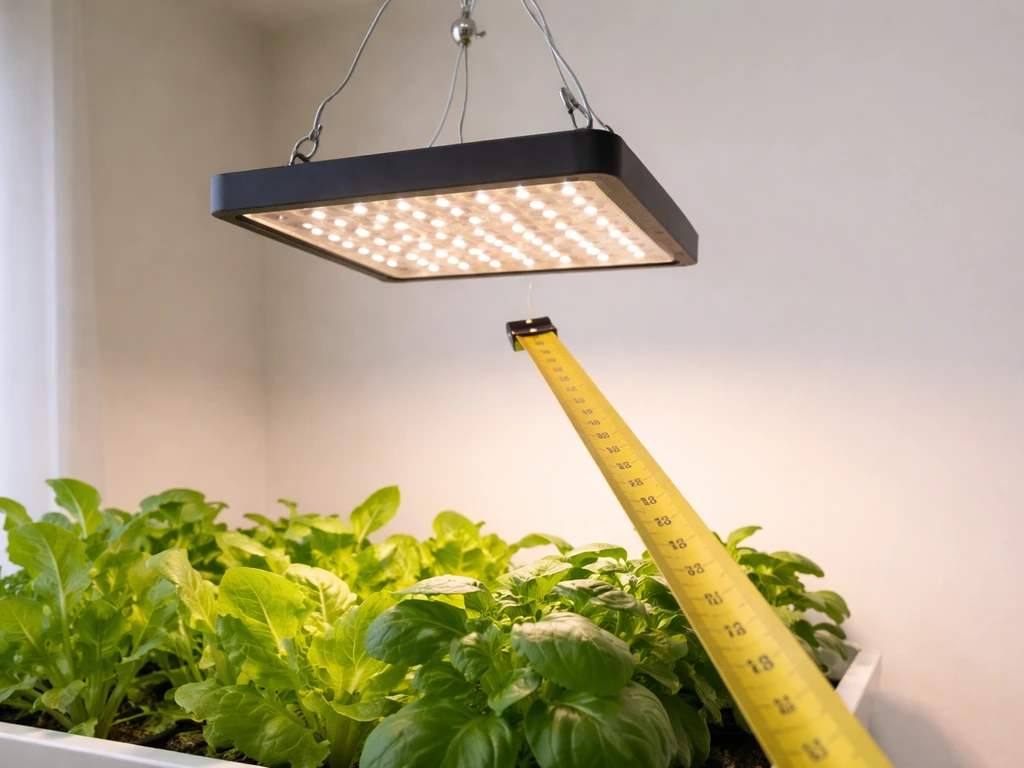
Distance from your plants
PPFD drops sharply as you move a light further from the canopy, following the inverse square law. Most full-spectrum LED panels designed for home use specify a recommended hanging height for their rated PPFD, often in the range of 18 to 24 inches above the canopy for vegetative growth and 12 to 18 inches for flowering stages. Start at the manufacturer's recommended height and adjust based on how your plants respond: if leaves are cupping, bleaching, or showing bleached spots at the growing tips, move the light up. If plants are stretching toward the light, move it down or increase the photoperiod.
Daily light hours (photoperiod)
For most vegetative plants and herbs, 14 to 18 hours of light per day works well under artificial lighting. Seedlings can often do fine with 16 hours. Flowering plants are where photoperiod becomes critical: short-day plants (like many flowers and cannabis varieties) need 12 hours of uninterrupted darkness to trigger and maintain flowering, while long-day plants need shorter nights. If you're growing something that doesn't care about day length (most herbs, most vegetables in vegetative stage), just aim for the DLI your plant needs by adjusting the combination of PPFD and hours.
Balancing colors across growth stages
During vegetative growth, prioritize red and blue in roughly a 3:1 to 5:1 red-to-blue ratio. This keeps plants compact and photosynthetically efficient. For seedlings, keep intensity moderate (under 200 μmol·m⁻²·s⁻¹) to avoid stress on young tissue. When you're pushing toward flowering, you can introduce more far-red through either a dedicated far-red LED strip or an end-of-day far-red pulse of 10 to 15 minutes, which mimics the natural light shift that happens at dusk and can help trigger flowering in many plants. If you're using a full-spectrum LED with a built-in spectrum, many quality fixtures handle this automatically or allow you to shift the output.
Common myths and mistakes about colored grow lights
There's a lot of lore floating around about grow light colors, and some of it leads growers to waste money or actually hurt their plants. Here are the most common ones worth addressing directly.
Myth: cranking brightness always means faster growth
More light is not always better. When DLI exceeds what a plant can use, photoinhibition can set in: the photosynthetic machinery becomes overwhelmed, and growth actually slows. Virginia Tech's guide on DLI explicitly warns that too-high DLI under electric lighting leads to plant stress and negative outcomes. Most houseplants and herbs have a saturation point well below what a high-powered LED at close range can deliver. If your leaves are yellowing, bleaching, or developing necrotic spots near the light source, too much intensity is often the culprit, not too little.
Myth: blurple lights are best because they match chlorophyll peaks
This was the original marketing logic behind red-blue-only LED panels, and it's not entirely wrong, but it's oversimplified. Yes, chlorophyll peaks are in the red and blue ranges. But plants also use carotenoids and other accessory pigments that absorb across a broader spectrum, and growing under only two narrow wavelength bands can produce plants that look strange, grow unevenly, and lack the physiological balance they'd get from a broader light source. Full-spectrum LEDs, including some green and far-red output, consistently produce better results in real-world growing conditions.
Myth: green light is completely wasted on plants
Plants reflect a lot of green light, which is why they look green, but that doesn't mean all green photons are wasted. Research has shown green light can drive photosynthesis in deeper leaf tissue under certain intensity conditions. The practical implication: full-spectrum lighting that includes green will serve your plants better than a light that deliberately omits it. That said, if you're building a custom spectrum, green is the lowest priority compared to red, blue, and even far-red.
Myth: you need a separate light for each growth stage
A quality full-spectrum LED can serve your plants from seed to harvest. What changes across stages is intensity, photoperiod, and potentially the red:far-red ratio, not the fundamental need for a different fixture. If you're using a dimmable, full-spectrum panel, you can dial back intensity for seedlings and ramp it up for fruiting without swapping hardware. The 'you need a separate veg and bloom light' idea is largely a legacy from HPS growing, where changing spectrum meant changing the bulb type.
Mistake: ignoring heat even with LEDs
LEDs run cooler than HPS, but high-powered panels still generate meaningful heat, especially in enclosed spaces. Heat stress can cause leaf curling, wilting, and reduced photosynthetic efficiency even when the light intensity itself is appropriate. Always monitor the temperature at canopy level, not just the ambient room temperature. If you're running lights in a tent or closed grow space, make sure ventilation is adequate to keep canopy temperatures in the 70 to 85°F range for most plants.
Putting it all together
Red and blue are the foundation. Far-red matters for flowering and should be used intentionally. Green is fine as part of a full spectrum but isn't something to seek out specifically. White light is often a convenient full-spectrum option because it includes a mix of the wavelengths plants use, rather than relying on only red and blue. And none of it works without hitting the right PPFD and photoperiod targets for your plant's growth stage. If you're comparing specific colors in more depth, the behaviors of red, blue, purple, green, white, and pink light each have their own nuances worth digging into, especially if you're optimizing a specific crop or grow setup.
The practical takeaway: buy a quality full-spectrum LED with documented PPFD specs at a stated distance, hang it at the right height, set a timer for the appropriate photoperiod, and you'll be ahead of 90% of indoor growers who are either chasing marketing language or guessing at spectrum. The science is on your side when you use it.
FAQ
If red and blue are best, can I use a red-blue LED with no far-red at all?
Yes for many vegetative goals, you can grow with red and blue only, especially for leafy herbs and seedlings. However, if you are trying to influence flowering timing, keep a far-red option available because red-to-far-red balance affects shade-avoidance and photoperiod signaling, which red-blue alone cannot replicate.
Does a higher percentage of blue always make plants grow faster?
Not necessarily. Blue helps regulate stomata and keeps growth compact, but too much blue can reduce overall biomass compared with a balanced red-to-blue target. Use intensity and DLI first, then tune blue within the recommended vegetative ratio rather than pushing blue to the highest setting.
Is green light pointless since plants reflect green?
No, green can still contribute to photosynthesis, especially under strong white light at certain intensity conditions and for deeper leaf penetration. That said, it is usually a secondary component, so prioritize red and blue (and far-red when needed) before optimizing green.
What color light helps plants flower, and is it the same “best” color as for growth?
For flowering behavior, far-red (around 700 to 800 nm) is the key addition because it shifts the phytochrome system, influencing elongation and flowering responses. Red supports photosynthesis and also participates in phytochrome switching, but the distinctive flowering-related lever is the red-to-far-red ratio.
How do I prevent stretching if my spectrum is correct but my plants are still leggy?
Legginess usually points to insufficient PPFD or a photoperiod that is too short for the crop’s DLI needs, not a missing “magic” color. Raise intensity, lower the light closer within safe limits, and confirm the timer gives enough hours, then adjust spectrum only after the light delivery is adequate.
Will using white “full-spectrum” LEDs always outperform blurple (red-blue) lights?
Often yes in real setups because white fixtures typically include a mix of wavelengths and usually allow better matching of total photon delivery. But performance still depends on actual PPFD at canopy level and the photoperiod, so compare documented PPFD specs rather than trusting label wording.
Do I need to change the light colors when switching from veg to bloom?
Not always. If you have a dimmable full-spectrum fixture, you can often keep the same hardware and adjust intensity, photoperiod, and optionally far-red pulses. Spectrum swaps are mainly useful when the original fixture cannot provide the far-red level or when the fixture is not controllable.
How long should far-red pulses be if I want to trigger flowering?
A common practical approach is a short end-of-day far-red pulse lasting about 10 to 15 minutes. Start modestly, because far-red can also encourage shade-avoidance traits like stretching if the total balance becomes too far toward far-red.
What’s the difference between PPFD, DLI, and “color,” and why does it matter for growth speed?
Color tells you which wavelengths you deliver, PPFD tells you the photon intensity at the canopy, and DLI tells you the total photons delivered per day. Faster growth usually requires getting all three right, so a great spectrum will still underperform if PPFD and daily hours do not hit the plant’s DLI needs.
Does hanging height change the effect of red versus blue?
It changes everything because intensity drops with distance. As you move the fixture farther away, PPFD falls sharply, so the plant receives fewer photons across all wavelengths. If your height increases, compensate with higher intensity or longer photoperiod to maintain the target DLI.
Can too much light make plants look worse even if I use the correct colors?
Yes. Excess DLI can cause photoinhibition, leading to stress symptoms like yellowing or bleaching and sometimes necrotic spots near the light source. If you see damage while the plant is otherwise healthy, first check intensity and distance before assuming the spectrum is wrong.
Do plants need complete darkness for flowering, and does color affect that requirement?
Many short-day plants require uninterrupted dark periods to trigger and maintain flowering, regardless of spectrum. Color can influence growth behavior, but it does not replace the need for correct dark hours, so use a timer that truly prevents light leaks during the night period.
Next Articles
How Do Microorganisms Help Plants Grow: Practical Guide
Learn how microbes in the rhizosphere fix nitrogen, boost phosphorus, aid roots, suppress disease, and how to grow them.
How Does Yeast Help Plants Grow? Safe, Practical Guide
Learn how yeast boosts plant growth via soil microbes, safe dilution and timing, plus myths, limits, and troubleshooting
Do Mushrooms Help Plants Grow? Science and How to Use
Science-backed answer on whether mushrooms help plants grow, plus how to use mycorrhiza, compost, and test results.