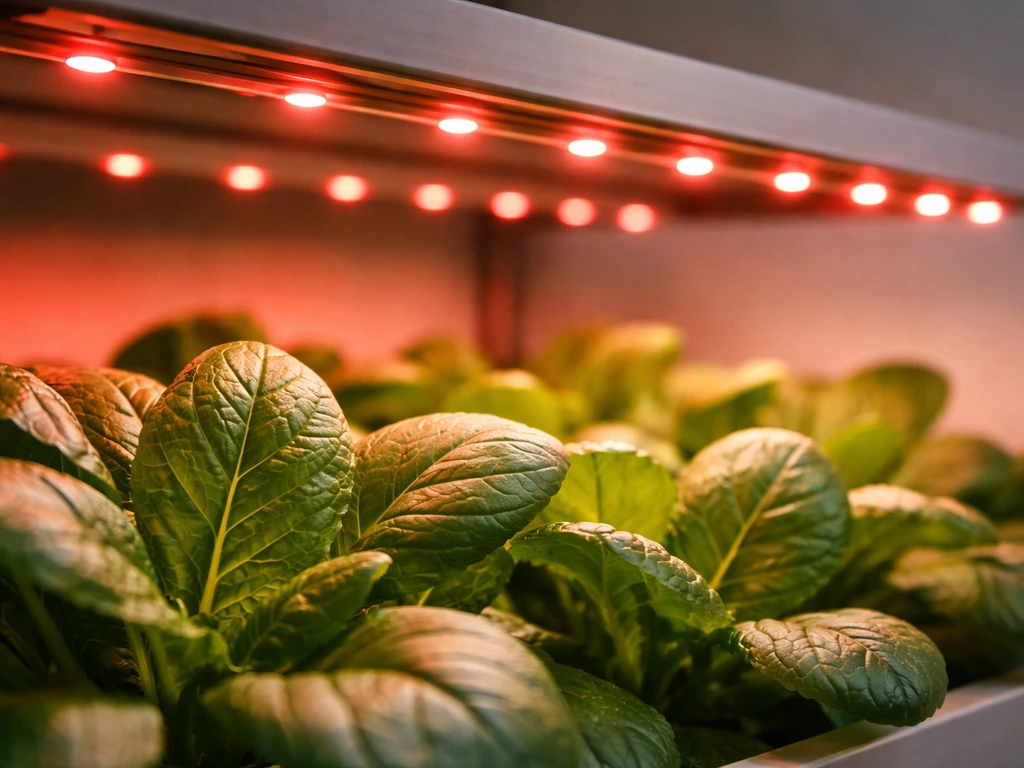
Yes, red light genuinely helps plants grow, and it's one of the most important wavelengths in the entire spectrum for photosynthesis and development. Plants absorb red light around 660 nm more efficiently than almost any other wavelength, which is why red LEDs have become a staple in commercial grow rooms and indoor gardens. That said, red light alone isn't a complete solution. If you're trying to figure out what color light makes plants grow faster overall, the answer is usually red paired with enough blue rather than red alone. It works best when paired with blue light, and understanding why makes all the difference in setting up a light that actually delivers results.
Does Red Light Help Plants Grow? Setup Guide and Why
Marcus Holloway
23 Apr 2026
Why red light matters to plants at a biological level
Plants have evolved a set of light-sensing proteins called phytochromes that act almost like molecular switches. Phytochrome comes in two interconvertible forms: Pr, which absorbs red light peaking around 660 nm, and Pfr, which absorbs far-red light peaking around 730 nm. When red light hits Pr, it converts to the active Pfr form, triggering a cascade of developmental signals. When far-red light hits Pfr, it converts back to Pr, essentially switching those signals off. The balance between these two forms, known as phytochrome photoequilibrium, is what tells the plant how much red light it's receiving and shapes everything from germination timing to flowering.
On top of phytochrome signaling, chlorophyll itself absorbs red light very efficiently. The red absorption peak of chlorophyll a sits right around 660 to 680 nm, which overlaps almost perfectly with the output of most red grow light LEDs. That's not a coincidence. When plant researchers started designing LED grow lights, they targeted those peaks deliberately. More absorbed red photons means more energy captured for photosynthesis, and that directly translates to faster dry matter accumulation and growth.
Which plant processes actually benefit from red light
Photosynthesis and chlorophyll production
Red light is a direct driver of photosynthesis. Chlorophyll absorbs it efficiently, and the energy feeds into the light reactions that produce ATP and NADPH, the fuel for everything else the plant does. Research consistently shows that red light increases chlorophyll content in leaves and boosts overall photosynthetic rate. In lettuce, for example, red-light treatments reliably increase chlorophyll accumulation. More chlorophyll means more capture capacity, which compounds over time into measurably larger, heavier plants.
Stem elongation and plant morphology
Here's where red light gets more nuanced. Through phytochrome signaling, red light tends to promote stem elongation. A high ratio of red to far-red light pushes the phytochrome equilibrium toward the active Pfr state, which in many plant species signals an open, unshaded environment and encourages vertical growth. This is great for crops where height and biomass are the goal, but it can work against you if you want compact, bushy plants. Red-only light, especially without adequate blue, is more likely to produce plants that are stretched and leggy rather than stocky and well-branched.
Flowering and photoperiod control
Red light also plays a critical role in photoperiod sensing. Because phytochromes use red and far-red ratios to track day length, extended red-light exposure at the end of the day can effectively extend the photoperiod for long-day plants. Research on cassava showed that extended red-light exposure significantly increased flowering and branching events by pushing the plant's light perception toward a long-day response. Growers use this strategically, particularly in greenhouse production, to manipulate flowering timing without changing the full light cycle.
What red LED grow lights can and can't do in real setups
A red LED grow light will absolutely drive photosynthesis and support healthy plant growth if the intensity is right. But it has a real limitation: stomatal behavior. Stomata, the tiny pores plants use for gas exchange, are opened primarily by blue light. If you want the best results, choose a grow light that includes red for photosynthesis but also adds blue, since blue supports key processes like stomatal opening blue light. Research shows blue light is roughly 20 times more effective at opening stomata than red light, and the stomatal response to blue saturates at relatively low fluence rates. Under red-only light, stomata tend to stay more closed, which restricts CO2 uptake. Less CO2 getting into the leaf means photosynthesis is limited from the supply side even if the red light is providing plenty of photon energy. This is why red-only setups often underperform compared to red-plus-blue setups, even when total photon flux density looks similar on paper.
Studies on lettuce anatomy add another layer. Red-only treatments have been associated with thinner mesophyll layers in leaves, which reduces the total photosynthetic machinery packed into each leaf. Red plus blue (RB) combinations, by contrast, tend to produce thicker leaves with better photosynthetic electron transport capacity and higher CO2 assimilation rates. So while red LEDs are genuinely useful, treating them as a standalone solution sets you up for results that fall short of what the same fixture can achieve with a bit of blue added in.
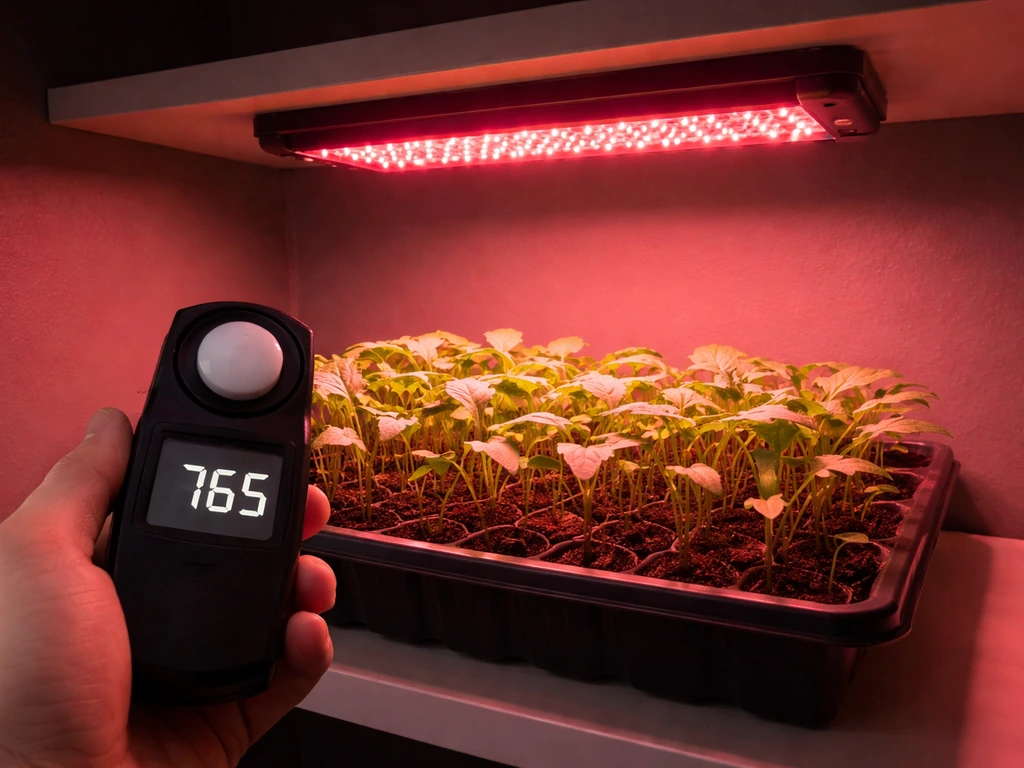
One more practical consideration: not all red LEDs are created equal. Cheap red diodes often don't hit the target wavelength precisely or deliver the rated photon output at the canopy. If you're serious about using red light to drive growth, knowing the actual PPFD (photosynthetic photon flux density) at leaf level, measured in µmol per square meter per second, matters a lot more than the wattage on the box.
How to choose the right red light: spectrum, strength, and fixture
Target wavelength
For photosynthesis, aim for red LEDs that peak around 660 nm. That's the sweet spot for chlorophyll absorption and phytochrome activation. Some fixtures include a far-red channel around 730 nm as well, which can be useful for end-of-day flowering triggers or for the Emerson enhancement effect (where red and far-red together briefly boost photosynthetic efficiency beyond what either achieves alone). If you see a fixture with a red peak at 664 nm and a far-red peak around 733 nm, that's a well-designed spectral combination for most crops.
Intensity: PPFD and daily light integral
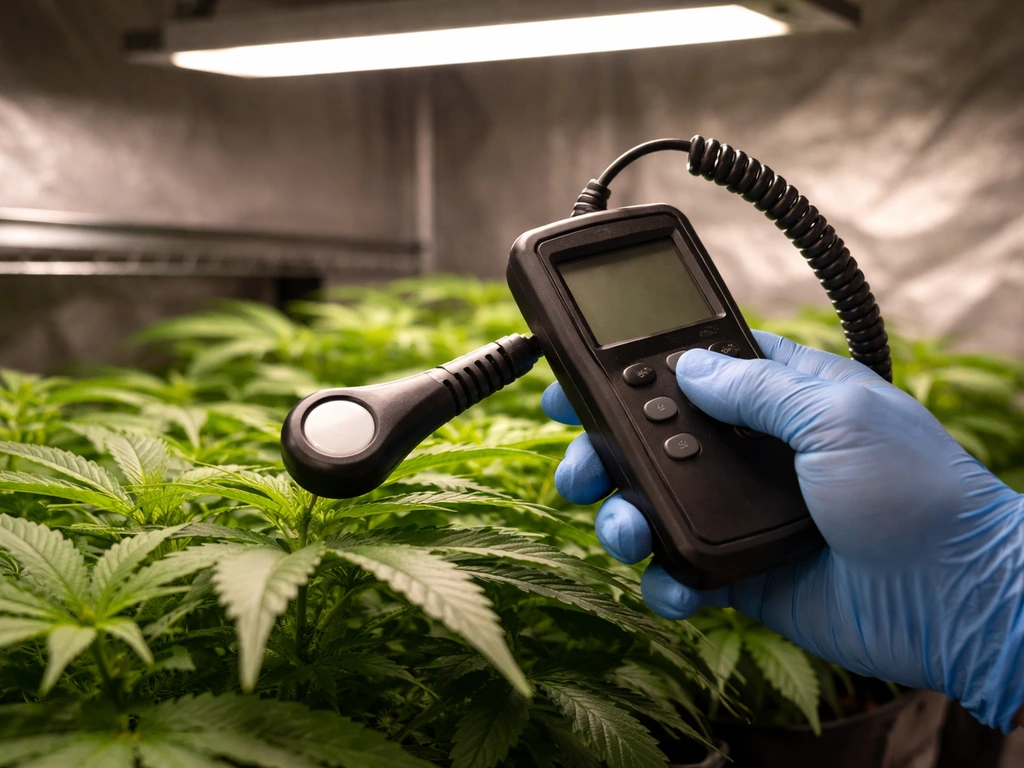
The most useful number for measuring your light setup is the daily light integral (DLI), which is the total amount of photosynthetically active light hitting your plants over a full day, measured in mol per square meter per day. You can calculate it quickly: DLI = 0.0036 × PPFD (µmol/m²/s) × hours of light per day. For example, running 250 µmol/m²/s for 16 hours gives you a DLI of about 14.4 mol/m²/day, which hits the sweet spot for lettuce production.
| Crop | Target DLI (mol/m²/day) | Notes |
|---|---|---|
| Seedlings | 5–10 | Lower end to avoid stress during early development |
| Microgreens | 9–12 | Short cycles, higher intensity works well |
| Lettuce | 12–17 | Well-studied; aim for at least 12 to avoid slow growth |
| Spinach | 14–20 | Higher-light crop; needs strong supplemental lighting |
| Herbs/cuttings | 10–15 | Varies by species; basil appreciates higher DLI |
Fixture type and distance
LED bars and panels both work, but bars tend to distribute light more evenly across a canopy. Distance matters enormously because PPFD follows an inverse square relationship with distance. Most LED grow lights spec their PPFD at a specific distance (often 18 to 24 inches), and moving the fixture even a few inches closer or farther can change the intensity significantly. Start at the manufacturer's recommended distance, take a PPFD reading if you have a quantum meter, and adjust from there. If you don't have a meter, watch the plants: bleached or curled leaves near the tops signal too much intensity; dark green but slow, stretchy growth signals too little.
How to use red light effectively: timing, photoperiod, and mixing spectra
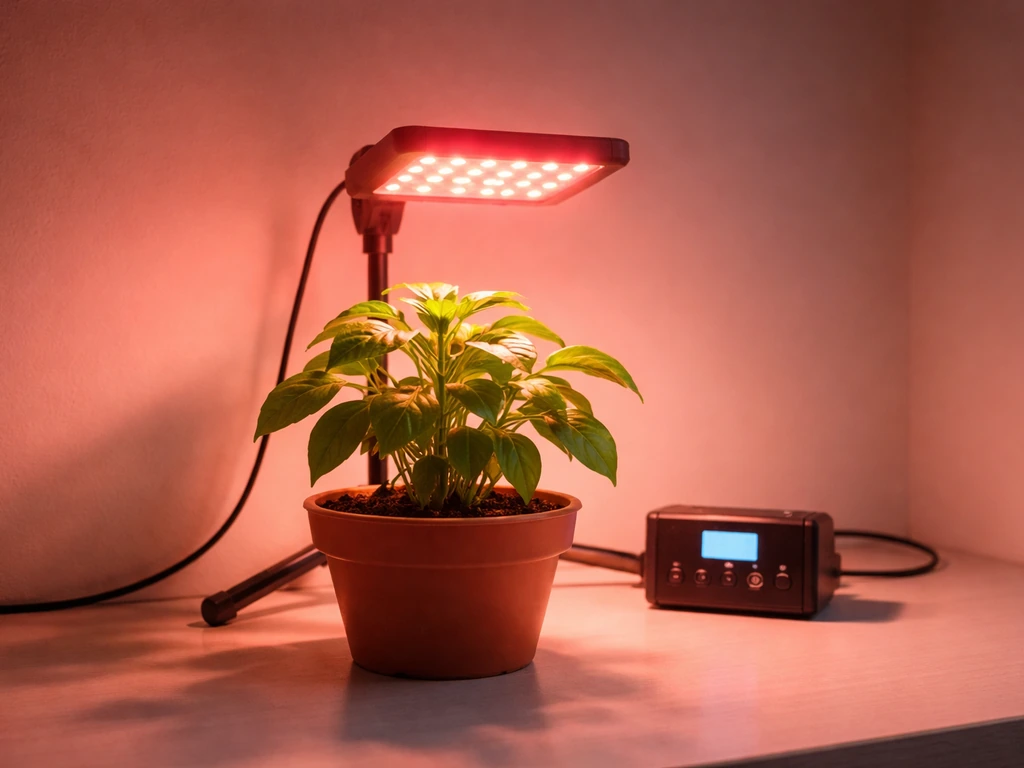
The most effective real-world approach is to use red light as part of a mixed spectrum, not alone. If you're choosing between a red-only LED setup and a red-plus-blue (or full-spectrum) LED setup at similar cost, choose the one with blue in it. Blue light handles stomatal opening, leaf anatomy development, and a whole suite of photomorphogenic responses that red can't replicate. Blue light helps with stomatal opening and compact, healthy growth, so pairing it with red often answers the broader question of does blue light help plants grow. Even a small proportion of blue (10 to 20 percent of total photon output) makes a meaningful difference in how well plants can utilize the red photons they're receiving.
For photoperiod, most vegetative crops grow well on a 16-hour light, 8-hour dark cycle indoors. Fruiting plants like tomatoes and peppers can handle 18 hours. If you're specifically using red light to manipulate flowering in photoperiod-sensitive plants, the classic technique is a brief red-light interruption in the middle of the dark period, which effectively converts a long night into two short nights for long-day plants, delaying flowering in short-day plants and promoting it in long-day ones. Just a few minutes of red light is enough to shift phytochrome equilibrium and change the flowering response.
If you're using a red-heavy LED alongside natural light coming through a window, the window is likely already providing some blue. That combination works reasonably well for low-to-medium light crops like herbs and leafy greens. If you're running a fully artificial setup with no window, you need blue in your fixture. A warm-white LED strip added alongside a red-dominant grow light is a cheap and effective way to fill in that gap.
What results to realistically expect, and how to troubleshoot
If you set up a red LED correctly (right intensity, right spectrum mix, right photoperiod), you should see noticeably faster vegetative growth compared to low-light or no-supplemental-light conditions. Chlorophyll content tends to increase, leaves look deeper green, and stem elongation accelerates. In leafy crops like lettuce, reaching harvest size faster is the most common measurable outcome. In seedlings, germination rate and early establishment improve when DLI is in the 5 to 10 mol/m²/day range.
However, "faster" doesn't mean unlimited. If your plants aren't responding the way you expected, work through this checklist before blaming the light.
- Check your actual PPFD at the canopy, not the wattage of the fixture. Many budget LEDs deliver far less than advertised at leaf level.
- Calculate your DLI. If you're running a light at 100 µmol/m²/s for 12 hours, that's only a DLI of 4.3 mol/m²/day, which is below the threshold for meaningful growth in most crops.
- Look for signs of stomatal limitation: plants that look healthy but grow slowly, especially in warm conditions, may be CO2-limited because red-only light isn't opening stomata efficiently. Add blue light.
- Check watering and nutrients. Light drives photosynthesis, but without adequate nitrogen, phosphorus, and water, the plant can't convert that energy into biomass. Slow growth under good light is often a root-zone problem.
- Check temperature. Most leafy crops grow optimally between 65 and 75°F (18 to 24°C). Temperatures outside that range slow metabolism regardless of light quality.
- Check for stretching and leggy growth. If stems are elongating but leaves are pale and small, you likely have too little intensity or too much red relative to blue. Raise the light a little and add blue if you haven't.
- Check soil or substrate. Poor drainage, compaction, or pH issues limit root function and make any light investment less effective.
One thing worth knowing: the phytochrome Pfr state (activated by red light) undergoes thermal reversion in the dark, gradually converting back to Pr overnight. This means the developmental effects of a single red-light exposure don't persist indefinitely. Consistent daily exposure at the right intensity and duration is what builds cumulative results, not a single dose.
Red light vs other spectra: where it fits in the bigger picture
It's worth putting red light in context alongside the rest of the spectrum. Blue light is the key driver of stomatal opening, compact morphology, and many photomorphogenic traits. Full-spectrum white light covers both and often outperforms narrow-band red-plus-blue in overall light-use efficiency, particularly for crops like lettuce where production studies have shown warm-white LEDs can deliver better yield per watt than red-blue combinations in some setups. In general, does white light help plants grow depends on whether its spectrum includes enough red and blue energy for the key processes like photosynthesis and stomatal opening. Pink light can help plants indirectly by contributing to the overall light spectrum, but it usually works best when combined with enough red and blue for photosynthesis and stomatal opening. Green light, which many growers assume is useless, actually penetrates deeper into the canopy and contributes meaningfully to total photosynthesis. Does green light help plants grow? It can support photosynthesis deeper in the canopy, even if it is not the primary spectrum for growth overall. Purple light, which is simply the visual combination of red and blue diodes, is a common marketing presentation of the red-blue mix rather than a separate spectrum. If you are wondering, does purple light help plants grow, it generally helps because it delivers a balanced mix of red and blue.
Red light is genuinely powerful for driving photosynthesis, and no serious indoor grow setup ignores it. But the practical takeaway is that red light works best as part of a complete spectral strategy, not as a solo solution. If you're building a grow light setup from scratch, a fixture with a strong red peak around 660 nm, meaningful blue coverage, and ideally some far-red capability around 730 nm will outperform a red-only approach consistently and measurably across almost every crop you're likely to grow.
FAQ
If I use red-only LEDs, will my plants still photosynthesize well?
Red light can support photosynthesis, but if your setup lacks enough blue, stomata may not open as effectively. That can limit CO2 intake, so plants may look dark green yet grow slowly or stay stretched. For best results, aim for a mixed spectrum (commonly 10 to 20% of photons in blue) rather than red-only.
How do I know whether red light intensity is enough for growth?
Most plants need a daily light integral (DLI) high enough to sustain growth, not just “a strong red color.” If you run red at a low PPFD or for too few hours, you can still end up with weak growth even if the spectrum is ideal. Use DLI (DLI = 0.0036 × PPFD × hours) to confirm you are in a practical range for your crop.
Does red light have a lasting effect after the lights go off?
Yes. After you turn lights off, the active phytochrome form (Pfr) slowly reverts back toward the inactive form overnight. That means red’s developmental effects are not permanent from one exposure, consistent daily delivery matters more than one long red session.
Are all red LEDs equally effective for plant growth?
Not always. Even with a red wavelength near 660 nm, cheap LEDs may miss the target peak or deliver less usable photon output at the leaf due to binning and driver differences. Rely on measured PPFD at canopy level (ideally with a quantum meter) rather than trusting box wattage alone.
Will far-red light change how my red light affects plant height?
Yes, red-to-far-red ratio can influence growth form. If your fixture includes far-red, or if you add far-red unintentionally, the plant may shift phytochrome signaling in a way that changes height and branching. If your goal is compact plants, keep far-red modest and make sure blue is present.
Should I use the same red spectrum for seedlings and for flowering crops?
It depends on your crop stage and goal. Seedlings often benefit from higher blue to keep them compact and support stomatal function, while some fruiting or flowering strategies use red and far-red ratios to steer development. If you are trying to maximize flowering or branching, extended red exposure near the end of the day can act like a photoperiod modifier, but it should be done intentionally rather than continuously.
Why are my plants not responding to red light even though the wavelength is correct?
Red light usually cannot fix a heat or ventilation problem. If the canopy is too hot or humidity is too high, stomata may remain constrained regardless of spectrum, leading to slow growth or stress. Confirm temperature and airflow first, then tune the spectrum.
Can red light fail to improve growth if CO2 or ventilation is limited?
Because the plant must be able to use the added photons for gas exchange and carbon fixation. If CO2 is low, stomata are less effective, or the environment is limiting, red may drive photosynthetic reactions but the supply side (CO2) still restricts overall assimilation. In such cases you can see minimal growth despite “good” red output.
Do I still need blue if my plants get some sunlight from a window?
If you have natural light from a window, you are likely already getting some blue, which can make a red-heavy setup perform better than red-only indoors. A window plus red can be sufficient for some herbs and leafy greens, but for fully artificial setups without window light, adding blue in the fixture is usually necessary.
How should I set the photoperiod when using red grow lights?
For most indoor vegetative cycles, a common starting point is about 16 hours on and 8 hours off, then adjust for the crop. For photoperiod-sensitive species, growers sometimes use a brief red interruption in the middle of the dark period to alter flowering timing. If you do this, keep the interruption short and consistent, because small timing differences can change outcomes.
Next Articles
What Color Light Helps Plants Grow Best (LED Guide)
Learn which light colors boost plant growth fastest using LEDs, plus science on red, blue, far-red and setup tips.
What Helps Flowers Grow: Light, Water, Soil, Fertilizer Tips
Boost flower growth with the right light, watering, drainage soil, fertilizer timing, and quick fixes for yellow leaves
How Do Bees Help Plants Grow and Increase Yields
Learn how bees pollinate flowers and crops, boosting fruit set, yields, and plant survival, plus how to support them.