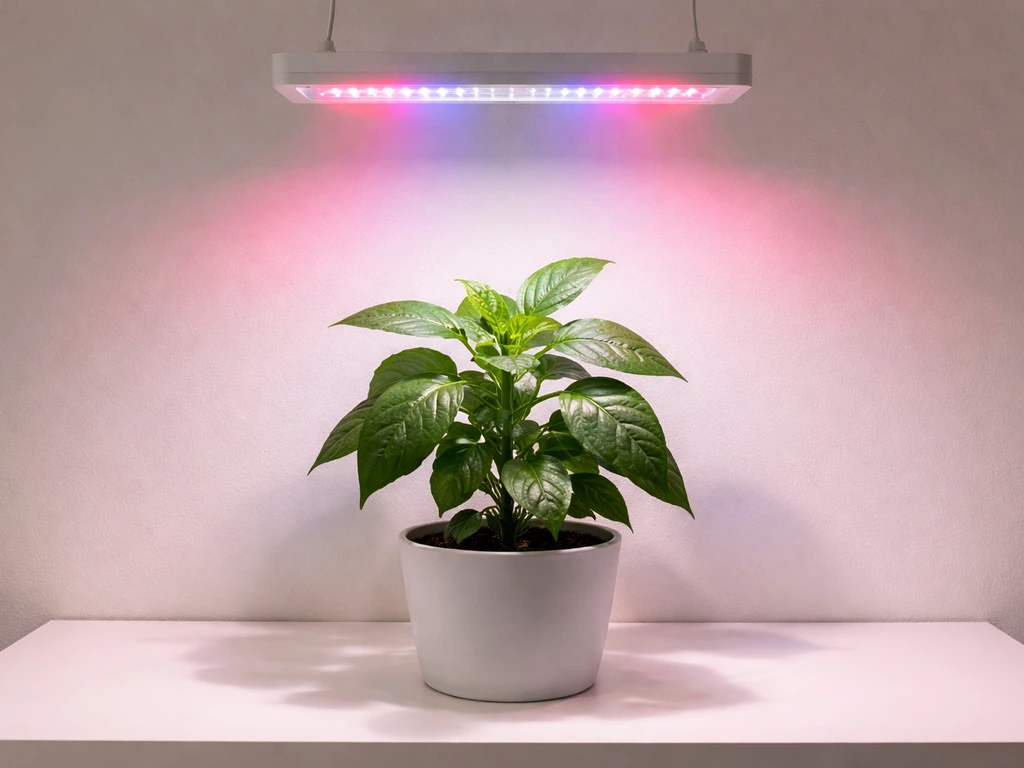
The short answer: plants grow best under red and blue light, ideally delivered by a full-spectrum LED grow light positioned at the right distance and run for 12 to 16 hours a day. But there's a lot packed into that sentence, and getting the details right is exactly what separates thriving plants from sad, leggy ones. Let me break it all down in plain terms so you can act on it today.
What Light Helps Plants Grow: Natural and Grow Light Guide
Marcus Holloway
21 Apr 2026
How light actually helps plants grow
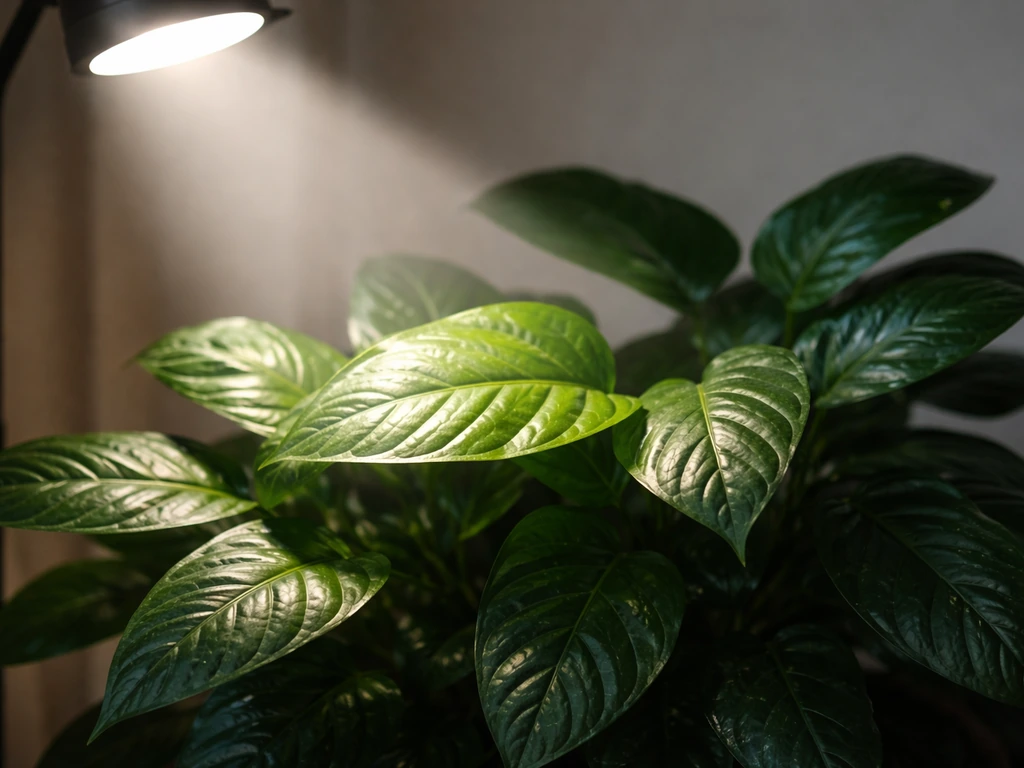
Light does two very different jobs for a plant, and understanding both changes how you think about lighting your setup. The first job is photosynthesis: the plant uses light energy to convert carbon dioxide and water into sugars that fuel growth. The second job is signaling: light tells the plant what to do with its body. These are distinct processes driven by different molecules.
Photosynthesis runs on chlorophyll, and chlorophyll has very specific tastes. Chlorophyll a absorbs most strongly at around 430 nm (blue-violet) and 662 nm (red). Chlorophyll b peaks at around 453 nm (blue) and 642 nm (red-orange). Everything in between, including the green wavelengths that plants reflect back at us (which is why they look green), is absorbed far less efficiently. This is why a random warm-white desk lamp, no matter how bright it looks to your eyes, is mostly delivering light that plants can't use well.
The signaling side involves photoreceptors called phytochromes and cryptochromes. Phytochromes toggle between two states depending on red and far-red light (roughly 600 to 750 nm), and that toggle controls things like seed germination, flowering time, and whether a plant stretches toward light or stays compact. Cryptochromes respond to blue and UV-A light (around 320 to 500 nm) and regulate leaf expansion, stomata behavior, and stem elongation. Give a plant too little blue and it stretches out tall and weak, reaching for light that isn't there. These aren't minor details: they're the difference between a stocky, productive plant and a spindly mess.
Does artificial light actually help?
Yes, absolutely, but with a big qualifier: not all artificial light is useful light. The critical concept here is PAR (photosynthetically active radiation), which is the slice of the light spectrum between 400 and 700 nm that plants can use for photosynthesis. A lamp that looks bright to you might deliver almost no PAR. Your eyes are tuned to green and yellow light; plants prioritize red and blue. A standard incandescent bulb, a typical office fluorescent, or a warm LED reading lamp delivers a spectrum that's either heavy in the wrong wavelengths or so low in total photon output that it barely moves the needle for a plant.
That said, a properly spec'd grow light, or even a cool-white T5 fluorescent placed close enough, absolutely helps plants grow. Controlled indoor growing is a proven, practical reality. Seedling trays, herb gardens, and houseplant collections all thrive under artificial light when the spectrum and intensity are right. The myth to bust here is not that artificial light helps, it's that any light helps. It doesn't. Intensity and spectrum both have to be in the right range, and that requires more than plugging in whatever lamp you have lying around.
What type of light helps plants most: the spectrum breakdown
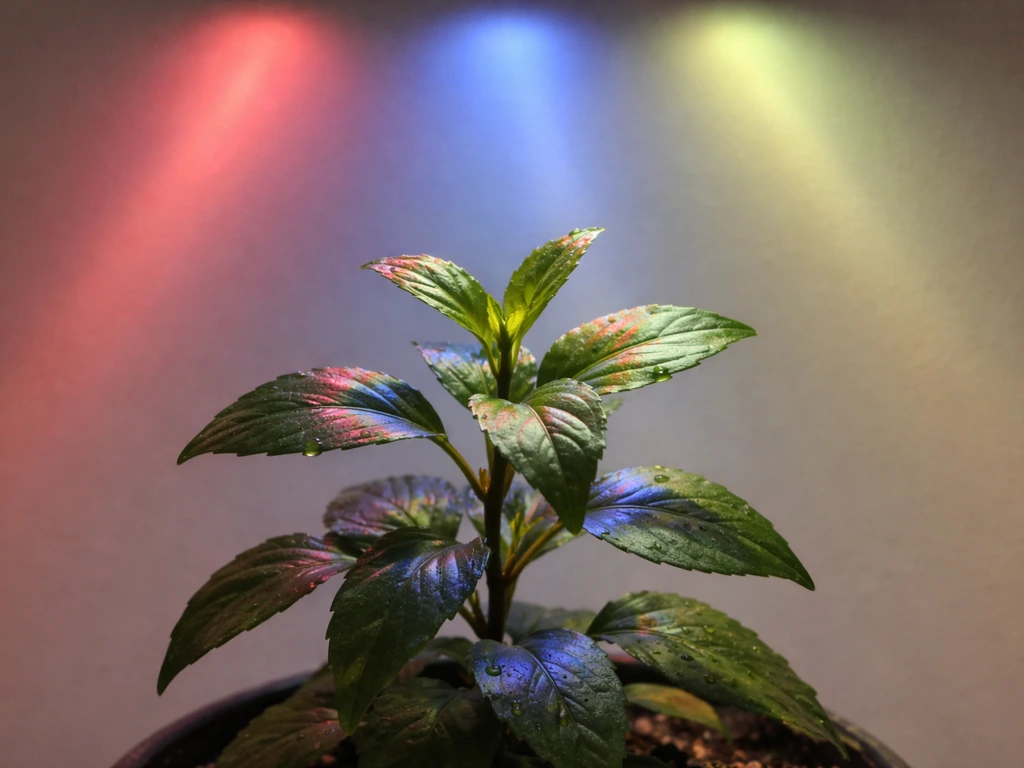
Red light (around 660 nm) is the single most efficient wavelength for driving photosynthesis, and it also controls the phytochrome response that regulates flowering and germination. Blue light (around 430 to 450 nm) is the second most important, driving photosynthesis efficiently and activating cryptochromes that keep plants compact and healthy-looking. Far-red (700 to 750 nm) is less talked about but matters too: it works with phytochromes to influence flowering timing and can actually accelerate photosynthesis when paired with red and blue (called the Emerson enhancement effect). Far-red wavelengths (700 to 750 nm) can interact with phytochromes and, when paired with red and blue light, may produce an blank" rel="noopener noreferrer">Emerson enhancement effect, with larger photosynthesis effects reported for specific far-red ranges tested by DLC.
Green light (around 500 to 600 nm) is often dismissed as useless because chlorophyll reflects most of it. But research shows green light does penetrate deeper into a leaf canopy than red or blue, meaning it helps lower leaves photosynthesize. For practical purposes, this means a broad-spectrum or "white" LED that includes some green is actually a good thing for most plants, not a waste.
The takeaway on spectrum: you want a light that delivers meaningful output in both the red (640 to 680 nm) and blue (430 to 460 nm) ranges. A light that's all red or all blue is less effective than one that combines both. Full-spectrum LEDs that mimic daylight while weighting red and blue are the sweet spot for most growers today.
Which grow lights actually work: LEDs, fluorescents, and HID
There are three main categories of artificial grow light, and they differ meaningfully in efficiency, spectrum quality, heat output, and cost. Here's the honest comparison:
| Light Type | Spectrum Quality | Energy Efficiency (approx.) | Heat Output | Best For |
|---|---|---|---|---|
| Full-spectrum LED | Excellent (tunable red/blue/white) | ~2.5–3.0 µmol/J (best-in-class up to ~4.8 µmol/J for red LEDs) | Low | Seedlings, herbs, houseplants, any indoor grow |
| T5/T8 Fluorescent | Good (cool-white or grow-spec) | ~1.0–1.5 µmol/J | Low-moderate | Seedlings, low-light houseplants, small herb trays |
| HID (HPS/MH) | Good but spectrum varies by bulb type | ~1.7–2.1 µmol/J (double-ended HPS) | High | Larger grows, fruiting plants, where budget matters more than efficiency |
| Standard incandescent/warm LED | Poor (wrong spectrum, low PAR) | Very low for plant use | High (incandescent) | Not recommended for plants |
LED grow lights are the practical recommendation for almost everyone reading this today. They run cool, last tens of thousands of hours, and modern full-spectrum LEDs deliver more usable photons per watt than any other option. A double-ended HPS fixture runs around 1.7 µmol/J of photon efficacy; a quality LED can hit 2.5 µmol/J or higher, with specialized red LED chips reaching up to 4.8 µmol/J. That difference adds up on your electricity bill fast. T5 fluorescents are still a solid, affordable choice for seedlings and low-light plants, especially if you already have them. HID lights (high-pressure sodium and metal halide) are more common in larger grows or commercial greenhouses and produce great results, but the heat management requirements and running costs make them less practical at home scale in 2026.
One important distinction: a "grow light" label on a product means almost nothing by itself. There are grow lights sold at hardware stores that deliver barely more usable PAR than a regular bulb. Always look for lights that specify PPFD output at a given distance, or at minimum list their wattage and spectrum coverage. A reputable LED grow light will be transparent about these numbers.
How much light your plants actually need
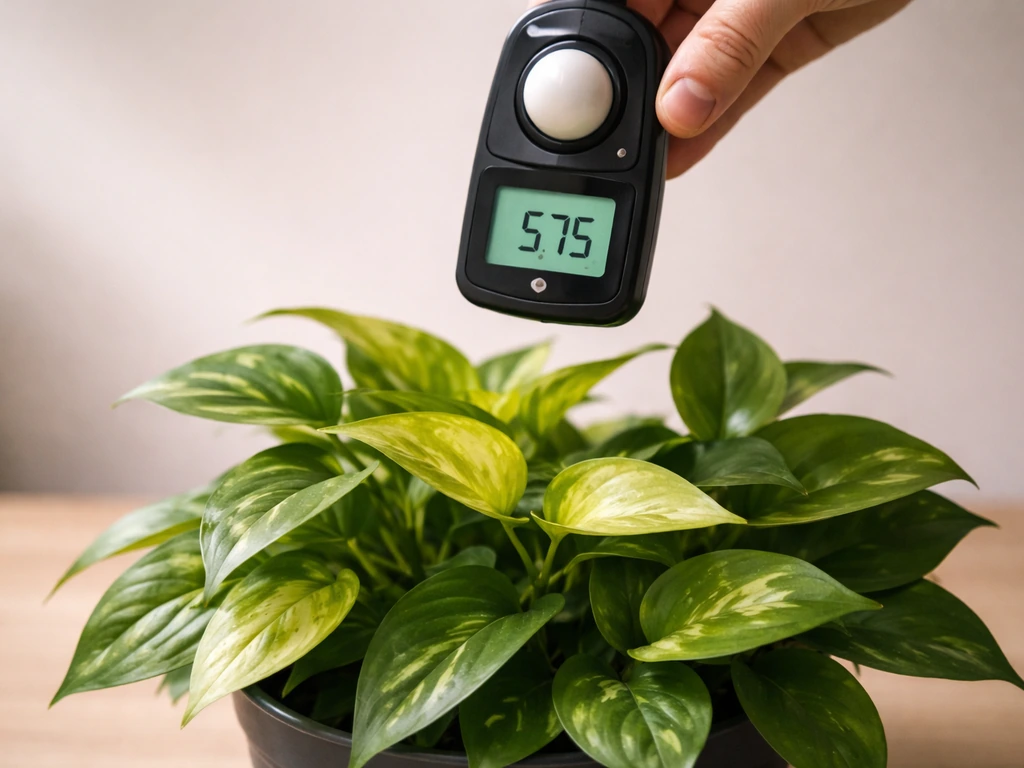
Light quantity for plants is measured in PPFD (photosynthetic photon flux density), expressed in micromoles of photons per square meter per second (µmol/m²/s). It sounds technical but think of it like water pressure: it's how many useful photons are hitting a square meter of leaf surface every second. The cumulative daily dose is called DLI (daily light integral), measured in mol/m²/day, and you calculate it like this: DLI = 0.0036 × PPFD × hours of light per day.
For practical reference, here are working PPFD targets that give you a real starting point:
| Plant Stage / Type | Target PPFD (µmol/m²/s) | Approx. Lux Equivalent | Daily Hours |
|---|---|---|---|
| Seedlings (cotyledon/first true leaves) | 200–300 | ~10,800–16,200 lux | 14–16 hrs |
| Seedlings (transplant-ready) | 400–500 | ~21,600–27,000 lux | 14–16 hrs |
| Herbs and leafy greens (vegetative) | 200–400 | ~10,800–21,600 lux | 12–16 hrs |
| Low-light houseplants | 50–150 | ~2,700–8,100 lux | 10–12 hrs |
| Fruiting/flowering plants | 400–1,200 | ~21,600–64,800 lux | 12–14 hrs |
| Office ambient (for reference) | 6–10 | ~324–540 lux | N/A for plant use |
The office ambient row is there to make a point: standard room lighting delivers less than 10 µmol/m²/s in most cases, which is far below even the minimum threshold for most plants. Turning on the room light is not supplementing your plant. It's doing almost nothing. You need a dedicated light source aimed at the plant.
Distance matters enormously. blank" rel="noopener noreferrer">Light intensity follows the inverse square law, meaning if you double the distance between the light and the plant, you get roughly one-quarter the intensity. A grow light that delivers 400 µmol/m²/s at 12 inches might only deliver 100 µmol/m²/s at 24 inches. Always check the manufacturer's PPFD chart for your specific fixture, and start at the recommended hanging height, then adjust based on how the plant responds.
Setting up light for different plants and common situations
Starting seeds and growing seedlings
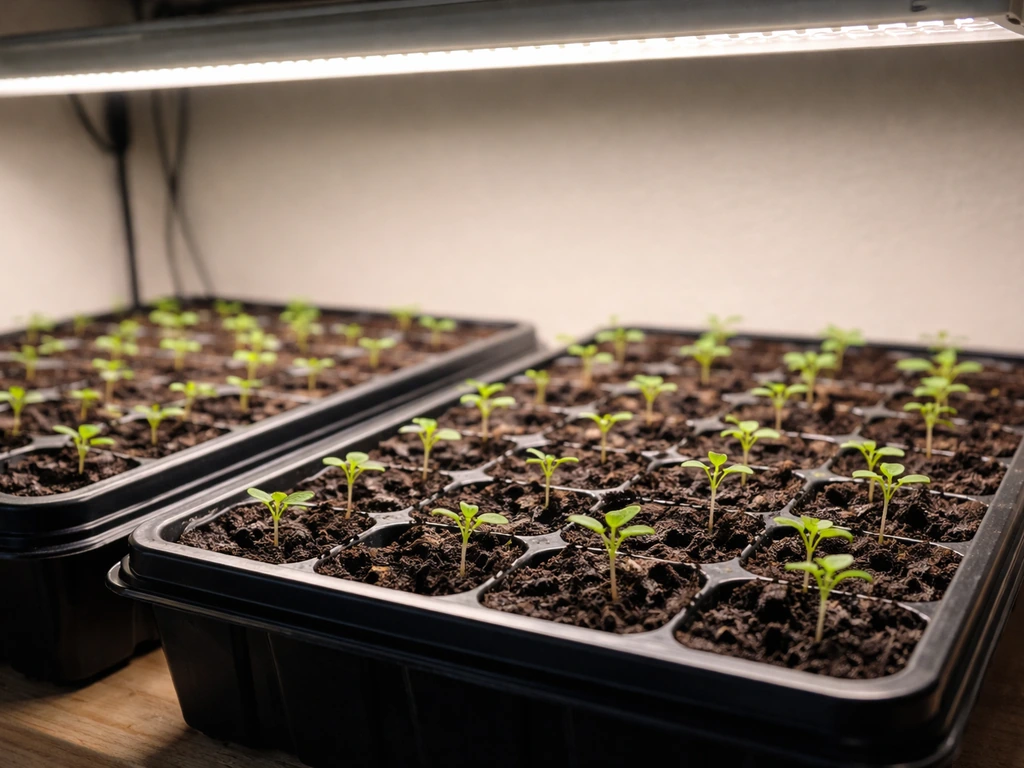
Seedlings are both the most light-hungry and the most light-sensitive stage. They need enough intensity to develop properly but can't handle the same PPFD as a mature plant. Start at 200 to 300 µmol/m²/s for the first week or two (cotyledons and first true leaves), then ramp up to 400 to 500 µmol/m²/s as the plants prepare for transplant. Run lights for 14 to 16 hours a day with a full dark period. The most common mistake with seedlings is placing the light too far away. Leggy, stretched seedlings are almost always a light intensity problem, not a genetics problem. A T5 or LED strip positioned 2 to 4 inches above the seedling tray is a practical starting point for fluorescents; full-spectrum LED panels will have their own recommended distances.
Houseplants under artificial light
Most popular houseplants (pothos, snake plants, peace lilies) are adapted to lower light and do fine at 50 to 150 µmol/m²/s. A decent full-spectrum LED positioned 12 to 18 inches above the plant, running 10 to 12 hours a day, will keep them healthy and growing in a room with little to no natural light. For light-hungry houseplants like succulents, fiddle-leaf figs, or most flowering plants, push toward 200 to 400 µmol/m²/s and increase the photoperiod to 12 to 14 hours. The common mistake here is running lights 24 hours a day thinking more is better. Plants need a dark period for certain metabolic processes. Give them real night time.
Herbs on a windowsill or under grow lights
Herbs like basil, cilantro, and parsley want 200 to 400 µmol/m²/s and at least 12 to 14 hours of it. A south-facing window in summer can get you there on sunny days, but a north-facing window almost certainly cannot. A small LED grow light strip or panel placed 6 to 12 inches above an herb tray is one of the most practical, immediate upgrades you can make. Basil especially will tell you quickly if it's not getting enough light: leaves turn pale, growth slows, and the plant gets tall and weak instead of bushy and productive. Supplement window light with even a modest grow light in winter and you'll notice a dramatic difference within a week.
The most common setup mistakes to avoid
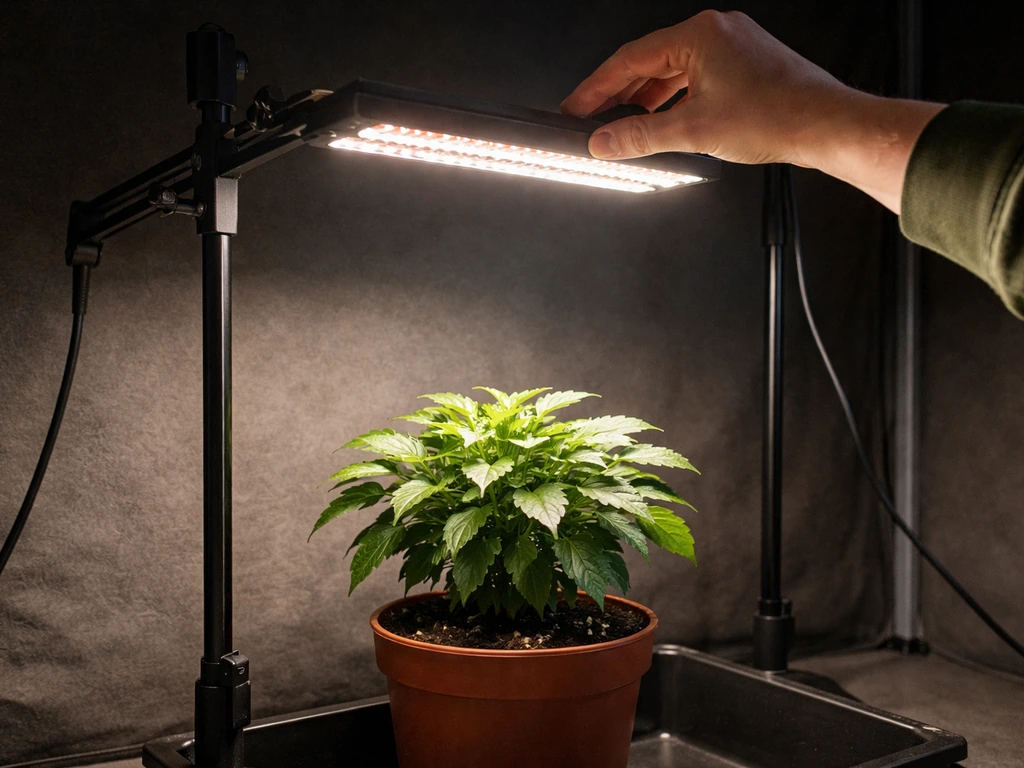
- Light placed too far away: halving the PPFD at every doubling of distance is a physics rule, not a suggestion. Get the light close enough to actually matter.
- Using a regular warm-white bulb as a grow light: the spectrum is wrong and the PAR output is too low. It will not help your plants meaningfully.
- Running lights 24 hours a day: plants need darkness. 16 hours on, 8 hours off is a safe maximum for most species.
- Ignoring reflective surfaces: white walls or reflective mylar behind a light setup can increase effective PPFD reaching the plant by 10 to 30 percent without spending anything.
- Not adjusting as plants grow: raise or lower lights as the plant canopy changes. A fixed height that worked for a seedling may be wrong for a mature plant.
What about sunlight and other light sources?
Natural sunlight remains the gold standard. It delivers the full PAR spectrum at high intensity (direct summer sun can hit 1,500 to 2,000 µmol/m²/s at plant level), it's free, and it includes far-red wavelengths that fine-tune plant behavior in ways that even good grow lights only approximate. If you have a south-facing window with unobstructed sunlight, use it. Supplement with artificial light only when natural light falls short, which for most indoor situations in winter is most of the time. Questions about how sunlight specifically compares to artificial light, or about narrower parts of the spectrum like UV light, are worth digging into separately since UV and far-red each have distinct effects on plant physiology that go beyond basic growth. UV light can affect plant growth through specific signaling effects, so the results depend on the wavelength and dose. Similarly, light sources like moonlight deliver almost no usable PAR and won't affect plant growth in any measurable way, despite the folklore around them.
Your practical next steps
If you're starting from scratch today, here's the simplest path forward. For seedlings or herbs, get a T5 or full-spectrum LED strip, position it 4 to 6 inches above the plants, run it 14 to 16 hours a day, and watch the difference within two weeks. For houseplants in a low-light room, a small LED grow light on a timer set to 12 hours will make a noticeable difference in growth rate and leaf color within a month. For anything fruiting or flowering, invest in a quality LED panel that publishes its PPFD output and hang it at the recommended height. The science is clear: red and blue light, delivered at the right intensity, for the right number of hours, is what helps plants grow. Lightning can provide useful light for photosynthesis only if the intensity and spectrum are in the right range for your plants lightning help plants grow. Everything else is just dialing in the details.
FAQ
How can I tell if a light’s actually strong enough for my plants, not just bright-looking?
Look beyond the marketing name and check the fixture’s PPFD map or PPFD at a stated distance. If a product only lists “watts” or vague phrases like full spectrum, you cannot reliably estimate how many usable photons reach your leaves, and the light may be far too weak even if it looks bright.
Will regular sunlight from a window be enough, or do I need a grow light?
Daytime brightness alone does not guarantee enough PPFD. A window can be strong in summer but drop sharply in winter or when clouds or curtains reduce intensity. The practical move is to measure your plant’s height and observe for leggy growth or pale leaves, then supplement with a dedicated grow light when natural intensity is clearly falling below your plant’s needs.
What’s the safest way to set a grow light schedule, and can I leave it on too long?
Use a timer, then avoid cutting the light cycle into irregular chunks. Most plants do best with a consistent photoperiod and a real dark period, then you adjust intensity or duration gradually. If you change both distance and hours at once, it becomes hard to know what caused improvements or problems.
How do I troubleshoot if my plant is getting the wrong amount of light?
If you cannot check PPFD, you can use plant response as a guide. Stretched, leaning growth and large gaps between nodes usually mean intensity is too low (or the light is too far). Very dark, clawed, or scorched-looking leaves (sometimes with bleaching) usually mean intensity is too high or the light is too close.
Do I really need a red and blue grow light, or will normal “full spectrum” white light work?
Yes, some “all-purpose” broad-spectrum white LEDs can work because many include meaningful red and blue. The key is weighting, not color. If the spectrum is heavy in green/yellow with weak red and blue, you may see slower growth even though the room looks bright.
How do I know when I’ve reached “too much” light, even if the plant looks green?
In general, stronger photoperiod plus stronger intensity is not always better. After a point, plants can reach a light saturation level where extra photons do not increase growth and can increase stress. Use DLI targets as a decision aid, especially for flowering or fruiting plants, rather than simply maximizing hours.
Should I add UV or far-red to make my plants grow faster?
Treat UV-A and far-red as specialty signals, not baseline nutrition. UV effects depend heavily on wavelength and dose, and too much UV exposure can cause leaf damage or stress. Far-red can influence flowering behavior and morphology, but adding it without knowing your plant’s stage and the rest of the spectrum can give unpredictable results.
What maintenance mistakes reduce how well my grow light works?
Clean the light and reflectors. Dust on LED panels, dirty T5 tubes, and dull reflector surfaces reduce the photons that reach the plants. Also check that the fixture stays at the recommended hanging height, since cords stretch and mounts settle over time.
Why did my cheap grow light help less than expected?
A “grow light” label is not a performance guarantee. Many inexpensive lamps provide low PPFD or limited useful spectrum, so the same plant under a true PPFD-specified LED can outperform it dramatically. Prefer products that publish PPFD values or PPFD at distance, and compare those numbers across options.
What should I do differently for seedlings versus mature plants when choosing intensity and distance?
For leafy herbs and most houseplants, a timer-controlled schedule is usually enough, and you can fine-tune once you see growth. For seedlings, use a conservative intensity start and ramp up, because young plants are more light-sensitive. If you jump to a high PPFD immediately, leggy or damaged growth can occur even with the right colors.
Next Articles
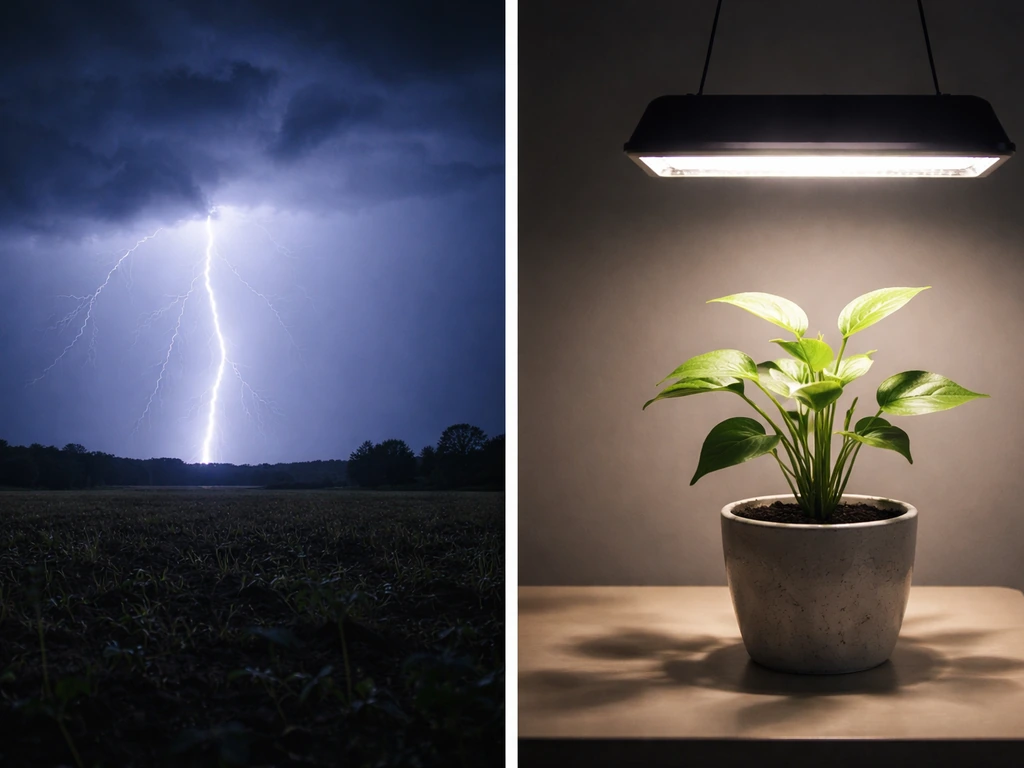
Does Lightning Help Plants Grow? Real Answer and Fixes
Lightning rarely helps plants; real growth needs proper light intensity, spectrum, and photoperiod, plus nutrients.
How Does Sunlight Help Plants Grow Step by Step
Step-by-step biology of sunlight for photosynthesis, growth, and flowering plus practical sun and light setup tips.
How Do Microorganisms Help Plants Grow: Practical Guide
Learn how microbes in the rhizosphere fix nitrogen, boost phosphorus, aid roots, suppress disease, and how to grow them.