Yes, potassium genuinely helps plants grow, but with a critical caveat: it only makes a visible difference when your plants actually need it. Potassium is one of the three primary macronutrients (the "K" in NPK), and it drives some of the most fundamental processes in plant biology, including stomatal control, enzyme activation, water balance, and the movement of sugars through the plant.
Does Potassium Help Plants Grow? How to Tell and Apply It
Marcus Holloway
7 May 2026
When a plant is potassium-deficient, you'll see it in the leaves, the fruit quality, and the plant's ability to handle stress. But if your soil already has adequate potassium, adding more won't turbocharge growth. That's the honest answer, and the rest of this guide will help you figure out which situation you're actually in.
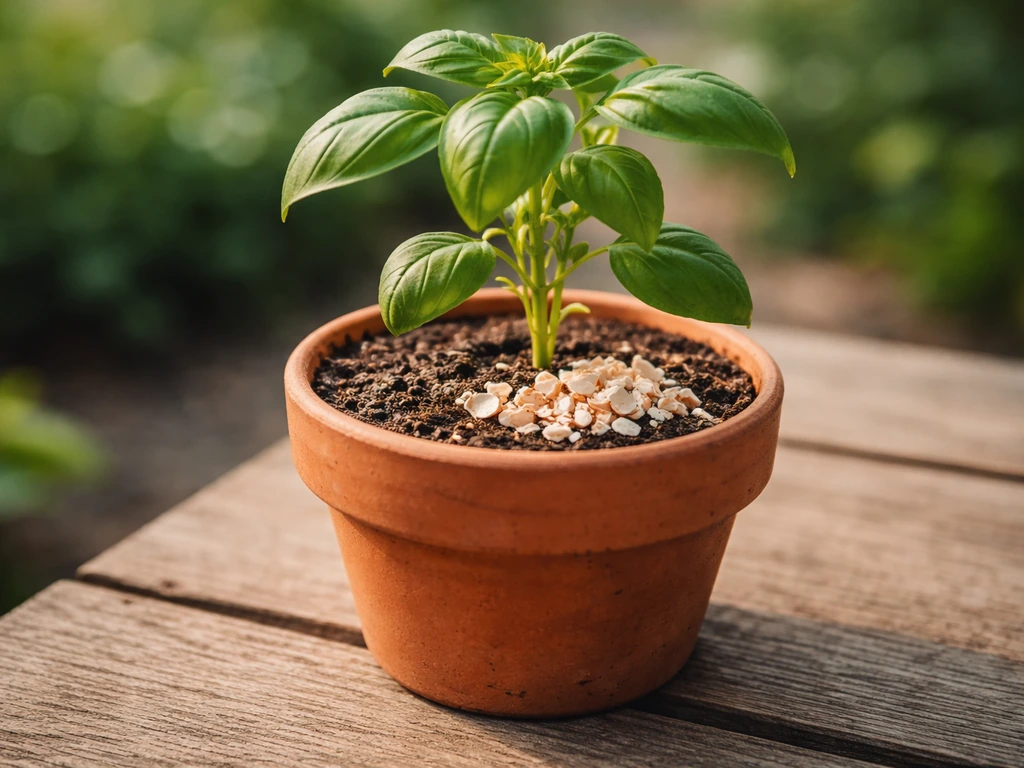
You might also wonder about eggshells or egg-based fertilizers, but eggs usually do not directly help plants grow the way properly balanced nutrients do do eggs help plants grow.
What potassium actually does inside a plant
Potassium doesn't build plant tissue the way nitrogen does, and it doesn't support root and flower development the way phosphorus does. Instead, it works more like a systems regulator, keeping multiple critical processes running smoothly at the same time.
The most important job potassium does is control the stomata, the tiny pores on leaf surfaces that open to take in carbon dioxide and close to conserve water. Guard cells flanking each pore rely on potassium ions to regulate their turgor pressure, which determines whether the stomata open or close. When potassium is short, this regulation breaks down, and plants lose water inefficiently while also struggling to absorb enough CO2 for photosynthesis. That's a compounding problem.
Beyond stomatal control, potassium is involved in activating more than 60 enzymes that affect protein synthesis, starch formation, and ATP energy production. It also drives phloem loading, which is the process of moving sugars produced in leaves down to roots, fruits, and developing seeds. If you've ever grown tomatoes with poor fruit fill or potatoes with unusually small tubers despite healthy-looking vines, potassium transport is worth investigating. The nutrient also plays a central role in osmotic regulation and turgor maintenance throughout the plant, which directly connects to drought tolerance and stress resistance.
How potassium affects growth and where you'll actually notice it
Because potassium is so involved in water regulation and energy transport, its effects show up most clearly under stress conditions. A plant with good potassium levels handles drought, heat, and disease pressure noticeably better than one running low. You'll see this less as dramatic explosive growth and more as sustained, sturdy performance when conditions aren't ideal. If you want the bigger picture of how do minerals help plants grow, potassium is just one piece of the nutrient system that supports healthy leaves, strong stems, and reliable photosynthesis.
In the vegetative stage, adequate potassium keeps leaves full-sized and stems strong. When potassium is limiting, leaf blades stay small, stems become weak and prone to lodging (falling over), and overall growth slows. In the flowering and fruiting stage, the impact is even more noticeable. Potassium is critical for the sugar transport that fills fruits and seeds, so deficiency during this stage tends to produce small, poorly developed fruit even when the plant looks otherwise okay from a distance.
Where potassium really separates itself from other nutrients is in plant resilience. Crops and garden plants with sufficient potassium tolerate dry spells better because their stomata operate efficiently and their cells maintain proper turgor. They also tend to have stronger cell walls and better resistance to fungal infections. If your plants consistently struggle through summer heat or wilt faster than your neighbors', low potassium could be one factor, though it's rarely the only one.
Potassium deficiency: what it looks like and how to be sure
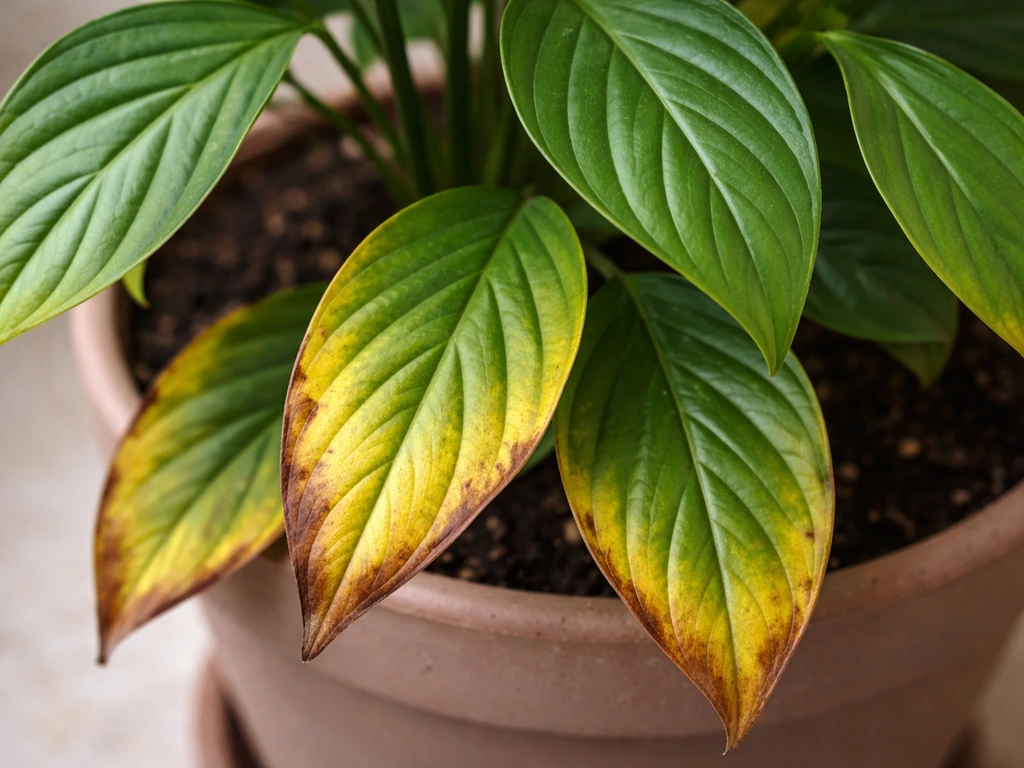
The classic potassium deficiency pattern starts on the older, lower leaves first. This is because potassium is mobile in the plant, so when there's not enough to go around, the plant pulls it from older tissue and redirects it to new growth. Here's what that typically looks like:
- Yellowing (chlorosis) starting at the leaf tips and margins of older, lower leaves
- Browning, scorching, or necrosis along the leaf edges that progresses inward
- Mottled or blotchy coloration on older leaves rather than uniform yellowing
- Weak, thin stems that bend or lodge easily
- Small leaf blades relative to what the plant should be producing
- Poor fruit size or fill, even with otherwise decent-looking foliage
- Slower overall growth that doesn't respond to watering
Corn shows necrosis along leaf margins. Potato leaves develop marginal scorch on older leaflets. Utah State University Extension notes that potato leaves can show blank" rel="noopener noreferrer">marginal scorch when potassium is deficient, which helps match visual diagnosis patterns. Tomatoes and peppers produce undersized fruits with uneven ripening. The pattern is consistent: older tissue first, margins and tips before the center of the leaf.
How to tell potassium deficiency apart from other problems
Here's where gardeners most often go wrong. Yellowing leaves and leaf scorch have many causes, and jumping straight to "I need more potassium" is a common and costly mistake. Before concluding it's a potassium problem, work through these alternatives:
| Symptom | Possible Cause | Key Distinguishing Feature |
|---|---|---|
| Yellowing on older leaves, margins first | Potassium deficiency | Mobile nutrient; starts at tips/margins of lowest leaves |
| Yellowing on older leaves, interveinal | Magnesium deficiency | Yellow between veins, veins stay green, older leaves first |
| Yellowing on new growth at the top | Iron or calcium deficiency | Immobile nutrients; newest leaves affected first |
| Uniform pale yellowing across whole plant | Nitrogen deficiency | Affects whole plant; older leaves turn yellow-green evenly |
| Leaf scorch with no yellowing pattern | Root damage, poor drainage, or salt injury | Evenly distributed burn; check roots and soil drainage |
| Chlorosis with compacted or waterlogged soil | Root stress, not nutrient deficiency | Symptoms don't match leaf-age pattern; check soil structure |
Root damage, poor drainage, soil compaction, and nematodes can all produce chlorosis and marginal scorch that looks almost identical to potassium deficiency. If your soil drains poorly or you've recently over-fertilized, fix those problems before buying a bag of potash. Similarly, when multiple stresses are happening at once (drought plus disease plus low nutrients, for example), the textbook deficiency symptom patterns often don't show up cleanly. Don't assume a single nutrient is the culprit just because you can find a leaf that sort of matches a photo online.
It's also worth knowing that sodium or road salt exposure can cause marginal leaf scorch that looks like potassium deficiency because those ions compete with potassium for uptake. If your garden is near a road or driveway that gets de-iced in winter, that's worth ruling out.
How to add potassium safely: sources, timing, and method
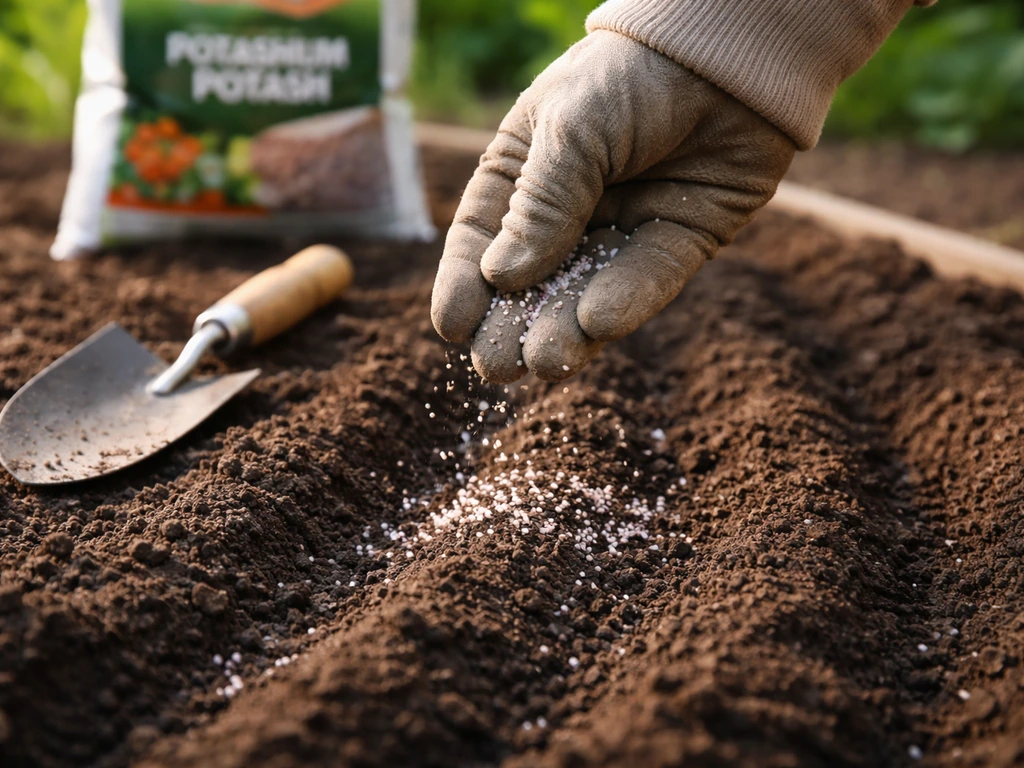
Once you've confirmed (ideally with a soil test, covered next) that your plants genuinely need more potassium, you have several straightforward options. The most widely used is muriate of potash, which is potassium chloride (KCl) sold under the label 0-0-60, meaning it's 60% potassium oxide (K2O). Potassium sulfate (0-0-50 or 0-0-52) is another common option and is preferred when chloride sensitivity is a concern, as with some crops and in soils already high in chloride.
For home gardeners, balanced fertilizers labeled for tomatoes, vegetables, or fruiting plants often already contain meaningful potassium, so check your current fertilizer's NPK label before adding a separate potassium source. Adding potassium on top of a complete fertilizer can lead to imbalances you didn't intend.
Timing and application method
For most vegetable gardens, potassium is best applied and incorporated into the soil before planting. Extension recommendations consistently point to pre-plant incorporation as the standard approach for phosphorus and potassium, with roughly 30 to 40 percent of nitrogen held back for side-dressing after establishment. This matters because potassium is relatively immobile in soil. Unlike nitrogen, it doesn't travel downward through the profile easily, so potassium sitting on the soil surface after planting doesn't reach roots as effectively as incorporated material does.
During the growing season, you can side-dress or water in soluble potassium products, but don't apply them directly against plant stems or on dry foliage because the salt concentration can cause burn. If you're using dry granular potash near seedlings, keep it away from the seed zone unless the label specifically says it's safe for banded application near seeds, and even then, use conservative rates.
For flowering and fruiting crops like tomatoes, peppers, squash, and corn, potassium demand increases as fruit development begins. If you're using a fertilizer program, this is the stage where shifting toward a formula with a higher K ratio relative to N makes practical sense.
Choosing the right dose: soil tests, ratios, and not overdoing it
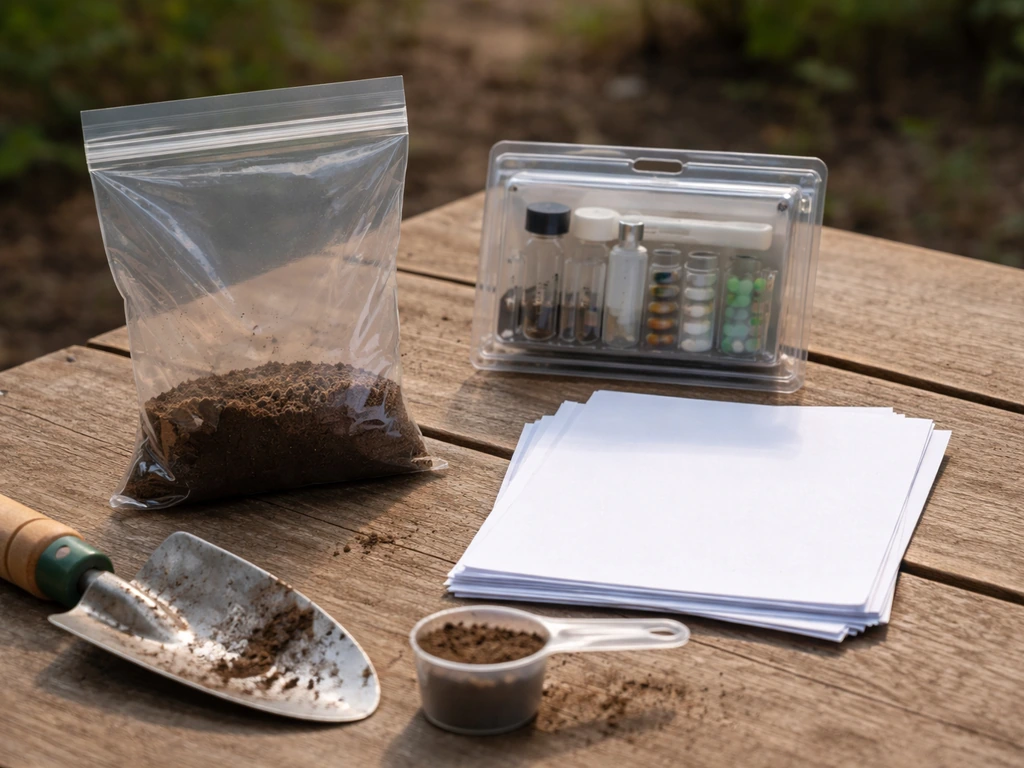
A soil test is the only reliable way to know whether you actually need to add potassium. Every extension service in the country offers affordable soil testing, and the results will tell you your exchangeable potassium level (the readily available fraction in soil solution plus exchangeable K on cation exchange sites) alongside a recommendation. Don't skip this step. Guessing almost always leads to either under-applying where it matters or wasting money on a nutrient your soil already has plenty of.
Soil test reports categorize potassium levels as low, medium, high, or excessive, and some use a "critical level" concept, where below a threshold K is limiting and above it you're unlikely to see a crop response to adding more. Your local extension service's interpretation guide (from Montana State, Ohio State, Purdue, UMN, and similar sources) will give you specific numbers for your region and crop type, because what counts as adequate K varies by soil texture, cation exchange capacity, and what you're growing.
One practical note: dry soil conditions at the time of sampling can distort your soil test K reading because moisture affects K release into solution. If you test during a drought, you may get a temporarily elevated K reading that doesn't reflect normal availability. Sample when soil moisture is reasonably normal.
When the label on a fertilizer bag shows the K2O percentage, you can convert to elemental potassium using the ratio: elemental K = K2O × 0.83. For most home garden situations with a confirmed low K soil test, applying potassium sulfate or muriate of potash at label rates for your square footage is the practical starting point. Avoid the temptation to build up K quickly on soils that can't hold it. Clay-based soils with higher cation exchange capacity can hold more applied K; sandy soils lose it faster. On sandy soil with low CEC, smaller, more frequent applications outperform one large dump.
Potassium over-application is a real concern too. Excess K can interfere with calcium and magnesium uptake because these cations compete for the same uptake sites in roots. If you're already adding Epsom salt (magnesium sulfate) and thinking about adding potassium, be aware that these nutrients interact. Getting the balance right matters more than maximizing any single one.
When adding potassium doesn't seem to work: myths and real troubleshooting
The most common reason potassium fertilization doesn't produce visible improvement is that potassium wasn't the actual limiting factor in the first place. If you're treating a symptom that looks like K deficiency but is actually caused by root rot, soil compaction, iron deficiency, or drought stress, adding potash won't fix it. Iron deficiency can also mimic symptoms that look like a potassium problem, so it's worth checking before you apply potash. Work through the diagnostic checklist before deciding potassium is your answer.
Soil pH is another frequent culprit. Potassium availability is generally good across the 6.0 to 7.0 pH range that most garden crops prefer, but if your soil is significantly outside that range, nutrient lockout can limit uptake even when K is present in the soil. If you've added potassium and aren't seeing improvement, test your pH. Fixing pH often unlocks nutrients that were already there.
Root stress is underappreciated as a reason K fertilization fails. If roots are damaged by overwatering, compaction, disease, nematodes, or physical disturbance, the plant simply can't take up potassium efficiently regardless of how much is in the soil. The fix in that case is better drainage, loosening compacted soil, or addressing the underlying root health problem, not adding more fertilizer.
A persistent myth worth addressing directly: some gardeners believe that because potassium is a macronutrient, more is always better, especially during flowering. This isn't true. Excessive potassium can suppress uptake of calcium and magnesium, leading to deficiency symptoms of those nutrients even when soil levels are fine. Fertilizer burn from high salt concentrations (muriate of potash has relatively high burn potential) can also damage roots, which then causes the exact wilting and leaf scorch you were trying to prevent. More isn't better. The right amount for your soil is better.
Finally, potassium can't compensate for other core limiting factors like insufficient light, chronic underwatering, or severely nitrogen-deficient soil. Eggshell can add a small amount of calcium to the soil, but it generally does not address the kind of potassium deficiency that drives stronger growth potassium can't compensate for other core limiting factors. If plants are pale, small, and slow-growing, nitrogen is almost always the first nutrient to investigate, not potassium.
Potassium supports and sustains growth; it doesn't substitute for the building blocks that nitrogen, phosphorus, and adequate light provide. If you're exploring other nutrients in this space, phosphorus plays a complementary but distinct role from potassium, and minerals like iron interact with K availability in ways that sometimes confuse diagnosis.
Your practical next steps
- Look at which leaves are affected first. If symptoms appear on older, lower leaves with tip and margin browning or scorching, potassium deficiency is plausible. If new growth is yellowing, look at iron, calcium, or other immobile nutrients instead.
- Rule out root stress, poor drainage, soil compaction, and over-fertilization before buying potassium amendments. These can produce nearly identical symptoms and won't respond to added potash.
- Get a soil test. Your local extension service can turn around results in one to two weeks and will give you a specific K recommendation for your crop and soil type. This is the single most useful thing you can do.
- If the test confirms low K, choose muriate of potash (0-0-60) for general use or potassium sulfate (0-0-50) where chloride sensitivity is a concern. Incorporate it into the soil before planting when possible.
- During the growing season, side-dress with soluble potassium during fruit development stages, keeping product away from stems and dry foliage to avoid burn.
- Reassess after one growing season. Potassium builds up in soil over time with consistent applications, so one season of correct application combined with a follow-up soil test will tell you whether you're on the right track.
FAQ
How can I tell the difference between potassium deficiency and drought or overwatering?
Potassium deficiency often starts on older leaves and shows marginal scorching or necrosis, while drought usually causes more general wilting and leaf droop across the plant. If the newest growth looks relatively okay at first but older leaf edges die back, potassium is more likely. Also check soil moisture and root health, because damaged or waterlogged roots can look like a nutrient problem even when K is available.
If my soil test shows potassium is “medium,” should I still add fertilizer?
Usually no. “Medium” or “adequate” categories mean you are not expected to see a yield or quality response from extra K. If you do fertilize, do it by adjusting your baseline fertilizer program for nutrition balance rather than dumping a separate potash product on top of what the soil already provides.
Can I apply potassium directly to leaves, like a foliar spray?
It is possible with certain soluble products, but it is higher risk because salts can burn foliage, especially on dry or hot days. If you foliar feed, use the label rate, apply when leaves can dry quickly (not during peak heat), and avoid spraying directly before intense sun. For most home gardens, soil or root-zone incorporation is more reliable.
Does using compost or manure reduce the need to add potassium?
It can help, but it depends on what you add and your existing K level. Compost and manures release nutrients slowly and may contribute meaningful potassium, yet they also vary widely in K content. If your goal is to decide whether to buy potash, a soil test is still the best way to avoid guessing.
What’s the safest way to apply potassium near seedlings?
Keep granular potash away from the seed zone unless the label explicitly allows banding near seeds. Even when you are trying to help with deficiency, fertilizer salts can damage young roots. If you need early-season K, prefer incorporation in the bed pre-plant or use a soluble source only at conservative rates and away from direct stem contact.
How often should I re-test soil if I keep seeing K-related symptoms?
If symptoms persist after correcting application method and rates, re-test once per growing season at minimum, and ideally wait until you have had enough time for the nutrient to equilibrate. Also sample more than one spot across the bed, because potassium can vary by area even within the same yard.
Is muriate of potash (KCl) always the best choice?
Not necessarily. Muriate of potash works for many situations, but chloride can be a concern for some crops and for soils already high in chloride. If you or your plants are showing issues consistent with chloride sensitivity, potassium sulfate is often the safer alternative, and your soil test or extension guidance can help you choose.
What happens if I apply too much potassium?
Excess potassium can interfere with calcium and magnesium uptake, leading to deficiency-like symptoms even when those nutrients are present. It can also increase the risk of salt burn, which causes wilting and leaf scorch that can mimic potassium deficiency. If you suspect oversupply, stop additional K and focus on correcting Ca and Mg balance if needed.
Can potassium fix yellowing leaves caused by iron deficiency?
Usually not. Iron deficiency can produce chlorosis that resembles potassium-related patterns, especially when you only look at leaf color. If you see pale new growth with distinct patterns, check pH and iron availability before applying potash, because low pH or iron-lockout issues are common causes.
How does soil pH affect whether potassium is usable?
If soil pH is outside the typical crop comfort zone, plants may not take up nutrients efficiently even when potassium exists in the soil. If you have applied K and still see no improvement, test pH and address lockout issues first. Correcting pH can “unlock” multiple nutrients at once, improving overall growth.
Why does potassium help more with stress tolerance than with fast growth?
Because potassium’s biggest roles involve regulating water movement through stomata and supporting energy and transport processes, its benefits show up as steadier performance under heat, drought, and disease pressure. If you only look for rapid “growth spurts,” potassium may seem unimpressive even when it is improving the plant’s resilience.
Should I add potassium if I’m already fertilizing with an NPK product?
Check the K number on the NPK label first. Many balanced fertilizers contain enough potassium for typical needs, and adding a separate potash product can push K too high and create nutrient imbalance. Adjust your feeding plan based on both your soil test and what your current fertilizer already supplies.
Can road salt or sodium exposure make potassium symptoms worse?
Yes. Sodium and road salt can compete with potassium for uptake pathways, leading to marginal scorching that can look like potassium deficiency. If your garden is near salted roads or driveways, account for that source and reduce exposure, then confirm with a soil test before increasing potassium.
Next Articles
Do Eggs Help Plants Grow? What Works and How to Use It
Eggshells can add calcium and affect pH when used right, but whole eggs and egg water rarely fertilize. Learn how and ho
Does Phosphorus Help Plants Grow? How to Fix Deficiency
Explains how phosphorus and phosphate boost growth, how to spot deficiency, fix soil lock-up, and dose safely for better
Does Egg Shell Help Plants Grow? How to Use It Right
Find out if eggshells help plants, how to apply them safely, and when calcium or pH fixes are needed.