Red and blue light make plants grow the fastest. Red light (around 660 nm) drives photosynthesis more efficiently than any other wavelength, and blue light (around 450 nm) keeps growth compact, triggers stomatal opening, and supports healthy leaf development. Used together in the right ratio, these two wavelengths are why purple-pink LED grow lights have become the go-to for serious indoor gardeners. If you want faster growth today, a full-spectrum LED that's heavy on red and blue is your best starting point.
What Color Light Makes Plants Grow Faster? Complete Guide
Marcus Holloway
16 May 2026
How plant growth is affected by light color
Plants don't see light the way we do. They have specialized photoreceptors that respond to specific wavelengths, and those receptors trigger very different physiological responses depending on what they detect. Chlorophyll, the pigment doing most of the photosynthesis work, absorbs red and blue light most efficiently and reflects green light (which is why leaves look green to us). But it goes deeper than just chlorophyll.
Blue light activates phototropins (specifically phot1 and phot2), which regulate chloroplast movement, stomatal opening, and leaf expansion. These responses matter a lot for growth rate, especially in lower light environments. Red light works through phytochrome receptors, which control processes like germination, stem elongation, and flowering timing. The ratio of red to far-red light (far-red sits around 730 nm) is particularly powerful: a low red-to-far-red ratio signals to the plant that it's being shaded, which triggers it to stretch upward fast to find more light.
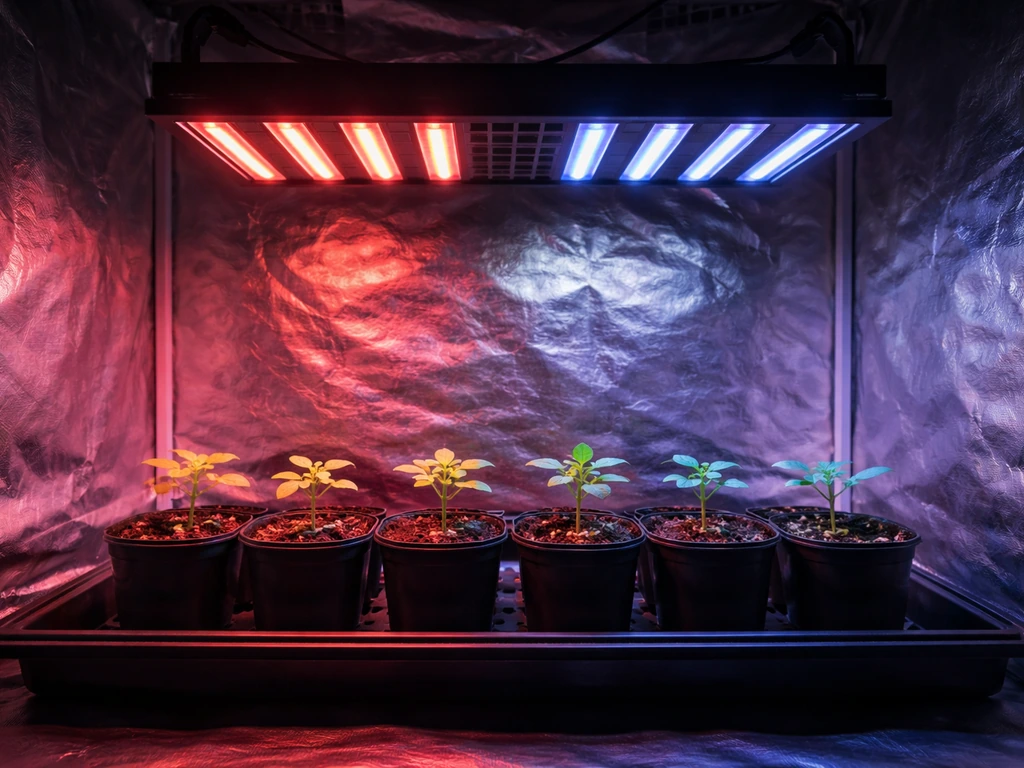
So when people ask what color light makes plants grow faster, the answer depends on what kind of growth you mean. Faster stem elongation? Low blue, high far-red. Faster, denser vegetative growth with more leaf area and stronger structure? Red and blue together, with blue kept at a meaningful percentage of the total spectrum.
Blue light vs red light: what each does best
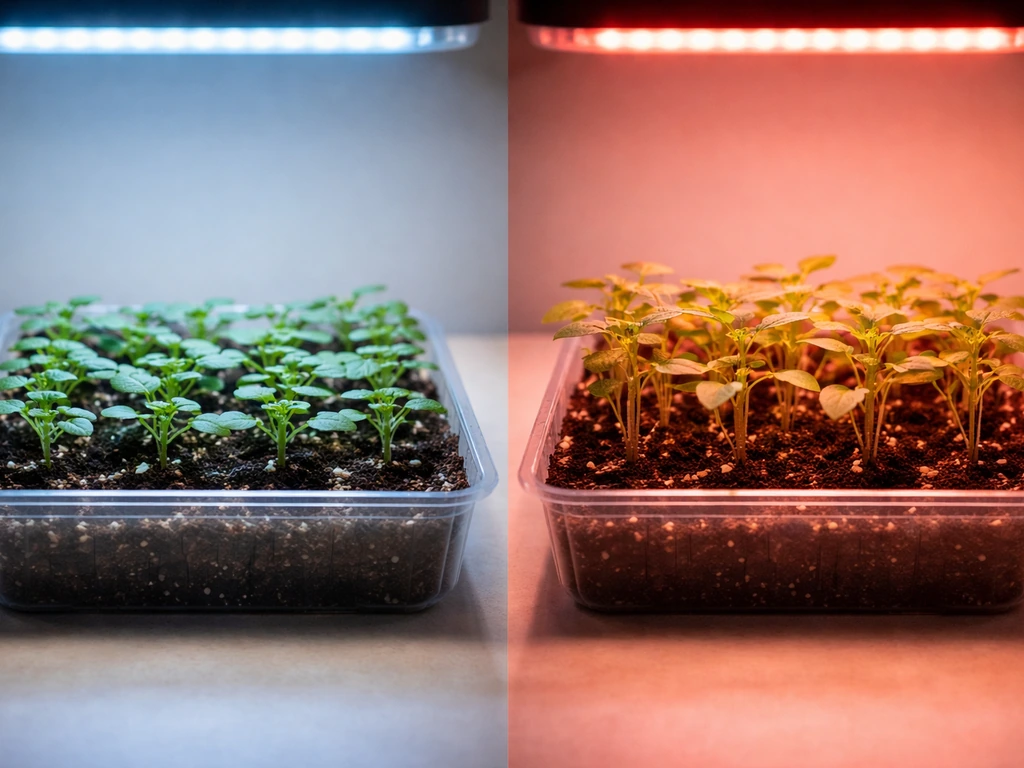
Red light (around 660 nm) is the primary photosynthesis driver. If you had to pick one wavelength to keep a plant alive and productive, red would win. It's absorbed directly by chlorophyll a and b, it's efficient at stimulating the light reactions of photosynthesis, and it's what most plants use to measure day length through phytochrome signaling. Plants grown under red-only light can photosynthesize just fine, but there's a catch: without any blue, growth tends to get strange. Studies on pepper plants showed that biomass was noticeably reduced when plants were grown under red LEDs alone, and adding blue light back in improved biomass significantly.
Blue light (around 450 nm) is the regulator. It keeps plants compact and structurally sound, opens stomata so CO2 can enter leaves, and drives leaf expansion through phototropin signaling. Research on tomato seedlings found that a higher blue-to-red ratio produced shorter stems compared to a lower ratio, which is exactly what you want for robust, stocky vegetative growth rather than tall, weak plants. Blue light also matters more than most people realize in low-light conditions: phototropin-mediated responses can meaningfully boost growth when light levels are generally low.
| Light Color | Wavelength | Primary Effect | Best Used For |
|---|---|---|---|
| Red | ~660 nm | Drives photosynthesis, controls day-length signaling via phytochrome | Vegetative growth, flowering, fruiting |
| Blue | ~450 nm | Stomatal opening, compact growth, leaf expansion via phototropins | Seedlings, vegetative stage, preventing leggy growth |
| Far-Red | ~730 nm | Triggers shade avoidance (elongation), influences flowering timing | Supplemental for flowering speed, extension growth |
| Green | ~510–530 nm | Reflected mostly but penetrates deeper into leaf canopy | Useful in canopy lighting; minimal direct growth driver |
| White (full-spectrum) | Broad | Covers all photosynthetically active wavelengths | General growing, mixed-use spaces |
A practical starting ratio many horticultural growers use is roughly 80–90% red to 10–20% blue for vegetative growth. AHDB horticultural guidance recommends that LED grow modules emit at least 10% of their output in the blue spectrum. Going much higher in blue slows elongation (sometimes useful, sometimes not), and dropping below 10% risks the abnormal growth you see in red-only setups.
Where green and white light fit in
Green light gets dismissed a lot, but it's not totally useless. While chlorophyll reflects most green wavelengths (hence the color), some green photons do get absorbed, and green light actually penetrates deeper into a leaf canopy than red or blue. Even so, green light can help fill in gaps, and the right mix of wavelengths overall is what determines whether green light helps plants grow does green light help plants grow. For dense plantings or thick-leaved crops, that penetration can help lower leaves photosynthesize when they'd otherwise be in shadow. That said, green light is the least efficient wavelength for driving photosynthesis in a single-layer plant setup, and you shouldn't prioritize it when buying grow lights.
White light is a different story. Full-spectrum white LEDs or warm-white LEDs cover the entire photosynthetically active range (roughly 400–700 nm) and include red, green, and blue in varying proportions depending on the color temperature. They're not as targeted as red-blue LED arrays, but they work well and they're much more pleasant to work under (purple LED light is genuinely hard to look at for extended periods).
For home growers, a high-quality full-spectrum white LED is a completely valid choice, especially if your plants are in a living space rather than a dedicated grow tent. If you're wondering does white light help plants grow, a high-quality full-spectrum white LED is a completely valid choice for the photosynthetically active range.
Best light types to buy: LED spectrum choices
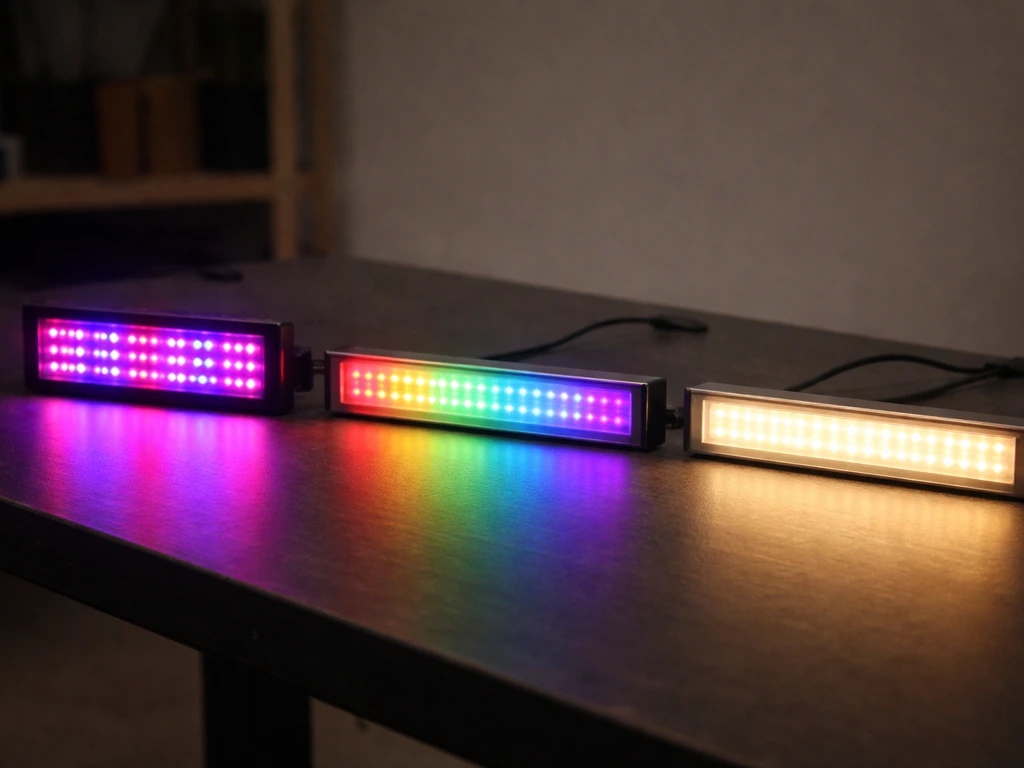
You've got three main LED categories to choose from, and the right pick depends on your setup and goals.
- Red-blue LED panels ("blurple" lights): These target the two most photosynthetically active wavelengths directly. They're efficient and effective, but the purple light makes it hard to spot pest damage or yellowing leaves. Best for dedicated grow tents or shelves where you don't need to visually inspect plants under natural-looking light.
- Full-spectrum white LEDs: These mimic daylight and cover the full photosynthetically active range. High-quality models (look for high efficiency ratings, ideally 2.0–3.0 µmol/J) are excellent for most home growers and work for every growth stage. Easier to work under and assess plant health.
- Full-spectrum LEDs with supplemental red and far-red diodes: The best of both worlds for serious growers. These add targeted red (~660 nm) and far-red (~730 nm) diodes to a white base spectrum, allowing you to dial in spectrum ratios for specific goals like faster flowering or denser vegetative growth.
When comparing products, ignore lumen ratings entirely. Lumens measure light as human eyes perceive it, not as plants use it. The number you want is PPFD (photosynthetic photon flux density, measured in µmol/m²/s), which tells you how much photosynthetically useful light actually reaches your plant canopy. Iowa State University Extension has specifically called PPFD the single most useful measurement for determining whether an indoor plant gets adequate light. Manufacturers who list PPFD charts at specific distances are giving you genuinely useful data.
How to set up lighting for faster growth
Getting the distance right
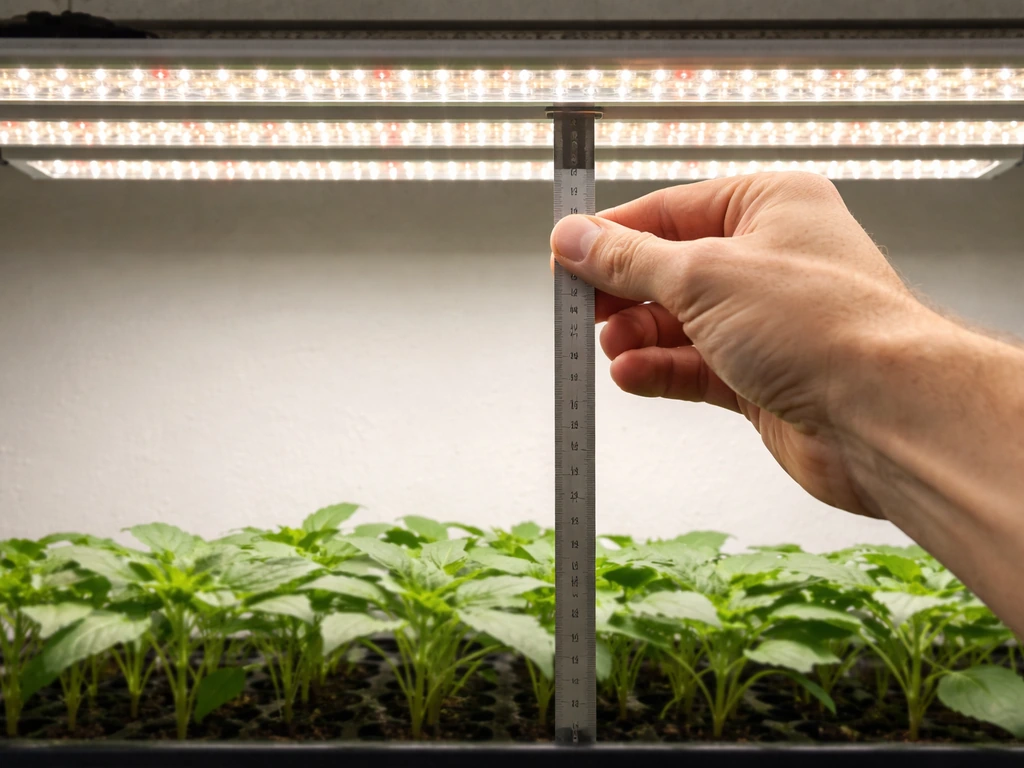
Distance from the light to the plant canopy is one of the most underestimated factors in home growing. PPFD drops dramatically as you move the light away from the plant, following an inverse square relationship. University of Minnesota Extension also explains that insufficient light causes leggy seedlings and that PPFD decreases as the distance from the light source increases [Lighting for indoor plants and starting seeds](https://extension. umn.
edu/planting-and-growing-guides/lighting-indoor-plants). Most LED grow lights work best somewhere between 12 and 24 inches above the canopy, but you need to check the manufacturer's PPFD chart for your specific light rather than guessing. University of Minnesota Extension specifically flags adjusting light height regularly as a core management task, because as seedlings grow toward the light, the distance shrinks and intensity spikes.
PPFD targets by growth stage
University of Maine Extension provides practical PPFD benchmarks that are worth keeping in your notes. Seedlings and clones need less than 100 µmol/m²/s. Vegetative plants need roughly 100–500 µmol/m²/s. Flowering and fruiting plants need 400–1,200 µmol/m²/s. Starting seedlings at the high end causes stress; starting mature fruiting plants at the low end means slow growth and poor yields.
Daily light duration (photoperiod)
Most vegetable seedlings and leafy greens do well with 14–18 hours of light per day under LEDs. Flowering plants are more sensitive to photoperiod: short-day plants (like many flowering annuals) need extended dark periods to trigger blooming, while long-day plants need more light hours. UNH Extension notes that in some fluorescent seedling setups, running lights up to 22 hours per day can achieve the right daily light integral (DLI) to support sun-loving seedlings, though that duration is compensating for low-intensity fluorescents. With higher-output LEDs, 16–18 hours is usually plenty for seedlings and vegetative growth.
DLI: the number that ties it all together
DLI (daily light integral, measured in mol/m²/day) combines intensity and duration into one number, representing total photosynthetic light delivered per day. Oklahoma State University Cooperative Extension highlights DLI alongside PPFD and PPF as the key metrics for plant production lighting decisions. A simple way to estimate DLI: multiply your PPFD by the number of light hours per day, then multiply by 0.0036. Leafy greens typically want 12–17 mol/m²/day; tomatoes and peppers want 20–30 mol/m²/day.
Common mistakes and how to fix them
Leggy, stretched seedlings
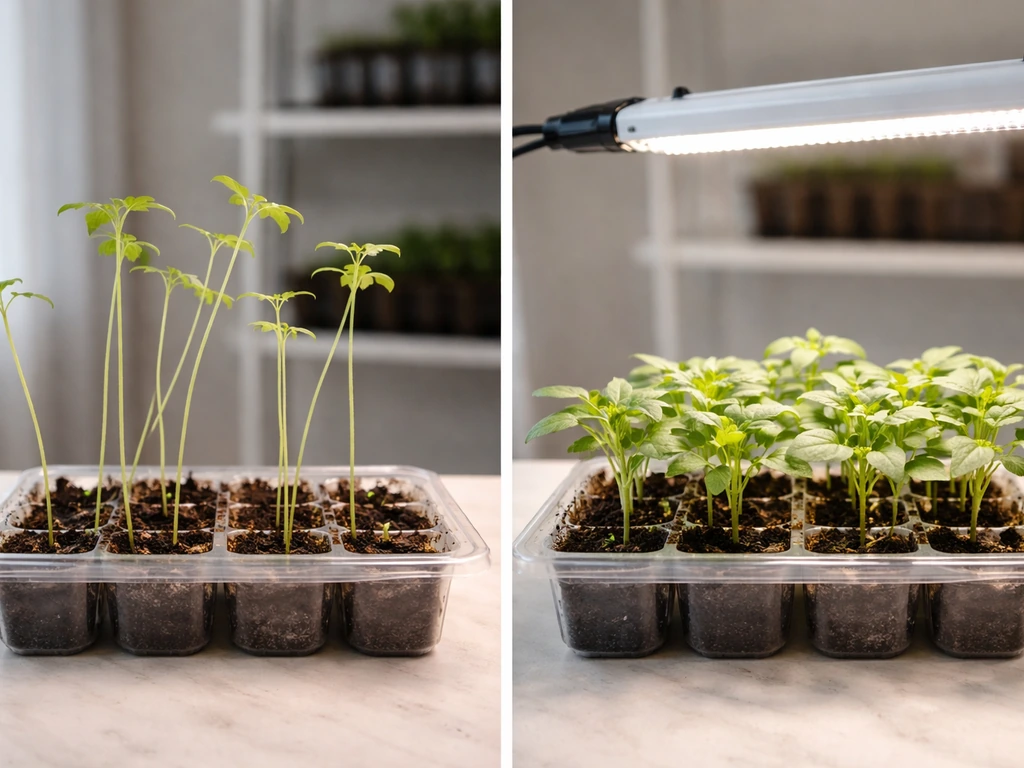
If your seedlings are tall and thin with wide spacing between leaf nodes, they're not getting enough light. The most common causes are lights positioned too far away, intensity too low for the growth stage, or too little blue light in the spectrum. Illinois Extension specifically calls out lights being too far away as the primary culprit for leggy seedlings. Fix: lower the light to the correct distance (check the PPFD chart), switch to a spectrum with adequate blue, or upgrade to a higher-output fixture. Don't just add more hours; adding hours won't compensate for low intensity.
Slow overall growth
Slow growth under artificial light usually comes down to insufficient PPFD, the wrong spectrum for the growth stage, or a combination of both. If your light is spec'd adequately but growth is still slow, check whether you're hitting target PPFD at the canopy (not just at the center of the light footprint, but across the whole area). Also check that you're not in a photoperiod mismatch: a long-day plant getting only 10 hours of light won't thrive even under a perfect spectrum.
Leaf bleaching and heat stress
If leaf tips are turning white or pale, or leaves closest to the light look washed out, you're likely too close or running too high an intensity for the plant's current stage. Penn State Extension notes that abnormal growth can result from light conditions being too intense, not just too weak. Pull the light up a few inches, check the temperature at canopy level (keep it below 80–85°F), and dial back intensity if your fixture has a dimmer. Modern LEDs run cool compared to HID lights, but high-intensity LEDs positioned too close can still cause photoinhibition (where excessive light actually shuts down photosynthesis rather than boosting it).
Buying a light based on watts or lumens
This is the most common purchasing mistake. Watts tell you energy consumption, not plant-usable output. Lumens describe brightness to the human eye, which weights green and yellow light heavily because that's what our eyes are most sensitive to. A light that looks very bright to you might be delivering almost no useful red or blue light to your plants. Always look for PPFD data from the manufacturer.
Your action plan for today
Here's a practical checklist you can work through right now to set up or optimize your grow light situation.
- Identify your goal: Are you growing seedlings, pushing vegetative growth, or triggering flowering? Your target PPFD and photoperiod differ for each stage.
- Check your current light's spectrum: Does it include meaningful red (around 660 nm) and blue (around 450 nm)? If it's a plain warm-white bulb or a non-horticultural LED, it's almost certainly insufficient. Look for lights marketed with PPFD specs, not just watts or lumens.
- Measure or estimate your PPFD: If you have a PAR meter, measure at canopy level. If not, use the manufacturer's PPFD chart at your current hanging height. Compare against the stage-specific targets: under 100 for seedlings, 100–500 for vegetative, 400–1,200 for flowering.
- Adjust your distance: Move the light up or down until you're in the right PPFD range for your growth stage. For most home LED grow lights, that's 12–24 inches above the canopy.
- Set your photoperiod: Use a timer. Vegetative growth: 16–18 hours on, 6–8 hours off. Flowering (for short-day plants): 12 hours on, 12 hours off. Seedlings: 14–16 hours on.
- Check your spectrum balance: If you're seeing leggy growth despite adequate intensity, increase blue light contribution or reduce far-red. If growth is slow and compact but not flowering, check that your photoperiod is appropriate for the species.
- Watch plant response for 7–10 days: New growth will tell you whether your adjustments are working. Healthy, compact new leaves mean you're dialed in. Continued stretch means more light or more blue. Bleaching or tip burn means back off on intensity or distance.
The bottom line is that no single color of light works in isolation. If you want the most practical answer to what color light helps plants grow, start with red and blue, then fine-tune the ratio for your growth goal. Red drives the engine, blue keeps it running clean, and the intensity and duration of the total spectrum determines how fast that engine runs. Get those three factors right, and you'll see noticeably faster, healthier growth within a couple of weeks.
FAQ
If I only have red LEDs, will my plants still grow fast?
They can survive and photosynthesize, but growth often becomes unbalanced. Without blue, plants may get stretched or show reduced biomass, so you may not get the fast, dense vegetative growth you want. A common fix is adding enough blue to reach at least about 10% of the spectrum output, then adjust height to hit the target PPFD at the canopy.
How do I tell whether my plants need more blue or just more light intensity (PPFD)?
If they are tall and thin with wide spacing between nodes, intensity is commonly too low or light is too far away, but insufficient blue can also contribute. If they are pale or “washed out” near the light, intensity may be too high for that stage. Use the PPFD chart for your fixture distance first, then refine the red-to-blue ratio once you know intensity is in range.
Does far-red light (around 730 nm) make plants grow faster?
It often speeds up stem elongation, especially when the red-to-far-red ratio is low, which can make plants taller but not necessarily sturdier. If your goal is rapid height, far-red can help, but for faster growth in the sense of denser leaves and stockier structure, prioritize red plus blue and treat far-red as a secondary tuning knob.
Will green light increase growth if I add it to a red-blue setup?
Green can help distribute light deeper into a canopy, so it may improve performance in dense plantings or thick-leaved crops. For single-layer setups, it is usually not the most efficient driver of photosynthesis, so adding green rarely beats simply optimizing PPFD, red level, and the blue fraction.
What is the best way to choose between “white full spectrum” and “red-blue” grow lights?
Pick red-blue if you want tighter control for a specific growth goal (compact veg versus elongation versus flowering triggers). Pick high-quality full-spectrum white if you need a practical solution for a living space and you prefer easier management, since it includes the needed wavelengths across the photosynthetically active range. In both cases, verify PPFD at your canopy distance rather than relying on how bright it looks.
Why do my seedlings grow leggy even when the light is on long hours?
Long photoperiod cannot fix low PPFD. Legginess usually means the canopy is receiving too little intensity because the fixture is too far away, the spectrum is missing enough blue, or the plant stage expects a lower or higher PPFD than you are providing. Measure or estimate PPFD at canopy level and adjust height before changing the schedule.
What PPFD should I target for tomatoes and peppers versus leafy greens?
Leafy greens often do well around the lower end of the vegetative range, while tomatoes and peppers typically need a higher intensity for strong growth. Use the typical benchmarks given in the article as starting points: seedlings under 100 µmol/m²/s, vegetative roughly 100–500, and flowering or fruiting roughly 400–1,200. Then adjust based on symptoms, since cultivar and setup can shift needs.
How do I avoid heat and light stress from strong LEDs placed close?
Even LEDs can cause photoinhibition if too intense and too close. If leaves are bleaching or you see washed-out tissue, raise the fixture a few inches and check canopy temperature (aim below about 80–85°F). If your unit has dimming, reduce output instead of only increasing height, then re-check PPFD at the canopy.
Should I trust wattage, lumens, or label marketing when buying a grow light?
No. Watts and lumens describe energy use and human-visible brightness, not how many photosynthetically useful photons your plants get. The decision number is PPFD (µmol/m²/s) at the relevant distance, and a manufacturer-provided PPFD chart is a strong sign you can dial your setup correctly.
How can I estimate daily light integral (DLI) quickly for my setup?
Use the simple relationship from the article: DLI ≈ PPFD × light hours × 0.0036. This helps you compare fixtures and schedules even when photoperiod differs. If DLI is low, increase intensity (via height or a stronger fixture) before extending hours, since photoperiod changes can conflict with flowering requirements.
Does the “right” light color change depending on whether I want veg growth or flowering?
Yes. For faster, compact vegetative growth, you generally want strong red plus a meaningful blue fraction to support structure and stomatal function. For flowering and fruiting, you still rely heavily on red plus blue, but the intensity level and photoperiod expectations become more critical, including respecting short-day or long-day behaviors depending on the plant.
If my plants grow fast but look unhealthy, what should I check first?
First confirm you are hitting the correct PPFD for the plant stage at canopy level, not just at the center of the light footprint. Next check photoperiod and temperature at canopy. Fast growth paired with bleaching or distortion usually indicates too much intensity or stress conditions rather than “more is better.”
Next Articles
Does Green Light Help Plants Grow? What Actually Works
Explains whether green light boosts plant growth, when it helps versus red and blue, and how to choose LEDs and set inte
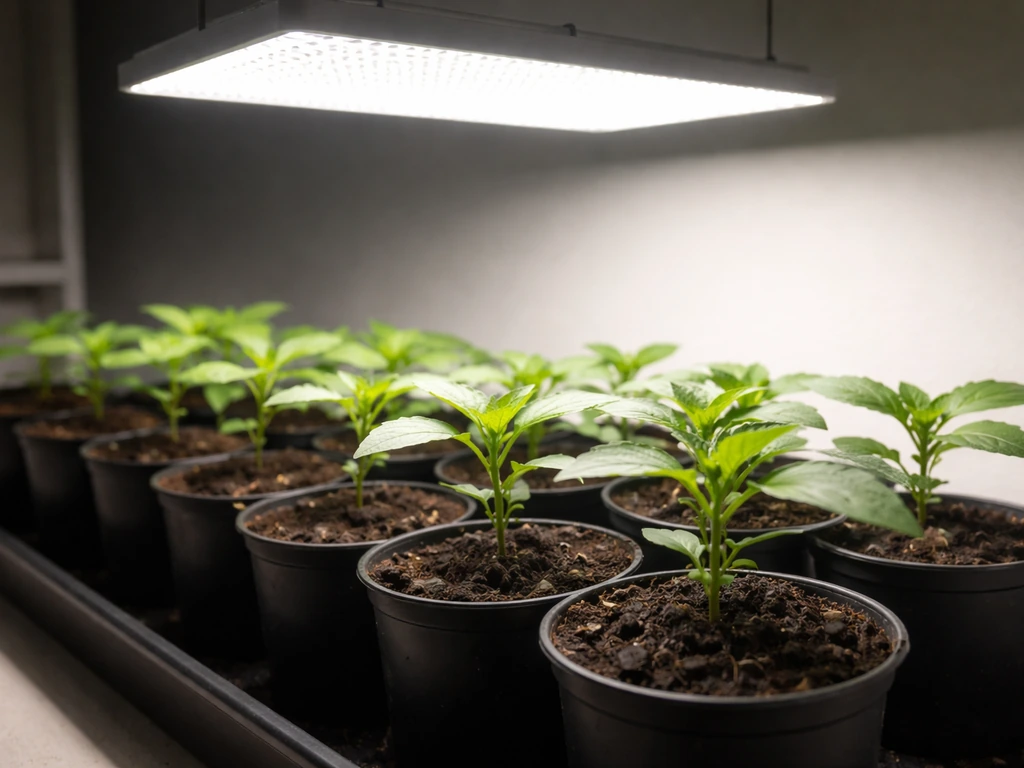
Does White Light Help Plants Grow? When It Works
Yes, white LED light helps plant growth when spectrum and intensity fit; learn CCT, placement, PPFD and fixes.
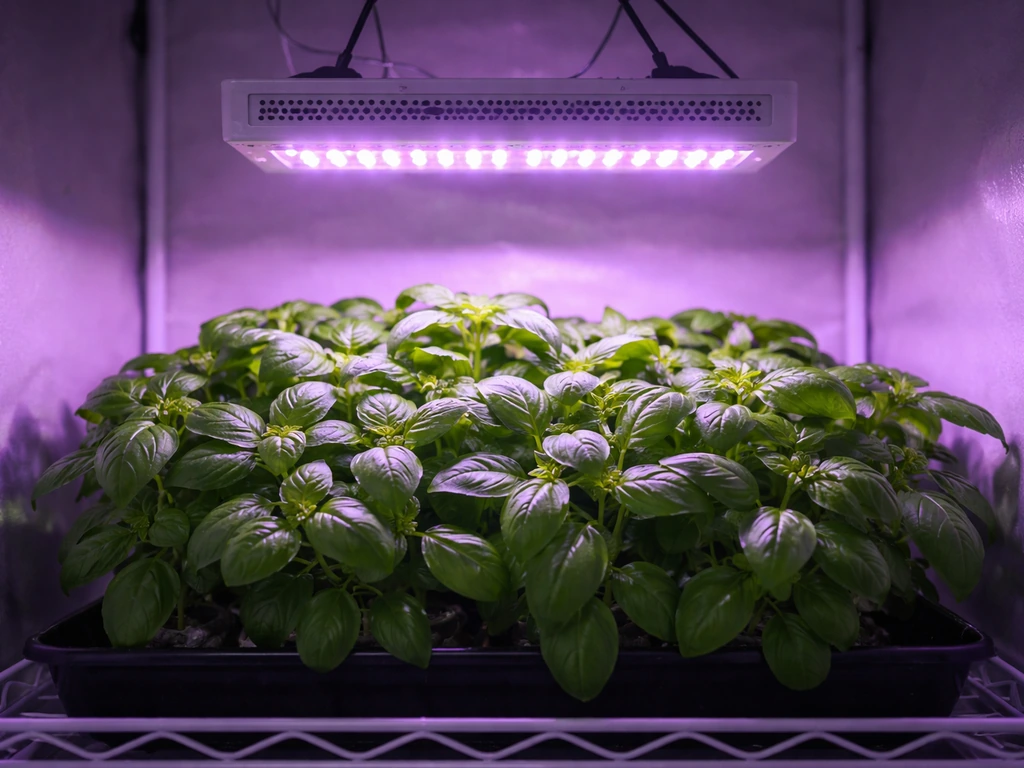
Does Purple Light Help Plants Grow? Practical Guide
Learn if purple LED light boosts plant growth, when it helps, and how to set PPFD, placement, and duration.