Crystals do not meaningfully help plants grow. Epsom salt can help only when your plants actually need magnesium, but it is not a crystal substitute for overall care like light, soil, and watering will epsom salt help plants grow. Decorative stones like quartz, amethyst, or rose quartz have no proven mechanism to stimulate photosynthesis, improve nutrient uptake, or strengthen roots. A few mineral-rich rocks can theoretically leach trace elements into soil over a very long time, but at concentrations too low and too slow to matter in a typical garden or pot. If your plants are struggling, crystals are not the fix. Light, soil quality, nutrients, and water are.
Do Crystals Help Plants Grow? Evidence and Practical Tests
Marcus Holloway
11 May 2026
Why the crystals-for-plants idea exists
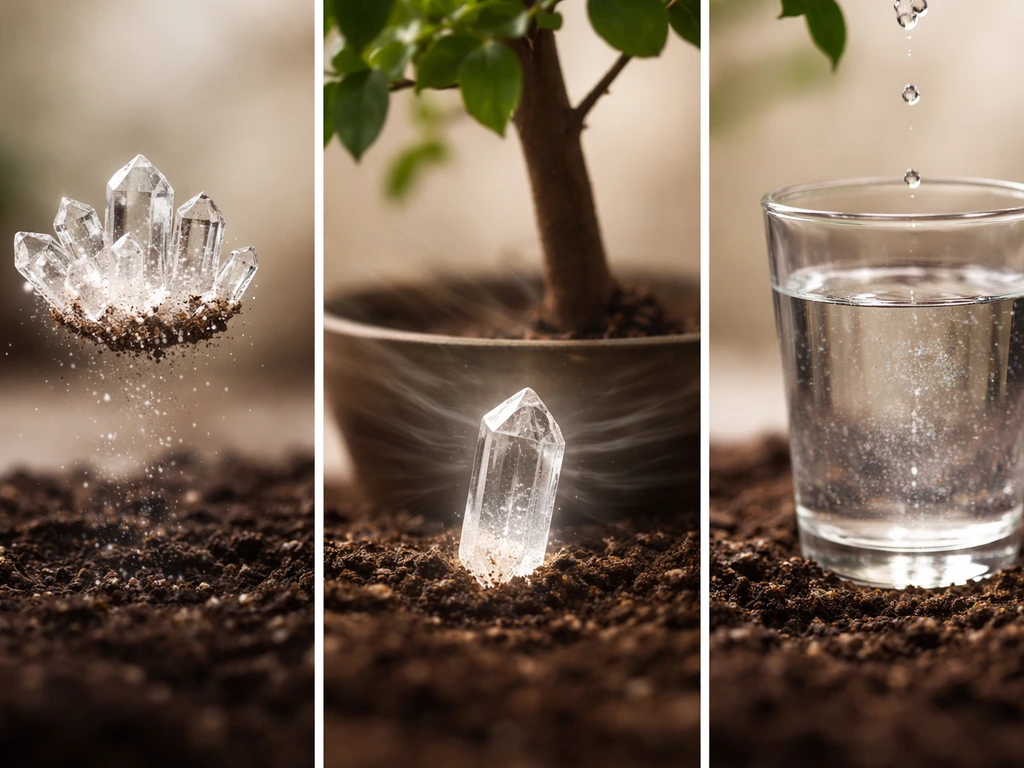
The claim usually takes one of three forms: crystals release beneficial minerals into soil, they emit vibrations or energy that stimulate plant growth, or they structure or charge water in ways that improve plant hydration. Each one sounds plausible enough on the surface, which is exactly why the idea keeps circulating.
The mineral-release angle has a kernel of logic to it. Rocks do contain minerals, and minerals do matter to plants. Potassium, phosphorus, iron, magnesium, and calcium are all found in various geological materials, and they are genuinely essential for plant function. Phosphorus is one essential nutrient plants need for processes like energy transfer and root development. The problem is that decorative crystals are typically very hard, chemically stable minerals. Quartz is almost entirely silicon dioxide, which plants cannot use. Amethyst is a variety of quartz. Rose quartz is quartz. Hardness on the Mohs scale directly correlates with how resistant a mineral is to weathering and dissolution, so the prettiest crystals tend to be the most geologically inert ones.
The vibration and energy claims have no peer-reviewed support in plant biology. Plants respond to light wavelengths, temperature gradients, gravitational pull, touch, and chemical signals. There is no receptor mechanism by which a crystal emitting some undefined energy influences cellular growth. I have looked for controlled studies and found none. That does not mean someone has not placed amethyst in their potted fern and watched it thrive, but correlation is not causation, and a thriving fern next to a crystal is far more likely responding to the better window placement you chose when arranging your shelf.
Structured water claims, where a crystal supposedly reorganizes water molecules into a more bioavailable form, are not supported by chemistry. Water molecules do form transient hydrogen-bonded networks, but those structures break and reform on picosecond timescales, far too fast for any crystal sitting in a glass to impose lasting change before the water reaches a plant root. A transient absorption study of water shows that hydrogen-bond networks evolve on ultrafast timescales, supporting the point that any “structured water” effect would be brief those structures break and reform on picosecond timescales.
Do crystals actually change soil, water, or pH?
This is the most honest question to ask, because if a crystal genuinely altered a measurable soil parameter, there might be something worth discussing. In most cases, the answer is no, but there are nuances depending on what you are actually placing in your pot.
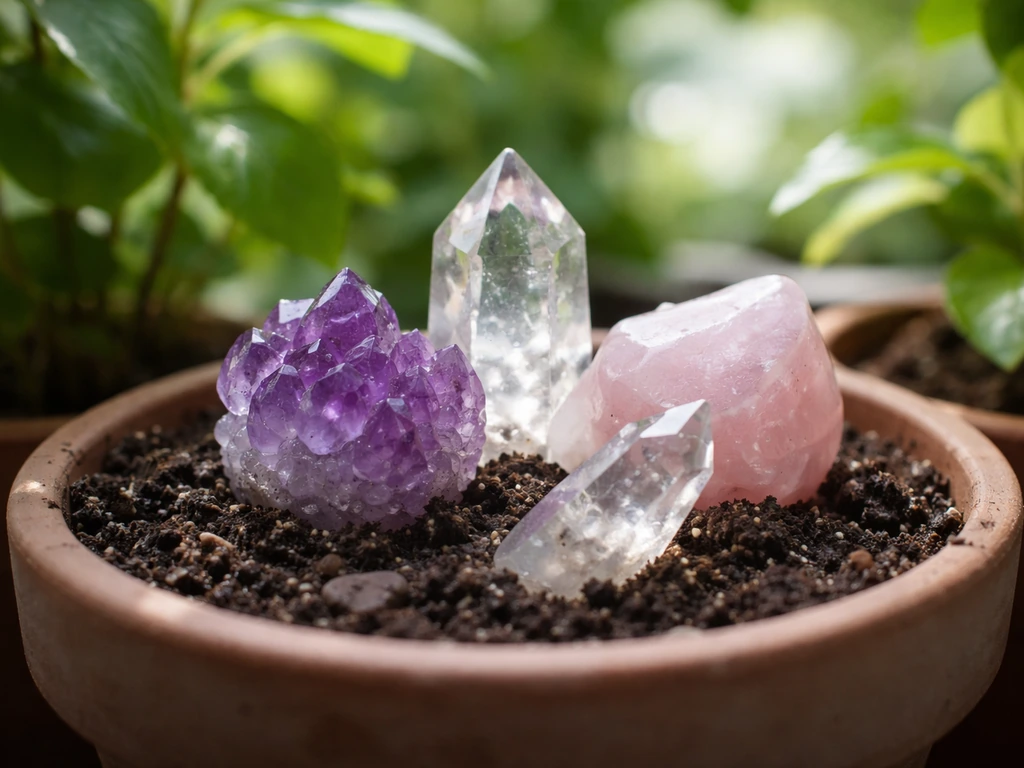
Soil pH is one of the most important factors in gardening because it controls which nutrients are chemically available to roots. Colorado State University Extension puts the acceptable range for most plants at 6.0 to 7.5, with near-neutral (6.8 to 7.2) being ideal for many common species. Outside that range, nutrients like iron, manganese, or phosphorus can bind into forms plants cannot absorb. Quartz, amethyst, and most popular decorative crystals are chemically neutral and will not shift pH in either direction. That is actually good news if you are using them as decorative pot toppers, because at least they are not causing harm.
Some crystals can shift pH. Calcite and aragonite (both forms of calcium carbonate, often sold as crystals) will slowly dissolve in acidic conditions and raise soil pH. If your soil is already at 7.0, adding a calcite crystal could push it alkaline over time, potentially locking out iron and manganese. Pyrite (fool's gold) oxidizes in moist soil and produces sulfuric acid, which would drop your pH. Neither effect is predictable enough to be useful, and both could cause real problems in containers where soil volumes are small and pH shifts happen faster. If you actually need to adjust pH, lime or sulfur applied at measured rates after a proper soil test is the only reliable approach.
On water: placing a crystal in a watering can or reservoir does not measurably change water chemistry, pH, or mineral content at any concentration that would affect a plant. Independent water testing laboratories have found no meaningful difference between water stored with crystals versus without.
Best crystals to try (and which ones are mostly hype)
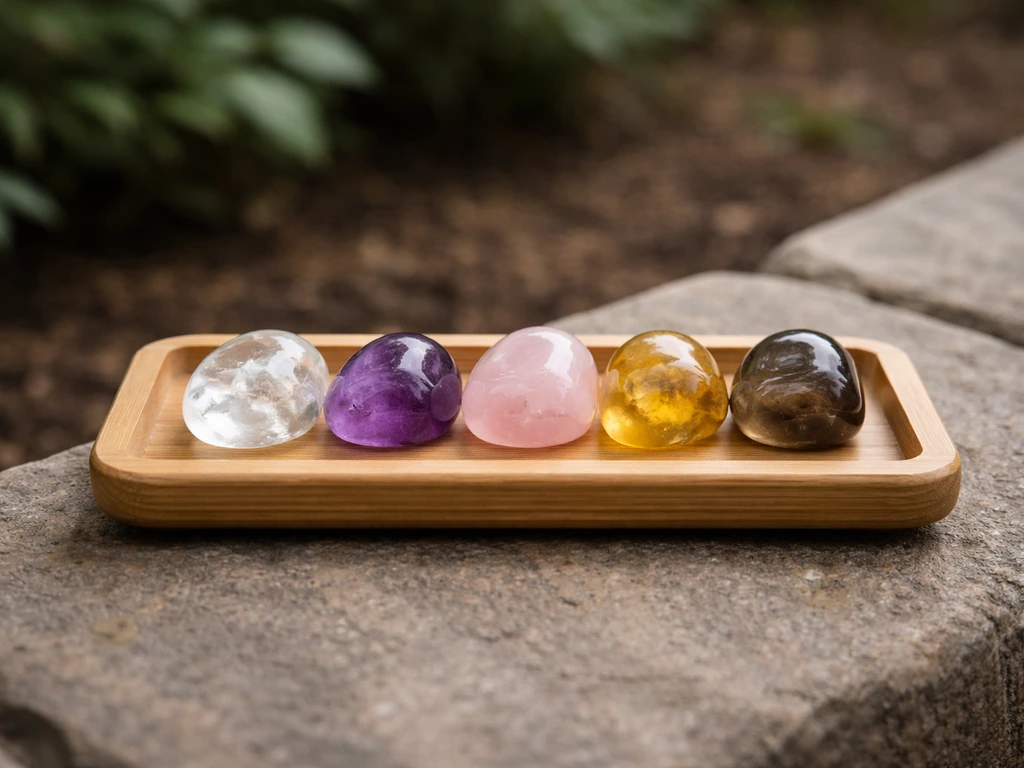
If you want to use crystals in your garden and you want to think through it honestly, here is a breakdown of the most commonly suggested stones and what, if anything, they actually bring to the table.
| Crystal | Composition | Any real horticultural effect? | Risk to plants |
|---|---|---|---|
| Clear quartz | Silicon dioxide (SiO2) | None measurable; chemically inert | Very low |
| Amethyst | Silicon dioxide with trace iron impurities | None measurable | Very low |
| Rose quartz | Silicon dioxide with trace minerals | None measurable | Very low |
| Calcite / limestone | Calcium carbonate (CaCO3) | Can raise soil pH over time; calcium source at very low rate | Medium — can cause alkalinity in containers |
| Pyrite (fool's gold) | Iron sulfide (FeS2) | Oxidizes to sulfuric acid in moist soil; lowers pH | High — unpredictable pH drop |
| Green aventurine | Quartz with fuchsite inclusions | None measurable | Very low |
| Selenite / gypsum | Calcium sulfate (CaSO4) | Provides calcium and sulfur; used in agriculture at scale | Low at small amounts; avoid concentrated use in pots |
| Black tourmaline | Complex borosilicate | Contains boron, but release is negligible | Very low |
Of that entire list, selenite (gypsum) is the only one with a real agronomic track record, because agricultural gypsum is a legitimate soil amendment used to supply calcium and sulfur and to improve clay soil structure. But the operative word is scale: farmers apply gypsum at rates of hundreds of pounds per acre. A small selenite crystal placed on top of a pot is not delivering meaningful amounts of either element.
The quartz-family stones (clear quartz, amethyst, rose quartz, aventurine) are essentially inert. They will not help, but they will not hurt either. If you like how they look in a pot, that is a perfectly fine reason to use them.
How to use crystals safely around plants
If you want to experiment with crystals and you want to do it without accidentally harming your plants, follow a few basic rules.
- Stick to quartz-family stones (clear quartz, amethyst, rose quartz, citrine) as pot decorations. They are chemically inert and pose essentially zero risk.
- Avoid reactive minerals like pyrite, calcite, or anything that fizzes when you drop vinegar on it (that fizzing means carbonate, which will raise pH).
- Do not bury crystals deep in the root zone of containers. If something does leach, confined soil volumes will concentrate the effect faster than open garden beds.
- Never use crystals as a substitute for soil testing. If you suspect a nutrient deficiency, get a soil test through your local Cooperative Extension office. Guessing and adding things to the soil without knowing your baseline is how you create new problems.
- Rinse crystals before placing them in soil or water. Mineral specimens can carry surface dust, dyes (some commercial crystals are color-treated), or coatings that may not be plant-friendly.
- If you want to test whether a crystal does anything, run a side-by-side comparison: two identical plants, same soil, same pot size, same light and water schedule, one with a crystal and one without. Observe for 8 to 12 weeks. That is the only honest way to evaluate it.
What actually makes plants grow faster
If your plants are underperforming, the cause is almost always one of four things: not enough light, poor or depleted soil, a nutrient imbalance, or inconsistent watering. These are the real levers, and they are worth far more of your time and money than any crystal. You may also have heard that crushed eggshells can help plants, but it is best to treat that claim skeptically and look at what eggshells actually change in soil does egg shell help plants grow.
Light
Light is the single most limiting factor for most indoor plants and shaded garden beds. Plants use specific wavelengths, primarily red (around 660 nm) and blue (around 450 nm), to drive photosynthesis. Moving a plant from a dim corner to a bright windowsill, or adding a full-spectrum grow light, often produces visible growth improvement within two weeks. No crystal produces or amplifies usable light.
Soil quality and pH
Soil is not just a physical anchor. It is a chemical and biological system that determines whether roots can access nutrients at all. A soil test (available through most Cooperative Extension services for under $20) tells you your pH and nutrient levels so you can amend precisely rather than guess. Penn State Extension and others are explicit about this: adding fertilizer to plants that are not actually deficient stresses them rather than helping. Know your baseline first.
Nutrients
Macronutrients like nitrogen, phosphorus, and potassium are the big drivers of growth, flowering, and root development respectively. Micronutrients like iron, magnesium, and boron matter too, but usually in much smaller amounts. If you are curious about how individual minerals influence plant biology, the relationships between minerals and plant growth are genuinely interesting, and they are where the real science of soil amendments lives. That is why the real path to better growth is understanding which nutrients and minerals your plants actually need from soil and fertilizer minerals influence plant biology.
Watering
Overwatering kills more houseplants than underwatering. Roots need oxygen as well as moisture, and waterlogged soil suffocates them. For most plants, watering deeply and then waiting until the top inch or two of soil dries out before watering again is more effective than frequent shallow watering. Consistent moisture (not constant wetness) is the goal.
A simple test plan (and when to move on)
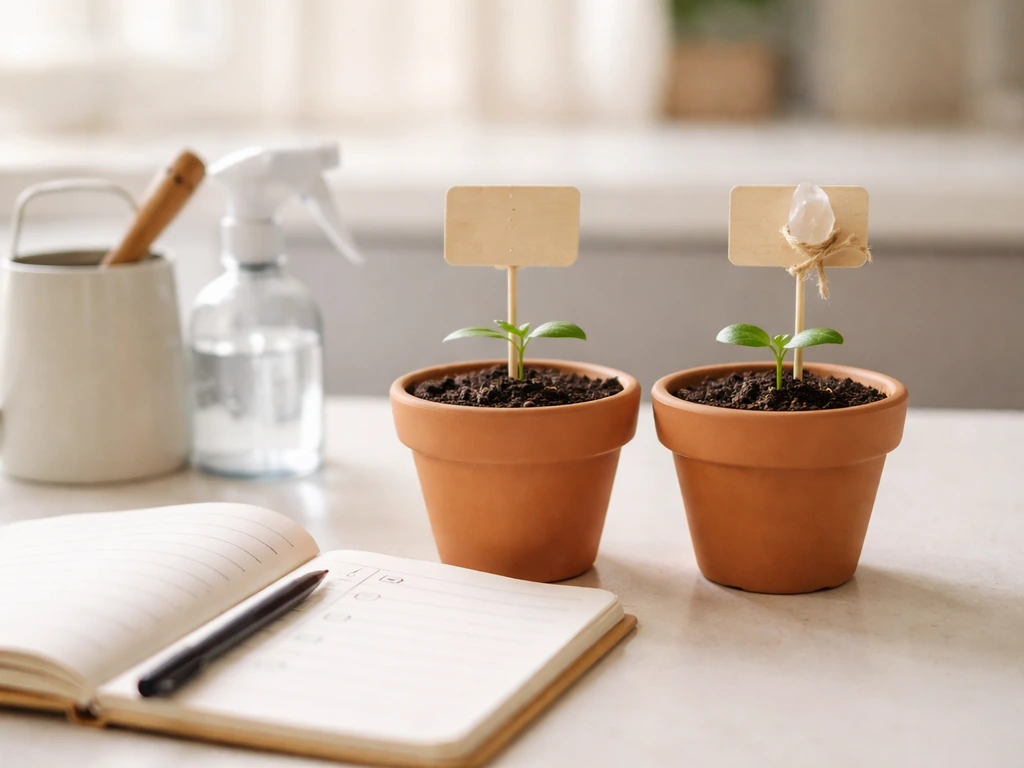
If you are genuinely curious and want to test crystals yourself rather than just take my word for it, here is a clean, low-effort protocol you can run at home.
- Pick two identical plants of the same species, ideally propagated from the same mother plant or bought as a matched pair.
- Pot both in identical fresh potting mix, same pot size, same drainage setup.
- Place them in the same location so they receive identical light.
- Water both on the same schedule with the same amount of water from the same source.
- Add a rinsed quartz crystal (or whichever crystal you want to test) to the soil surface or root zone of one plant only.
- Measure both plants at the start: height, number of leaves, and if possible take a photo from the same angle.
- Repeat measurements every two weeks for 10 to 12 weeks.
- If there is no measurable difference in growth rate, leaf count, or plant health after 12 weeks, you have your answer.
Twelve weeks is a reasonable window. Most growth responses to a genuine change in care (a new fertilizer, a pH correction, a light upgrade) show up within four to six weeks. If you see nothing by week 12, the crystal is not doing anything detectable, and you can redirect your attention to the inputs that have real evidence behind them.
The honest bottom line: crystals are fine as decoration and harmless for the most part, but they are not a growth strategy. Do eggs help plants grow in a similar way, or are they also more likely to be myth than magic? If you want your plants to actually thrive, fix your light first, test your soil, address any nutrient gaps with targeted amendments, and water consistently. Oregon State University Extension’s soil test interpretation guide uses a framework that categorizes results as low, high, or intermediate for likely fertilizer yield response, aligning with “test before you add.” blank" rel="noopener noreferrer">test your soil. Those four things will outperform any crystal arrangement every single time.
FAQ
Can I use crystals in my pot as long as I’m not expecting them to “improve growth”?
Yes, for most quartz-family stones they are essentially inert and mainly act as decoration. The main risk is indirect, if you bury sharp or heavy pieces that make repotting harder, or if you accidentally change soil conditions with a stone that slowly dissolves (like calcite) over time.
Do crystals help seedlings or only mature plants?
If a crystal were going to help, you would normally see effects within the same window you’d see any real care change, typically weeks. In practice, seedlings are less forgiving, so any unintended pH shift from dissolving stones or any disruption to watering is more likely to harm than help.
What about using crushed crystals instead of whole stones?
Crushing increases surface area, which can make any dissolving effect stronger, but it still does not reliably deliver plant-available nutrients. For hard minerals like quartz, crushed material generally stays chemically unavailable. If you want to add minerals, targeted amendments based on a soil test are far more predictable.
Could crystals affect soil pH without me noticing?
Yes, some stones can. Calcite or aragonite can gradually raise pH in acidic conditions, and pyrite can lower pH through oxidation. In small container volumes those shifts can happen faster than in-ground, so it’s best to avoid pH-reactive stones unless you already tested your soil and have a clear goal.
Is it safe to put crystals in a watering can or reservoir?
For most decorative stones, there is no reliable, measurable change to water chemistry. The practical caveat is leaching or dust, if the stone sheds fine particles. If you try it anyway, rinse the stone and use a strainer, and do not rely on this as a substitute for correcting water issues.
Do “crystal energy” claims work better if the crystal is held near the plant?
No known plant mechanism supports energy or vibration claims, and proximity does not solve the absence of a measurable, biologically relevant input. If plants improve when crystals are present, it’s much more likely to be coincidence with better light, warmer temperatures, better watering timing, or a nutrient adjustment.
How can I tell whether crystals are helping or I’m just seeing normal variation?
Use a control. Try the same plant, same pot size, same soil mix, same light, and same watering schedule, with one pot containing crystals and one without. Measure outcomes like growth rate, leaf color, and soil moisture, and give it a full 4 to 6 weeks, then reassess by 12 weeks.
If my plant is failing, should I try crystals first?
Usually no. The highest-yield fixes are light level, soil quality, nutrient gaps identified by a soil test, and consistent watering that avoids waterlogged roots. Crystals can delay the real diagnosis, especially if a pH problem is actually the root cause.
Can crystals substitute for fertilizer or epsom salt?
No. Fertilizer and magnesium supplements only help when there is an actual deficiency or an imbalance. Crystals do not provide nutrients in amounts that are dependable enough to correct deficiency, and many stones are chemically inert in typical pot conditions.
Are there any crystals with legitimate gardening use?
Agricultural gypsum (related to selenite, but used in regulated soil-amendment form) can improve soil structure and supply calcium and sulfur, but at field scale rates. A decorative selenite crystal on a pot top is not comparable in dose, so don’t treat it like a real amendment.
Could crystals cause problems for pets or kids?
Sometimes. Decorative stones can be choking hazards if broken, and some minerals can be irritating if swallowed or handled poorly. Also, anything that changes soil handling, like adding heavy pieces, increases the chance of spills or falls, so keep them stable and out of reach.
If I want to “test crystals” at home, what’s the simplest safe protocol?
Start by correcting the big variables (light and watering). Then run a side-by-side test for 12 weeks: same plant type, same pot and soil, same watering, and only one difference, the crystal. Record weekly photos and any signs of stress, and if you see no improvement by week 12, stop and focus on proven inputs.
Next Articles
Does Potassium Help Plants Grow? How to Tell and Apply It
Learn if potassium truly helps plants grow, spot real deficiency, and apply the right potash dose safely.
Do Eggs Help Plants Grow? What Works and How to Use It
Eggshells can add calcium and affect pH when used right, but whole eggs and egg water rarely fertilize. Learn how and ho
Does Phosphorus Help Plants Grow? How to Fix Deficiency
Explains how phosphorus and phosphate boost growth, how to spot deficiency, fix soil lock-up, and dose safely for better