Plants do respond to sound and vibration at the molecular level, and some controlled studies show measurable effects on germination rates and growth metrics. But those effects are tied to specific frequencies, sound pressure levels, and exposure durations, not to whether you're playing jazz or death metal. For a science fair project, that distinction matters enormously: you're really testing vibration and sound wave parameters, not music as a concept. A well-designed experiment can get you real, defensible results, but only if you control the variables that actually drive plant growth (light, water, nutrients, soil) and isolate sound as the only thing that differs between your groups.
Does Music Help Plants Grow? Science Fair Project Guide
Marcus Holloway
10 Jun 2026
What the science actually says about music and plant growth
Research on sound and plants has moved well beyond the "play Mozart and watch your tomatoes thrive" mythology. This is why the popular MythBusters-style question is best answered by focusing on sound parameters, not the idea of music itself.
Studies on Arabidopsis thaliana, the go-to model plant in botany, have found that sound exposure at 500 Hz triggers measurable gene expression changes, including up-regulation of growth-related hormones like IAA (auxin) and GA3 (gibberellin), and defense-related hormones like salicylic acid and jasmonic acid.
Those hormonal shifts happen fast: peak gene induction was observed at 0 hours post-exposure, with expression declining toward control levels by 30 minutes, then showing another wave of up-regulation at 6 hours for other frequencies like 2000 and 3000 Hz. That's not folklore. That's molecular biology. Mechanotransduction-like responses have been proposed and validated at the [molecular level in Arabidopsis for specific sound frequencies](https://www.
frontiersin. org/journals/plant-science/articles/10. 3389/fpls. 2018.
00025/pdf), including effects on growth, defense hormones, and gene induction.
Germination research adds another layer. A maize study found that both white noise and a 300 Hz bass sound had positive effects on germination rate compared to silence. Seed experiments in field-like conditions have reported that rice and related seed types can accelerate germination when exposed to sufficiently intense impulsive rain sound, interpreted as the sound shaking statoliths to trigger gravitropic growth mechanisms [impulsive rain sound accelerates germination](https://www. nature.
com/articles/s41598-026-44444-1). Paddy rice seed experiments showed that sound at around 0. 4 kHz and 106 dB increased germination index, stem height, and fresh weight gain. Importantly, when frequency exceeded roughly 4 kHz or sound pressure level exceeded about 111 dB, the effects flipped from beneficial to inhibitory.
That dose-response pattern is a key finding: sound isn't simply "good" or "bad" for plants. The frequency and intensity are everything.
The honest takeaway for a science fair project is this: there is plausible, peer-reviewed evidence that specific sound vibrations can affect plant physiology. But the music itself, meaning the melody, harmony, rhythm, or genre, almost certainly isn't the active ingredient. What's likely doing the work is the dominant frequency content and the sound pressure level. That said, testing it yourself under controlled conditions is genuinely useful science, and it can produce a strong project if you design it properly.
What "music" actually means in a plant experiment
Before you write a single word of your hypothesis, you need to get clear on what variable you're actually testing. "Music" is not a single physical thing. When you play a song near a plant, several things happen simultaneously: sound pressure waves at specific frequencies move through the air and physically vibrate plant tissues, the speaker generates a tiny amount of heat, and if you're using a phone speaker on a shelf, there may be indirect light from the screen. Only one of those things has documented biological relevance to plant growth: the sound waves and their vibration.
A proposed mechanism for how sound affects plants involves mechanotransduction, which is the way physical forces get converted into biological signals. Sound waves may physically move leaf tissues, alter air boundary layers around leaves (which could modestly increase transpiration), and trigger calcium and reactive oxygen species signaling cascades that then influence hormone levels and gene expression. This is why frequency matters: a 500 Hz sine wave applies a specific, repeating mechanical stimulus. A classical violin piece cycles through dozens of frequencies per second. That complexity makes "classical music" almost impossible to interpret as a treatment, which is exactly why the research literature has moved toward using pure tones, specific frequency bands, or calibrated noise rather than playlists.
For your project, the cleanest framing is to think of "music" as a source of sound energy at certain frequencies and intensities, and to pick treatments that let you compare those parameters directly. Genre comparisons (classical vs. rock vs. silence) are popular but scientifically weak unless you also measure and match the actual sound pressure levels and dominant frequencies. Vibration-only controls, where you physically contact the pot without airborne sound, are even harder to set up at home. Stick to airborne sound, use a consistent playback setup, and measure your SPL with a free decibel meter app.
How to design a fair test
Writing a testable hypothesis

A strong hypothesis is specific and falsifiable. Avoid "music helps plants grow. If you want to test whether touching plants helps them grow, focus on a clearly defined physical stimulus and keep every other growing variable the same music helps plants grow. " Instead try something like: "Bean seedlings exposed to continuous 300 Hz tone at 70 dB for 8 hours per day will show a higher germination rate and greater shoot height after 14 days than seedlings kept in acoustic silence, when all other growing conditions are held constant." That hypothesis names the organism, the treatment parameters, the outcome variables, the duration, and the comparison condition. A judge can evaluate every word of it.
Controls and what they need to control for
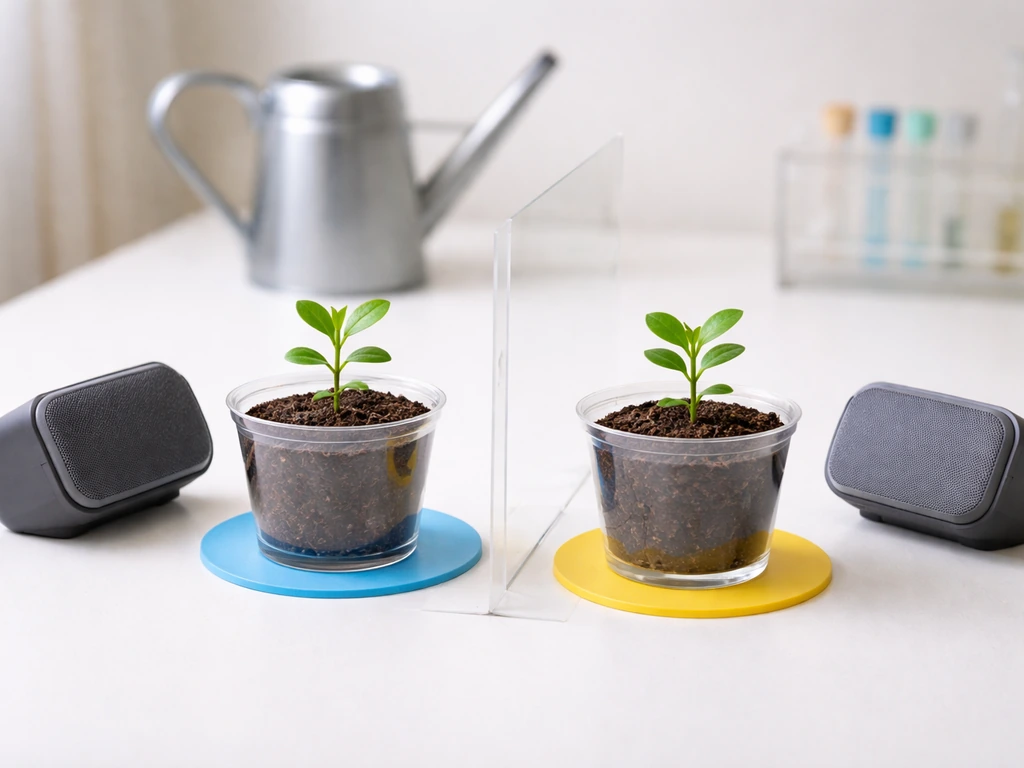
Your control group must be identical to your treatment group in every way except the sound. Same species, same seed batch, same soil mix, same pot size, same watering schedule, same fertilizer, same light source, same light duration, and the same physical location or a randomized position arrangement. The only variable that changes is whether the plants are exposed to sound. If your treatment group sits 6 inches closer to the window, your results are worthless because light, not sound, is doing the work. If your speaker is warming the air around the treatment plants by even 2 degrees Celsius, you've introduced a thermal confounder.
Replication: how many plants you actually need
Single-plant results prove nothing. Individual plant variation is enormous, even within the same seed packet. Aim for at least 8 to 10 plants per treatment group for a germination or short-term growth study. More is better. If you're comparing three conditions (silence, low-frequency tone, high-frequency tone), you want 8 to 10 plants in each group, for 24 to 30 plants total. Randomize pot positions daily by rotating them so that any position effects inside your growing space average out across groups rather than favoring one treatment.
Materials and setup
Plants and growing media
Choose a fast-growing species with reliable germination: bean, radish, basil, or mung bean all work well for 2 to 4 week projects. Use seeds from a single packet to minimize genetic variation. Fill identical pots (same size, same material) with the same premixed potting soil from one bag, measuring equal volumes per pot with a measuring cup. Start from seed rather than transplants so you can track germination as one of your metrics.
Light, water, and nutrients

Use identical artificial light sources positioned at exactly the same height above each plant group, running on a timer for equal hours per day. Fluorescent shop lights or LED grow lights both work; just make sure every pot gets the same wattage, spectrum, and duration. Water by weight or by measuring equal volumes at equal intervals. If you're using any fertilizer, mix a single batch and split it equally. These are the real drivers of plant growth, so if they differ between groups, your sound experiment is ruined before it starts.
Sound system
A small Bluetooth speaker or a wired computer speaker works fine. For frequency-specific tests, use a free tone generator app or website (search "online tone generator") to play a continuous sine wave at your chosen frequency. Set the volume to a consistent level and measure it with a free SPL meter app on your phone, placed at the same distance from the speaker as your plants.
Aim for around 70 to 75 dB based on the literature showing effects in that range without the harmful thresholds seen above 111 dB. Position the speaker so it's equally distant from all treatment plants, and keep it completely away from the control group, ideally in a separate room or with acoustic separation between groups.
How to measure results that actually mean something
Pick your metrics before you start

Define and commit to your measurements before the experiment begins. Changing what you measure partway through is a form of bias. For a 2 to 4 week seed-to-seedling project, the most practical and defensible metrics are germination rate (percentage of seeds that sprout by a set day), days to first germination, shoot height measured in millimeters from soil surface to the apical tip, leaf count, and fresh weight at harvest (weigh the whole plant immediately after pulling it from the soil). If you have access to a simple leaf color chart or a phone-based chlorophyll app, leaf greenness can serve as a rough proxy for photosynthetic health.
| Metric | How to Measure | When to Record |
|---|---|---|
| Germination rate | Count sprouted seeds as % of total planted | Daily until all have sprouted or day 7 |
| Days to germination | Record the exact day each seed breaks surface | Daily |
| Shoot height (mm) | Ruler from soil surface to growing tip | Every 2 days |
| Leaf count | Count all visible unfolded leaves | Every 2 days |
| Fresh weight (g) | Weigh immediately after harvest | End of experiment |
| Leaf color/greenness | Phone chlorophyll app or color chart score | Midpoint and end |
Recording and organizing your data
Use a spreadsheet from day one. Give each plant an ID number (Treatment A, Plant 1 through 10; Control, Plant 1 through 10). Record every measurement in its own row and date-stamp everything. Calculate group averages and standard deviations for each measurement at each time point. A simple line graph of average shoot height over time, with error bars showing standard deviation, is one of the clearest ways to present your results and is highly legible to a science fair judge.
How to interpret your results and avoid common traps
The confounders that kill science fair projects

- Heat from the speaker: Speakers generate heat. If your treatment plants are sitting next to the speaker and your control plants are across the room, any growth difference could be from temperature, not sound. Check temperature at each plant location with a basic thermometer.
- Uneven light: Even a few centimeters of difference in distance to a light source can noticeably affect growth. Measure light intensity at each pot with a lux meter app before starting.
- Observer bias: If you're measuring and you know which plants are "supposed" to grow better, you may unconsciously read the ruler slightly in their favor. Have someone else measure, or photograph all plants next to a ruler and measure from the photos.
- Noise contamination of controls: Background household noise can reach your control group. Record ambient SPL in both locations to confirm the control group is genuinely quieter.
- Unequal watering: If you water by feel rather than measure, treatment and control plants will receive different amounts. Weigh or volumetrically measure every time.
What to do if you find no effect
A null result is a real result. If your treatment and control groups look essentially the same at the end, report that honestly with your group averages, your standard deviations, and the range of values you observed. A science fair judge who sees "I found no significant difference, and here's what that means" is far more impressed than a project that fudges the data to support the hypothesis. If your confidence intervals are wide (meaning high variability within groups), that tells you your sample size was too small to detect a real effect even if one exists. Write that as a limitation and suggest what n you'd need next time.
A null result also points toward refinements: maybe your frequency choice was off, or your SPL was too low to match the 70 to 106 dB range where effects have been reported in the literature. Maybe a 2-week window was too short to see growth effects even if germination was affected. Your conclusion section should address these alternative explanations directly. That kind of analytical thinking is exactly what earns high scores.
If you do see a difference, ask these questions before claiming victory
Before concluding that music or sound caused your growth difference, work through this checklist: Were temperature and light genuinely matched at both locations? Did you randomize pot positions? Was the difference larger than the variation within each group (check your standard deviations)? Is the effect consistent across most individual plants or driven by one or two outliers? If you can answer yes, yes, yes, and yes, you have a credible result. If not, you have an interesting pilot study that needs a cleaner follow-up.
Putting it all together for your submission
The most common mistake in science fair projects on this topic is treating "music" as a monolithic thing and not specifying what physical variable is actually being tested. Your project stands out the moment you frame it correctly: you are testing whether exposure to sound at a specific frequency and decibel level affects measurable plant growth outcomes compared to an acoustically controlled group. These effects are often what people mean when they ask whether magnets help plants grow. That framing is accurate, it's defensible, and it aligns with how actual plant acoustics researchers design their work.
It's also worth knowing that the music-and-plants question sits alongside a whole family of similar "does X help plants grow" questions, including whether talking to plants, shaking them, or touching them regularly makes a difference. Adding mirrors to the setup is unlikely to change growth in a meaningful way compared with directly controlling the sound’s frequency and decibel level does X help plants grow. Several of those involve related mechanosensory pathways, so if you're curious about the broader picture of how physical stimuli affect plant biology, there's a lot of interesting territory to explore beyond just sound.
Your final project report should include: a specific, testable hypothesis; a description of exactly how you standardized light, water, nutrients, and soil; your measured SPL and frequency at the plant locations; your raw data table; group averages and standard deviations for each metric; at least one graph showing results over time; and an honest interpretation of whether your results support, refute, or are inconclusive about your hypothesis. Include a section on limitations and what you'd change in a follow-up. That structure, applied to a real biological question with genuine scientific precedent, is what a strong science fair entry looks like.
FAQ
Can I test “music” by just playing songs near the plants, and is that still valid science?
Yes, but only if you can keep all other factors identical and you treat “touching” as a vibration or mechanical-stimulation variable, not as accidental handling. Use a vibration-only control (same speaker arrangement for the treatment group, but no airborne sound, only pot contact vibration) or a “handling” control where the control plants are handled the same number of times for the same duration, even if no vibration is delivered.
What’s the best sound setup for a science fair (songs, playlists, or tones)?
Not usually. Songs change frequency content over time, and speaker volume can drift. If you want strong results, use a continuous pure tone (sine wave) or calibrated noise, and log the SPL long enough to confirm it stays within a narrow range across the exposure window.
How do I prevent the control plants from still “hearing” the sound?
You should avoid comparing groups that are at different distances from the speaker or that sit behind different barriers. In practice, SPL drops with distance and walls can reflect sound, so keep the speaker at the same location and distance for every treatment pot, and keep the control group in an acoustically separated area (or at least behind an effective barrier) to reduce spillover.
What if my speaker warms the air near the plants, could that ruin the experiment?
Temperature changes can mask sound effects. Even small heating from an active speaker or warm phone screen can alter growth. To control this, monitor air temperature near both groups with a simple thermometer and keep playback equipment identical across rooms, or switch to lower-heat sources and verify that temperature stays within a tight band.
How should I measure and report sound pressure level (SPL) in a way judges will trust?
Use the same definition of SPL across treatments, and measure at the plant level. A phone decibel meter app can vary with placement and orientation, so place your phone at the same height and at the same distance from the speaker where the plants sit, then check SPL at the start and again mid-exposure to confirm stability.
Does rotating pots daily fully control for position effects like window light or airflow?
Randomization helps, but it is not enough if your environment has a gradient (like one side of a room gets warmer or brighter). For best practice, rotate pots daily and also verify that all positions get equal light hours and similar temperatures, then report any residual imbalance as a limitation.
If my results show no difference, how do I explain that without losing points?
Be careful with what you interpret. A lack of difference can mean the sound truly had no effect, or it can mean your frequency and SPL missed the effective range, your exposure duration was too short, or your sample size was too small. In your write-up, connect the null result to specific design parameters (frequency, SPL, hours per day, and n).
Should I test multiple volumes or multiple exposure times, or is one setting enough?
Try adding at least one “dose” comparison, such as two SPL levels at the same frequency, or two exposure durations at the same SPL. If you only test one setting, you can’t tell whether “no effect” is due to the absence of a biological response or because your setup was outside the effective window.
How do I avoid accidentally changing the frequency or creating distortion with the audio device?
If you use a speaker, make sure it is driven consistently and not clipping. Clipping and harmonics can create unintended higher frequencies. For tones, keep volume at a level that you can reproduce, then verify the dominant frequency content with a basic frequency-check approach (for example, by ensuring your tone generator is producing the correct frequency and that the device audio settings are unchanged).
Can I compare different music genres, like classical versus rock, for a science fair?
Yes, but only as an exploratory step, because the setup often changes more than one stimulus at once. If you include “classical vs rock,” you must measure and match SPL and dominant frequency content for each condition, otherwise genre becomes a bundle of uncontrolled variables.
Next Articles
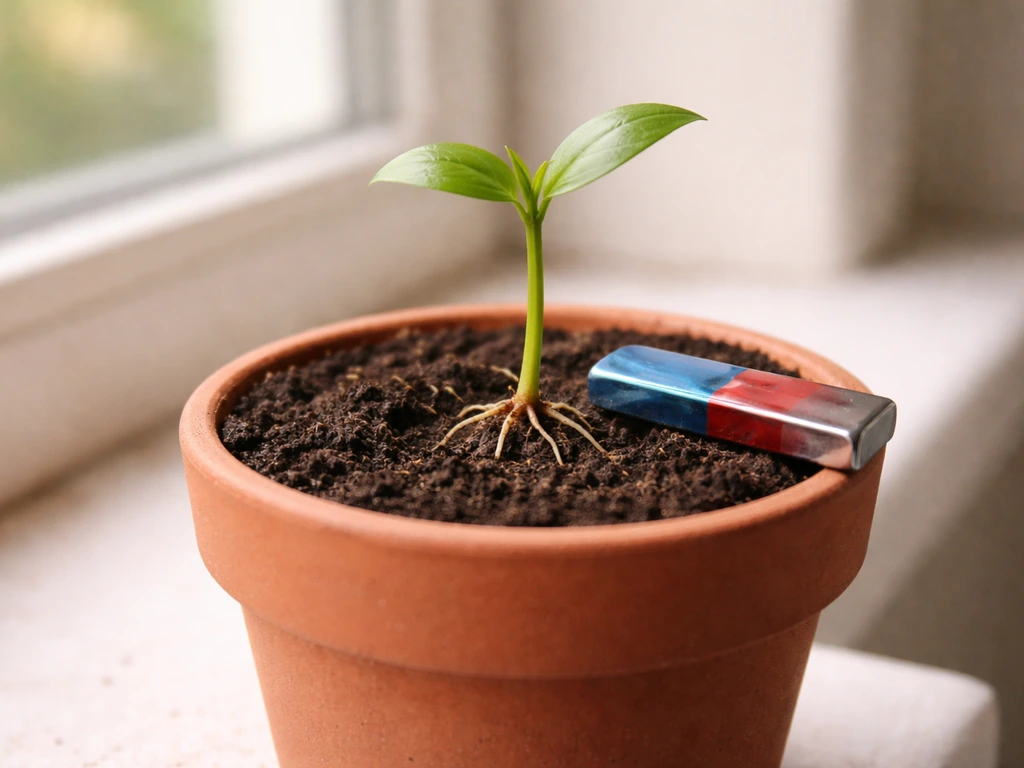
Do Magnets Help Plants Grow Faster? Evidence and Tests
Do magnets help plants grow faster? Evidence is mixed; use them as optional test, not a reliable growth hack.
Do Birds Help Plants Grow? Real Benefits in New Gardens
Learn how birds boost new gardens through seed dispersal, pollination, nutrients and pest effects, plus what to avoid an
Does Touching Plants Help Them Grow? What Actually Works
Does touching plants help them grow? Learn which gentle handling boosts health and which harms leaves, stems, pests, and