Urea helps plants grow by supplying nitrogen, the single nutrient plants need in the largest amounts. It does this through a two-step soil conversion: urea breaks down into ammonium first, then bacteria oxidize that ammonium into nitrate. Plants absorb both forms, using the nitrogen to build chlorophyll, proteins, and every new leaf, root, and shoot they produce. At 46% nitrogen by weight (sold as 46-0-0), urea is the most concentrated dry nitrogen fertilizer you can buy, which makes it cheap, effective, and worth understanding properly before you start spreading it around.
How Does Urea Help Plants Grow and How to Use It

Marcus Holloway
9 Jun 2026

What urea is and how it works in soil
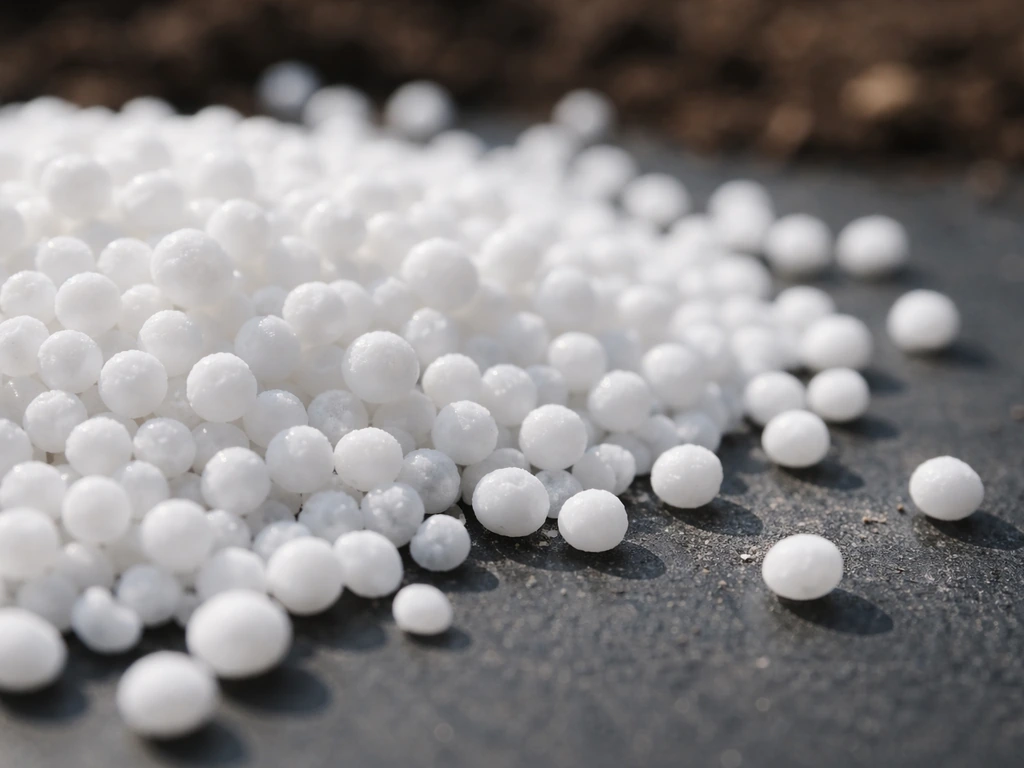
Urea (molecular formula CH4N2O) is an organic compound that mammals excrete naturally, but the fertilizer version is synthesized industrially. It looks like white granules or prills and dissolves readily in water. On its own, urea isn't directly available to plants. What makes it useful is what happens once it hits moist soil: an enzyme called urease, produced by soil microbes, catalyzes a reaction that converts urea into ammonium (NH4+) and carbon dioxide. That ammonium is the first plant-available nitrogen form urea produces.
The speed of that conversion depends almost entirely on soil temperature and moisture. Under warm conditions with adequate soil moisture, hydrolysis typically completes in 4 to 7 days. Cool, dry soils slow the process considerably. This is worth knowing because urea sitting on dry soil surface isn't just slow, it's actively losing nitrogen to the air as ammonia gas, which I'll get into in the problems section.
One quality spec worth knowing: better urea products are labeled "low biuret." Biuret is a byproduct of urea manufacturing that can damage plant tissue, especially when urea is used as a foliar spray. For soil application it matters less, but for foliar use, always look for urea with biuret content at or below about 0.2%.
How urea supplies nitrogen: the ammonium-to-nitrate pathway
Once urease converts urea to ammonium, nitrogen goes through a second biological process called nitrification. Soil bacteria (mainly Nitrosomonas and Nitrobacter) oxidize ammonium, first to nitrite and then to nitrate (NO3-). The first step, ammonium to nitrite, is the rate-limiting one, meaning it controls how fast usable nitrate becomes available. The whole urea-to-nitrate journey can take one to two weeks depending on soil conditions.
Plants use both ammonium and nitrate, but they pull them in through different uptake mechanisms and in different proportions depending on the plant and the soil. Once inside the plant, nitrogen is incorporated into amino acids and proteins, into the chlorophyll molecules that power photosynthesis, and into the nucleic acids in every cell. This is why nitrogen-deficient plants look pale yellow, especially in older leaves: there isn't enough nitrogen to maintain chlorophyll, so the plant cannibalizes it from older tissue and ships it to new growth.
It's also worth noting that nitrification is an aerobic process. Waterlogged, oxygen-poor soils slow nitrification and open the door to denitrification, where bacteria convert nitrate back into nitrogen gas and it escapes into the atmosphere. Good soil structure and drainage aren't just about root health, they're about keeping your nitrogen investment working. This is one reason why humus and worm castings, which improve soil structure and aeration, can indirectly make nitrogen fertilizers more effective. Good soil structure also helps explain how humus supports plant growth by improving moisture retention and aeration around roots. Plowing helps improve soil structure and aeration, which can make nitrogen from urea and other fertilizers work better for plant growth improves soil structure and aeration.
How much urea to use: rates, dilution, and timing

Because urea is 46% nitrogen, every 2.2 pounds of urea delivers roughly 1 pound of actual nitrogen. That math matters because all rate recommendations are given in pounds of actual nitrogen, not pounds of fertilizer product.
For lawns, the standard guidance from multiple extension services lands consistently at no more than 1 pound of actual nitrogen per 1,000 square feet per application, with 0.5 to 1 lb being the practical range depending on grass type and time of season. At 46% N, that means you're applying roughly 1.1 to 2.2 pounds of urea granules per 1,000 square feet per application. Don't apply more than once a month, and stick to the lower end of that range in summer heat.
For vegetable gardens, rates depend heavily on what the soil test shows and what crop you're growing. WVU Extension gives a practical example: for an additional nitrogen need of about 75 lb per acre, roughly 6 ounces of urea per 100 square feet covers it. That's a useful calibration point for working out your own vegetable bed rates once you know your soil nitrogen baseline.
For foliar sprays, typical concentrations run from 0.5% to 2% urea solution by weight, meaning roughly 1 to 4 teaspoons of urea dissolved per quart of water for a light spray. Always start at the lower concentration and test on a few leaves first before spraying an entire plant. Apply in the early morning or evening when leaf temperatures are lower and the solution dries more slowly, giving more time for absorption.
| Application | Actual N Rate | Urea Amount (46-0-0) | Frequency |
|---|---|---|---|
| Lawn (maintenance) | 0.5–1 lb N per 1,000 sq ft | 1.1–2.2 lb urea per 1,000 sq ft | No more than monthly |
| Vegetable garden (additional N) | ~75 lb N/acre example | ~6 oz urea per 100 sq ft | Per soil test need |
| Foliar spray | 0.5–2% solution | 1–4 tsp urea per quart water | As needed for deficiency |
Urea foliar feed vs soil application: when to use each
Soil application is the right default for urea in almost every situation. Roots are the primary nitrogen uptake pathway, full stop. Penn State Extension makes this point clearly: foliar feeding is mainly useful for targeted micronutrient corrections, not as a primary nitrogen delivery system. When you apply urea to soil and water it in properly, you're feeding through the mechanism plants evolved to use.
That said, foliar urea has legitimate uses. It can correct a sudden nitrogen deficiency faster than waiting for soil-applied urea to hydrolyze and nitrify. Fruit growers sometimes use foliar urea sprays post-harvest to boost nitrogen reserves in the tree. Certain crops with known foliar uptake efficiency (corn, some tree crops) are commonly listed in extension guidance as candidates for foliar urea.
The risk with foliar urea is burn. High concentrations, hot midday temperatures, or high biuret content can scorch leaves. Always use low-biuret urea (0.2% biuret or less) for foliar applications. Spray early in the morning, never onto wet foliage, and never when plants are heat-stressed. For most home gardeners with leafy vegetables, herbs, or ornamentals, I'd skip foliar urea altogether and focus on getting the soil application right.
Avoiding the big problems: burn, volatilization, leaching, and pH

Fertilizer burn
Burn happens when urea concentration near roots or on leaf surfaces gets high enough to draw water out of plant cells through osmosis. The fix is simple: apply at the right rate, don't concentrate granules near plant crowns or stems, and water in after application. If you spread urea on a lawn and don't water for several days, you're asking for trouble, especially in hot weather.
Ammonia volatilization
This is the biggest practical problem with urea. When urea sits on the soil surface and hydrolyzes, some of the ammonium converts back to ammonia gas (NH3) and escapes into the air before plants can use it. USU Extension puts the loss potential bluntly: urea on the soil surface or on plant foliage can lose 50% to 90% of its nitrogen as ammonia if it isn't moved into the soil quickly. Compare that to incorporated urea, where FAO data puts volatilization losses at just 5 to 15%.
The window is short. You want urea moved into the soil within hours of application, not days. The practical rule from Kansas State and Michigan State extension work: apply before at least half an inch of rain or irrigation. That amount of water moves urea off the surface and into the soil profile where it's protected. If you're applying in summer when soil temperatures are above 60°F, that window is even tighter because warmer soil means faster urease activity and faster ammonia loss.
Leaching
Once urea converts to nitrate, that nitrate is negatively charged and doesn't bind to soil particles well. Heavy rainfall after nitrification is complete can push nitrate below the root zone, where plants can't reach it. This is less of an issue with split applications and more of a risk if you apply a large single dose before a heavy storm. Splitting your nitrogen into two or three smaller applications across the season is the simplest way to reduce leaching losses.
Soil pH effects
Soil pH matters in two ways. First, high pH soils (alkaline conditions) increase volatilization risk because at higher pH, more nitrogen exists in the ammonia gas form rather than as dissolved ammonium. If you're on a high-pH soil, time your urea applications even more carefully around irrigation. Second, repeated nitrogen fertilization can gradually acidify soil over time because nitrification releases hydrogen ions. A soil test every year or two keeps you aware of any drift toward acidity, which affects not just nitrogen availability but the uptake of phosphorus, calcium, and other nutrients too.
Getting it right: soil testing, watering, and pairing with other nutrients
Start with a soil test before you commit to any urea application. Oklahoma State Extension's approach is the right framework: calculate your nitrogen need for the crop and yield goal, subtract what the soil already contains, and apply only the difference. This prevents waste, reduces run-off risk, and stops you from chasing nitrogen problems that are actually something else entirely.
Nitrogen is the primary factor limiting plant growth in most soils, but it isn't the only one. Fertile soil helps plants grow partly because it supports the nitrogen cycle, making nutrients easier for roots to take up Nitrogen is the primary factor limiting plant growth. If phosphorus, potassium, or sulfur are deficient, adding more nitrogen won't fix the problem and may actually make plants look worse by pushing leafy growth without the supporting nutrients. Think of urea as one part of a nutritional picture. Pairing it with a complete soil test means you know whether you also need to address sulfur levels, potassium, or soil organic matter, which is where inputs like compost and worm castings complement a mineral nitrogen fertilizer like urea.
Here's a practical checklist for applying urea correctly:
- Get a soil test first and use it to calculate your actual nitrogen need, don't guess.
- Convert your nitrogen target to urea weight using the 46% N factor (divide lb N needed by 0.46 to get lb of urea).
- Apply at no more than 1 lb actual N per 1,000 sq ft per application for lawns; use test-based rates for gardens.
- Apply when rain of at least 0.5 inch is forecast within hours, or irrigate immediately after spreading.
- Avoid applying when soil temperature is above 60°F and you can't guarantee quick incorporation.
- Keep granules away from direct contact with plant stems and crowns.
- Split larger seasonal nitrogen needs into two or three applications rather than one large dose.
- If using foliar urea, use low-biuret product (0.2% or less), dilute to 0.5–1% solution, and spray in the early morning.
- Retest soil annually if you're fertilizing regularly, watch for pH drift toward acidity.
Signs you're getting it right: new growth is a healthy deep green, older leaves maintain their color, and growth rate picks up within one to two weeks of application. Signs of too much: leaf tips browning or scorching, excessive soft leafy growth with weak stems, or in lawns, fast-growing light green patches. Signs of too little: uniform yellowing starting in older leaves, slow growth, pale overall color. Nitrogen deficiency tends to show up in the oldest leaves first because the plant pulls nitrogen from them to feed new growth. Knowing that pattern makes diagnosis much easier when something looks off.
FAQ
How quickly can plants actually use urea after I apply it to the soil?
If you want plants to use urea fast, apply it to moist soil and water it in promptly. Keeping granules off the dry surface is the difference between urease doing its job and nitrogen escaping as ammonia gas. As a rule of thumb, if you cannot irrigate within hours, wait and apply later when you can.
Will urea fix other nutrient problems, or does it only help with nitrogen?
Urea is mainly a nitrogen source, it will not “correct” pH, salt buildup, or potassium and phosphorus shortages by itself. If your soil test shows low phosphorus or potassium, adding urea can increase lush growth that is still nutrient-limited, leading to weak stems or poor fruiting.
What if my urea bag doesn’t clearly say low-biuret, can I still use it as a foliar spray?
Biuret risk is worst for foliar urea because leaf tissue is directly exposed to dissolved urea. For soil use it matters less, but for any spray, choose low-biuret urea and avoid concentrating the solution. If you cannot confirm the biuret label, skip foliar application.
Can I apply urea right before rain, or will it wash away?
Yes, but timing matters. Apply urea after you know you have adequate moisture, and split applications if heavy rain is likely later. For best nitrogen retention, avoid large single doses right before storms, since nitrate can move below the root zone after nitrification.
What happens if my soil is poorly drained or stays wet after fertilizing?
In waterlogged, oxygen-poor conditions, nitrification slows and other microbial processes can reduce fertilizer efficiency, so plants may not receive nitrogen when expected. If you have drainage issues, consider improving soil structure and aeration first, or use smaller, more frequent doses.
How can I tell the difference between nitrogen deficiency and too much nitrogen after using urea?
Look at leaf color progression and plant response. True nitrogen deficiency typically starts on older leaves and causes general yellowing, while too much nitrogen more often shows fast soft growth with weak structure and can cause tip burn or scorching. When you suspect a “nitrogen problem,” verify with soil tests before increasing rates.
Should I fertilize with urea even if I think my soil already has enough nitrogen?
Yes, but avoid using urea as a substitute for establishing nitrogen needs based on a soil test. If your soil already has ample nitrate or ammonium, extra urea just increases the chance of losses and can worsen imbalance with other nutrients.
Is it better to apply urea all at once or split it into multiple feedings?
For lawns and most crops, applying more often but at lower amounts is usually safer than one heavy dose. Splitting reduces volatilization and leaching risk, and it matches nitrogen demand more closely as plants grow.
Why didn’t I see results from urea when I expected, could cold weather be the cause?
Yes, but urea uptake can be limited by temperature, water availability, and how quickly it is incorporated. In cold soils urease and downstream conversion slow down, so the visible response can lag. Plan fertilizer timing around soil warmth and moisture to avoid “waiting” too long for results.
How does soil pH change the way I should use urea?
For pH, the key decision aid is: if your soil is alkaline, volatilization risk is higher, so be extra strict about quick water-in and timing. Also, repeated nitrification can gradually acidify soil, so recheck pH every year or two to keep nutrient availability balanced.
Next Articles

How Do Worm Castings Help Plants Grow? Benefits and Use
Learn how worm castings boost plant growth with better soil, microbes, nutrients, plus exact application steps and tips.
How Does Sulfur Help Plants Grow? Fix Deficiency Fast
Learn how sulfur boosts growth, spot sulfur deficiency, then choose and apply the right sulfur product safely and fast.
How Fertile Soil Helps Plants Grow: Key Mechanisms
Learn how fertile soil boosts growth via nutrients, structure, water balance, microbes, and quick testing for better gar